
Identification of Subsurface Geological Structures of the Arjuno-Welirang Geothermal Potential Area Using the Gravity Method
DOI:
https://doi.org/10.11113/mjfas.v22n1.4573Keywords:
Geothermal, Derivative Analysis, 2D Modeling, InversionAbstract
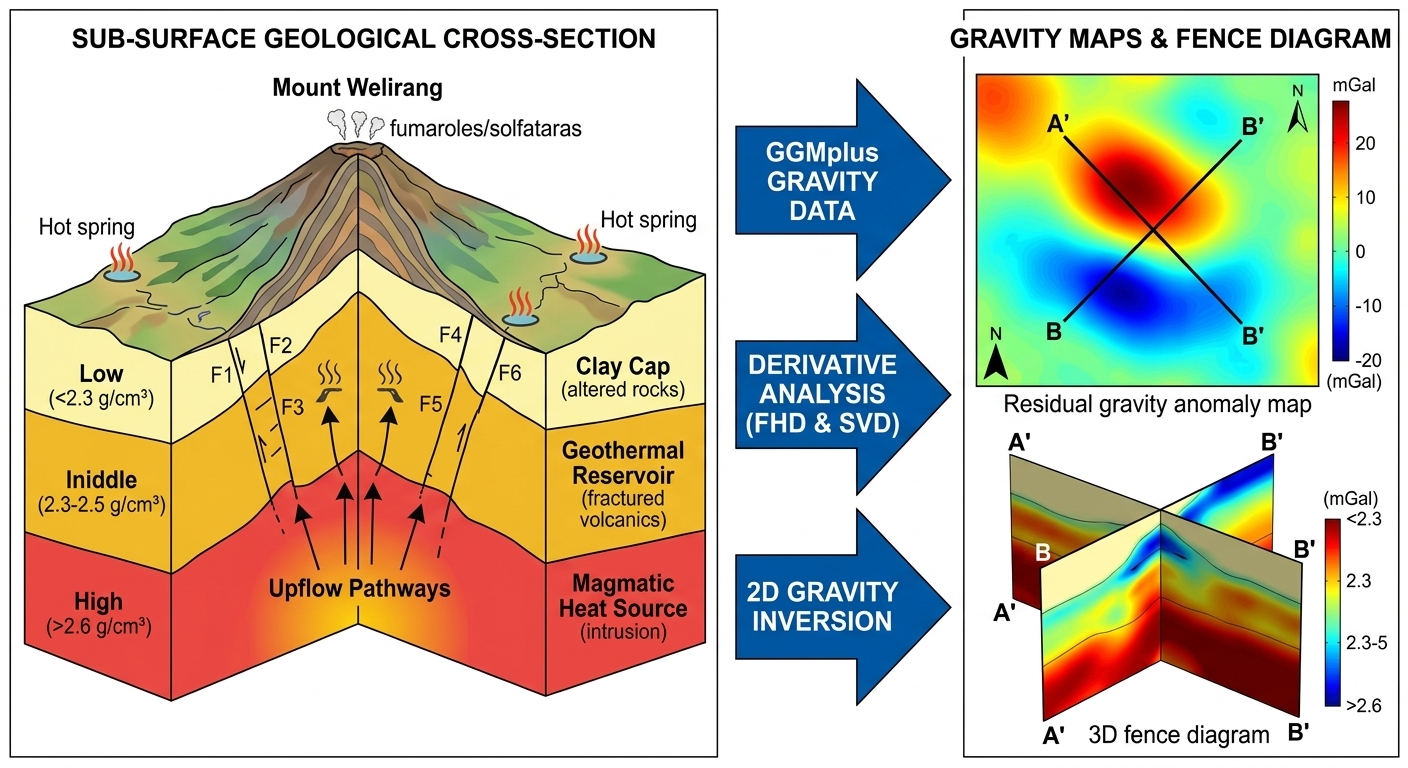
Java Island has several geothermal prospects, one of which is located in the Arjuno–Welirang area in East Java. The objective of this study is to determine the subsurface geological structures that have the potential to generate geothermal energy in the region. The study utilizes a gravity-based method that is based on the Global Gravity Model Plus. Complete Bouguer anomalies, first horizontal derivative, and second vertical derivative were analyzed to identify fault structures. Additionally, 2D modeling was performed using inversion modeling implemented in the ZondGM2D software. A total of six major faults were identified four normal faults and two reverse faults primarily distributed near active geothermal manifestations such as Padusan hot springs, Coban Hot Springs and Mount Welirang. Furthermore, 2D gravity inversion modeling was performed along two main profiles (A–A′ and B–B′). The inversion results revealed three key subsurface layers: (1) a low-density zone (<2.3 g/cm³) interpreted as a clay cap formed by hydrothermal alteration, (2) an intermediate-density reservoir zone (2.3–2.5 g/cm³) composed of fractured volcanic rocks, and (3) a high-density magmatic intrusion zone (>2.6 g/cm³) serving as the heat source.
References
Ermawati, T., Dwiastuti, I., Purwanto, & Negara, S. D. (2014). Analisis kebijakan pengembangan energi panas bumi di Indonesia.
Saraswati, G. P., Prasetyo, Y., & Sukmono, A. (2019). Analisis estimasi energi panas bumi dan rekomendasi lokasi pembangkit listrik tenaga panas bumi menggunakan citra Landsat 8 (studi kasus: Kawasan Gunung Ungaran, Jawa Tengah). Jurnal Geodesi Undip, 8(1), 170–179.
Mokom, N., Ujah, C., Christian, A., & Kallon, D. (2025). Exploring geothermal energy as a sustainable source of energy: A systemic review. Unconventional Resources, 6, 100149. https://doi.org/10.1016/j.uncres.2025.100149.
Domra Kana, J., Djongyang, N., Raïdandi, D., Njandjock Nouck, P., & Dadjé, A. (2015). A review of geophysical methods for geothermal exploration. Renewable and Sustainable Energy Reviews, 44, 87–95. https://doi.org/10.1016/j.rser.2014.12.026.
Meilasandi, T., Sugianto, A., Indriana, R. D., & Harmoko, U. (2019). 3D gravity data modelling for determining a subsurface structure of the SDP geothermal field. Journal of Physics: Conference Series, 1217(1), 012042. https://doi.org/10.1088/1742-6596/1217/1/012042.
Pocasangre, C., Fujimitsu, Y., & Nishijima, J. (2020). Interpretation of gravity data to delineate the geothermal reservoir extent and assess the geothermal resource from low-temperature fluids in the municipality of Isa, southern Kyushu, Japan. Geothermics, 83, 101735. https://doi.org/10.1016/j.geothermics.2019.101735.
Karimah, N. A., Supriyadi, S., & Suprianto, A. (2021). Korelasi data gravitasi satelit pada daerah panas bumi Blawan–Ijen. Jurnal Sains Dasar, 9(1), 11–15. https://doi.org/10.21831/jsd.v9i1.26431.
Martha, A. A., Setiawan, A., & Setiadi, T. A. P. (2023). Utilization of global gravity model plus (GGMPlus) to identify fault structures in Mamasa District, West Sulawesi. AIP Conference Proceedings, 2941(1), 030006. https://doi.org/10.1063/5.0181519.
Fauzik, D., Haris, A., Martha, A. A., & Riyanto, A. (2020). Liquefaction potential identification in Central Sulawesi using gravity inversion model. IOP Conference Series: Earth and Environmental Science, 538(1), 012035. https://doi.org/10.1088/1755-1315/538/1/012035.
Juwita, W., Juventa, J., Setiawan, A. M., Martha, A. A., Hudayat, N., & Sutedja, B. (2024). Identification of potential hydrocarbon traps using the gravity method in the Bengkulu Basin. Iranian Journal of Geophysics, 18(3), 69–83. https://doi.org/10.30499/ijg.2023.409882.1535.
Rahman, S. A. N., Martha, A. A., Sutrisno, S., Wulandari, A., & Hudayat, N. (2025). Identification of subsurface structures and potential reservoir zones of geothermal fields based on gravity data analysis in the Karaha–Cakrana area, West Java. Iranian Journal of Geophysics, 19(3), 63–76. https://doi.org/10.30499/ijg.2024.434652.1563.
Wahyuningsih, R. (2005). Kolokium hasil lapangan–DIM (pp. 1–9).
Wahyuningsih, R. (n.d.). Potensi dan wilayah kerja pertambangan panas bumi di Indonesia.
Lita, F. (2012). Identifikasi anomali magnetik di daerah prospek panas bumi Arjuna–Welirang (Undergraduate thesis). Universitas Indonesia.
Suharno, Nindya, F., Rustadi, Zaenuddin, A., & Mulyatno, B. S. (2013). Characteristics of Mountain Arjuno–Welirang geothermal, East Java Province, Indonesia. Proceedings of the 13th Indonesian International Geothermal Convention & Exhibition.
Daud, Y., Fahmi, F., Nuqramadha, W. A., Heditama, D. M., Pratama, S. A., & Suhanto, E. (2015). 3-dimensional inversion of MT data over the Arjuno–Welirang volcanic geothermal system, East Java (Indonesia). Proceedings of the World Geothermal Congress 2015.
API, P. B. D. I. K. G., & Welirang, A. (2016). Studi vulkanisme dan struktur geologi untuk eksplorasi awal.
Nidya, F., Suharno, Zarkasyi, A., & Sugianto, A. (2013). Analisis karakteristik panas bumi daerah outflow Gunung Arjuno–Welirang berdasarkan data geologi, geokimia, dan geofisika (3G). Jurnal Geofisika Eksplorasi, 1(2), 7.
Sumotarto, U. (2018). Geothermal energy potential of Arjuno and Welirang volcanoes area, East Java, Indonesia. International Journal of Renewable Energy Research, 8(1), 614–624. https://doi.org/10.20508/ijrer.v8i1.6690.g7336.
Indriana, R. D., Kirbani, S. B., Setiawan, A., & Sunantyo, T. A. (2018). Gravity observation data analysis 1988–1998–2011 to determine gravity changes of Merapi Volcano. Journal of Physics: Conference Series, 983(1), 012042. https://doi.org/10.1088/1742-6596/983/1/012042.
Araffa, S. A. S., et al. (2018). Implementation of magnetic and gravity methods to delineate the subsurface structural features of the basement complex in central Sinai area, Egypt. NRIAG Journal of Astronomy and Geophysics, 7(1), 162–174. https://doi.org/10.1016/j.nrjag.2017.12.002.
Anggraeni, F. K. A., & Sulistyorini. (2021). Two-dimensional modeling (2D) gravity method for interpreting subsurface structure of Mount Merapi. Journal of Physics: Conference Series, 1832(1), 012002. https://doi.org/10.1088/1742-6596/1832/1/012002.
Permana, N. R., & Gunawan, B. (2024). Estimations of the geothermal energy potential in the Mount Anak Krakatau region based on derivative analysis and 3D model of gravitational satellite data, 7(1), 43–57.
Hirt, C., Claessens, S., Fecher, T., Kuhn, M., Pail, R., & Rexer, M. (2013). New ultrahigh-resolution picture of Earth’s gravity field. Geophysical Research Letters, 40(16), 4279–4283. https://doi.org/10.1002/grl.50838.
Awaliyah, A., & Pohan, A. F. (2024). Perbandingan koreksi medan (terrain correction) konvensional dan modern pada metode gravitasi menggunakan data DEM ERTM2160 dan SRTM2gravity pada wilayah Cianjur. Jurnal Fisika Unand, 13(5), 651–657. https://doi.org/10.25077/jfu.13.5.651-657.2024.
Parasnis, D., & Cook, A. H. (1952). A study of rock density in the English Midlands. Geophysical Journal International, 6, 252–271. https://doi.org/10.1111/j.1365-246X.1952.tb03013.x.
Hinze, W., et al. (2005). New standards for reducing gravity data: The North American gravity database. Geophysics, 70(4). https://doi.org/10.1190/1.1988183.
Sarkowi, M. (2014). Eksplorasi gaya berat. Graha Ilmu.
Purnomo, J., Koesuma, S., & Yunianto, M. (2016). Pemisahan anomali regional–residual pada metode gravitasi menggunakan metode moving average, polynomial, dan inversion. Indonesian Journal of Applied Physics, 3(01), 10. https://doi.org/10.13057/ijap.v3i01.1208.
Anggraeni, F. K. A. (2023). Identifikasi struktur bawah permukaan Gunung Semeru pasca erupsi tahun 2022. Jurnal Ilmu dan Inovasi Fisika, 7(1), 69–77. https://doi.org/10.24198/jiif.v7i1.40885.
Mickus, K., Aiken, C., & Kennedy, W. (1991). Regional–residual gravity anomaly separation using the minimum-curvature technique. Geophysics, 56, 279–283. https://doi.org/10.1190/1.1443041.
Juwita, W., Juventa, J., Setiawan, A. M., Martha, A. A., Hudayat, N., & Sutejo, B. (2024). Identification of potential hydrocarbon traps using the gravity method in the Bengkulu Basin. Iranian Journal of Geophysics, 18(3), 69–83. https://doi.org/10.30499/ijg.2023.409882.1535.
Wijanarko, E., Sunarjanto, D., & Dian Nur, D. N. (2021). Identifikasi struktur geologi bawah permukaan menggunakan metode horizontal gradient, Euler deconvolution, dan second vertical derivative: Studi eksplorasi panas bumi Baturaden, Jawa Tengah. Lembaran Publikasi Minyak dan Gas Bumi, 55(1), 25–35. https://doi.org/10.29017/lpmgb.55.1.574.
Fitriastuti, A., Aristo, & Putri, F. F. (2019). Identifikasi struktur bawah permukaan menggunakan metode gaya berat analisis first horizontal derivative (FHD) dan second vertical derivative (SVD) guna mitigasi bencana gempabumi di Kabupaten Wonosobo. Prosiding Seminar Nasional Kebumian ke-12, 604–614.
Pemodelan tiga dimensi anomali gravitasi dan identifikasi sesar lokal dalam penentuan jenis sesar di daerah Pacitan (n.d.).
Ibrahim, M. M., Utami, P., & Raharjo, I. B. (2022). Analisis struktur geologi berdasarkan data gravitasi menggunakan metode second vertical derivative (SVD) pada lapangan panas bumi “X.” Jurnal Geosains dan Remote Sensing, 3(2), 59. https://doi.org/10.23960/jgrs.2022.v3i2.76.
Zaenudin, A., & Yulistina, S. (2020). Studi identifikasi struktur geologi bawah permukaan untuk mengetahui sistem sesar berdasarkan analisis FHD, SVD, dan pemodelan forward 2.5D di daerah Manokwari, Papua Barat. Jurnal Geofisika Eksplorasi, 4(2), 173–186. https://doi.org/10.23960/jge.v4i2.15.
Blakely, R. J., & Simpson, R. W. (1986). Approximating edges of source bodies from magnetic or gravity anomalies. Geophysics, 51(7), 1494–1498. https://doi.org/10.1190/1.1442197.
Telford, W. M., Geldart, L. P., & Sheriff, R. E. (1990). Applied geophysics (2nd ed.). Cambridge University Press.
Grandis, H. (2009). Pengantar pemodelan inversi geofisika. Himpunan Ahli Geofisika Indonesia.
Permana, N. R., Gunawan, B., & Nafian, M. (2022). Analysis of subsurface structure of Sembalun geothermal prospect area, East Lombok, with 2D and 3D gravity modeling. Al-Fiziya Journal of Materials Science, Geophysics, Instrumentation and Theoretical Physics, 5(1), 10–22. https://doi.org/10.15408/fiziya.v5i2.24943
Safira, A., Saipuddin, M., Andita, Z. A., & Catur, R. (2024). Identifikasi struktur geologi daerah panas bumi Way Panas Kecamatan Wonosobo menggunakan analisis FHD dan SVD berdasarkan data gaya berat GGMPlus. 5(1). https://doi.org/10.29303/goescienceed.v5i1.240.
Wibowo, R. C., & Tobing, J. B. L. (2022). Geological structure identification using derivative analysis of gravity method. JIT: Journal of Innovation Technology, 3(2). https://doi.org/10.31629/jit.v3i2.5048
Ibrahim, D., Sumai, K., & Tengah, I. (2009). Buku 1: Bidang energi (pp. 273–294).
Daud, Y., et al. (2019). Resistivity characterization of the Arjuno–Welirang volcanic geothermal system (Indonesia) through 3-D magnetotelluric inverse modeling. Journal of Asian Earth Sciences, 174, 352–363. https://doi.org/10.1016/j.jseaes.2019.01.033.
Zhang, R. (2019). Joint inversion of 2D gravity gradiometry and magnetotelluric data in mineral exploration.
Downloads
Published
Issue
Section
License
Copyright (c) 2025 Ratih Nur Jaya Pratiwi, Agustya Adi Martha, Hartono Hartono, Rizki Wijayanti, Ahmad Ali Muckharom, Amelia Siffa Arum Kinanti, Nanda Putri Nurul Ngaeni

This work is licensed under a Creative Commons Attribution-NonCommercial 4.0 International License.