
Euglena sp. as Mercury Phycoremediation Agent in FWS-CW System: Growth and Productivity, Photosynthetic Pigments, SOD Activity, and Equilibrium Kinetic Models
DOI:
https://doi.org/10.11113/mjfas.v21n6.4452Keywords:
Chlorophyll, Euglena sp., Kinetic models, Mercury, Superoxide dismutaseAbstract
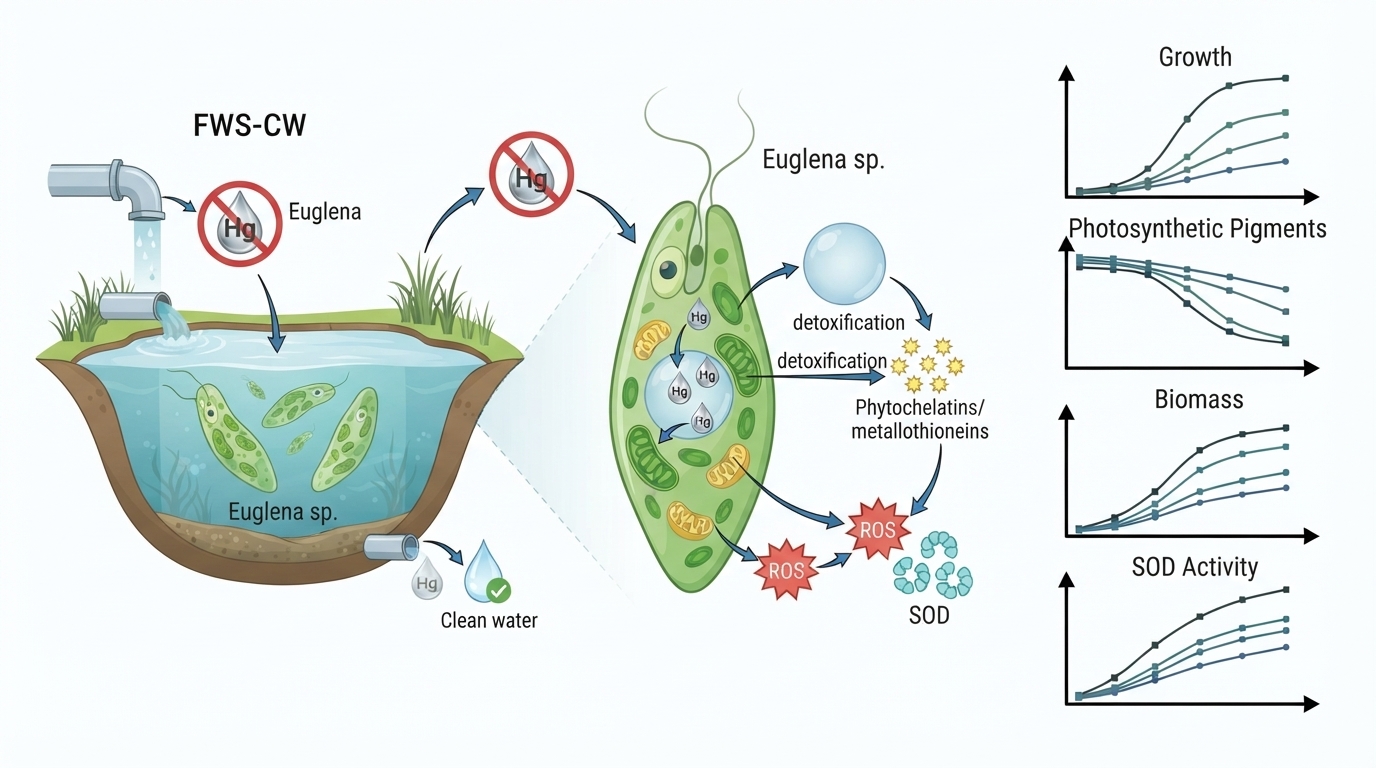
Society now faces a problem with environmental pollution, primarily due to industrial pollution. Mercury is a poisonous pollutant with a widespread distribution that settles in ecosystems. Numerous traditional methods have been used to clean mercury contamination. Bioremediation is one potential and eco-friendly method of reducing toxicants by using organisms. Phycoremediation uses algae, such as Euglena sp., in its process. This research aimed to analyze the growth, productivity, photosynthetic pigments, and Superoxide dismutase activity of Euglena sp. and analyze the kinetic model of mercury content in Euglena sp. using Pseudo-First-Order and Pseudo-Second-Order equations in the Free Water Surface-Constructed Wetlands (FWS-CW) system. This research shows that Euglena sp. chlorophyll a, chlorophyll b, carotenoid, and total chlorophyll content decrease at the lowest level at a concentration of 15 ppm. SOD activity of Euglena sp. increased with the increase of mercury stress. However, it was insignificant for the concentrations of 5 ppm, 10 ppm, and 20 ppm. The growth and productivity of Euglena sp. decrease with the increase of mercury stress. These experiences happen because Euglena sp. carries out a detoxification process. The mercury phycoremediation process by Euglena sp. is more suitable with the Pseudo-Second-Order kinetic model with an R2 value of 0.43. These results indicate that Euglena sp. can potentially be a phycoremediation agent of mercury with a maximum mercury concentration of 15 ppm.
References
Singh, A., Pal, D. B., Kumar, S., Srivastva, N., Syed, A., Elgorban, A. M., Singh, R., Gupta, V. K. (2021). Studies on Zero-cost algae based phytoremediation of dye and heavy metal from simulated wastewater. Bioresour. Technol. 342, 125971. https://doi.org/10.1016/j.biortech.2021.125971.
Widyaningrum, D. A., Rinanti, A., Hadisoebroto, R. (2021). The kinetics of Fe2+ heavy metal adsorption by microalgae Desmodesmus sp. beads. IOP Conf. Ser.: Earth Environ. Sci. 894, 012040. http://dx.doi.org/10.1088/1755-1315/894/1/012040.
Faruque, M. O., Uddin, S., Hossain, M. M., Hossain, S. M. Z., Shafiquzzaman, Md., Razzak, S. A. (2024). A comprehensive review on microalgae-driven heavy metals removal from industrial wastewater using living and nonliving microalgae. J. Hazard. Mater. 16, 100492. https://doi.org/10.1016/j.hazadv.2024.100492.
Jaishankar, M., Tseten, T., Anbalagan, N., Mathew, B. B., Beeregowda, K. N. (2014). Toxicity, mechanism and health effects of some heavy metals. Interdiscip Toxicol. 7(2), 6072. https://doi.org/10.2478/intox-2014-0009.
Siswanti, D. U., Ayuningtyas, D., Nugraheni, S. N. N., Nurhanifah, T., Petrus, H. T. B. M., Suyono, E. A., Daryono, B. S. (2024). Mercury removal by Aquarius palifolius (Nees & Mart.) Christenh. & Byng: Isotherms model, superoxide dismutase activity, and chlorophyll content. Watershed Ecol. Environ. 6, 227233. https://doi.org/10.1016/j.wsee.2024.10.001 .
Kumari, S., Jamwal, A. R., Mishra, N., Singh, D. K. (2020). Recent developments in environmental mercury bioremediation and its toxicity: A review. Environ. Nanotechnol. Monit. Manag. 13, 100283. https://doi.org/10.1016/j.enmm.2020.100283.
Leong, Y. K., Chang, J. S. (2020). Bioremediation of heavy metals using microalgae: Recent advance and mechanisms. Bioresour. Technol. 303, 122886. https://doi.org/10.1016/j.biortech.2020.122886.
Ajitha, V., Sreevidya, C. P., Sarasan, M., Park, J. C., Mohandas, A., Singh, I. S. B., Puthumana, J., Lee, J. S. (2021). Effects of zinc and mercury on ROS-mediated oxidative stress-induced physiological impairments and antioxidant responses in the microalga Chlorella vulgaris. Environ. Sci. Pollut. Res. 28, 3247532492. https://doi.org/10.1007/s11356-021-12950-6.
Nurhanifah, T., Siswanti, D. U. (2025). Effect of mercury dose variation on growth and nitrate reductase activity in Aquarius palifolius (Nees & Mart.) Christenh. & Byng. Makara Journal of Science. 29(12), 280290.
https://doi.org/10.7454/mss.v29i2.2556.
De, J., Dash, H. R., & Das, S. (2014). Mercury pollution and bioremediation—A case study on biosorption by a mercury-resistant marine bacterium. In S. Das (Ed.), Microbial biodegradation and bioremediation (pp. 137–166). Elsevier. https://doi.org/10.1016/B978-0-12-800021-2.00006-6.
Danouche, M., El Ghachtouli, N., El Arroussi, H. (2021). Phycoremediation mechanisms of heavy metals using living green microalgae: physicochemical and molecular approaches for enhancing selectively and removal capacity. Heliyon, 7(7), e07609. https://doi.org/10.1016/j.heliyon.2021.e07609.
Rangkuti, P. M., Siswanti, D. U., Suyono, E. A. (2023). Salinity Treatment as bacterial control and its impact on growth and nutritional value of spirulina (Arthrospira platensis) culture in open pond system. J. Fish. Environ. 47(1), 6374.
Khatiwada, B., Hasan, M. T., Sun, A., Kamath, K. S., Mirzaei, M., Sunna, A., Nevalainen, H. (2020). Proteomic response of Euglena gracilis to heavy metal exposure-Identification of key proteins involved in heavy metal tolerance and accumulation. Algal Res., 45, 101764. https://doi.org/10.1016/j.algal.2019.101764.
Yoshioka, K., Suzuki, K., Osanai, T. (2020). Effect of pH on metabolite excretion and cell morphology of Euglena gracilis under dark, anaerobic conditions. Algal Res., 51, 102084. https://doi.org/10.1016/j.algal.2020.102084.
Kishore, G., Kadam, A. D., Kumar, U., Arunachalam, K. (2018). Modeling Euglena sp. growth under different conditions using an artificial neural network. J. Appl. Phycol. 30(2), 955967. https://doi.org/10.1007/s10811-017-1331-z.
Siswanti, D. U., Daryono, B. S., Petrus, H. T. B. M., Suyono, E. A. (2023). Bioremediation of mercury-polluted water in free water surface-constructed wetland system by Euglena sp. and Echinodorus palifolius (Nees & Mart.) J.F.Macbr. J. Trop. Biodivers. Biotechnol., 8(3), 113. http://dx.doi.org/10.22146/jtbb.88143.
Jasso-Chávez, R., Campos-García, M. L., Vega-Segura, A., Pichardo-Ramos, G., Silva-Flores, M., Santiago-Martínez, M. G., Feregrino-Mondragón, R. D., Sánchez-Thomas, R., García-Contreras, R., Torres-Márquez, M. E., Moreno-Sánchez, R. (2021). Microaerophilia enhances heavy metal biosorption and internal binding by polyphosphates in photosynthetic Euglena gracilis. Algal Res., 58, 102384. https://doi.org/10.1016/j.algal.2021.102384.
Gauthier, M. R., Senhorinho, G. N. A., Scott, J. A. (2020). Microalgae under environmental stress as a source of antioxidants. Algal Res. 52, 1012104. https://doi.org/10.1016/j.algal.2020.102104.
Stephenie, S., Chang, Y. P., Gnanasekaran, A., Esa, N. M., Gnanaraj, C. (2020). An insight on superoxide dismutase (SOD) from plants for mammalian health enhancement. J. Funct. Foods, 68, 103917. https://doi.org/10.1016/j.jff.2020.103917.
Liang, S. X. T., Wong, L. S., Dhanapal, A. C. T. A., Djearamane, S. (2020). Toxicity of metals and metallic nanoparticles on nutritional properties of microalgae. Water Air Soil Pollut., 231(52),.https://doi.org/10.1007/s11270-020-4413-5.
Gojkovic, Z., Skrobonja, A., Funk, C., Garbayo, I., Vilchez, C. (2022). The role of microalgae in the biogeochemical cycling of methylmercury (MeHg) in aquatic environments. Phycology, 2(3), 344362. https://doi.org/10.3390/phycology2030019 .
Song, S., Wang, P., Liu, Y., Zhao, D., Leng, X., An, S. (2019). Effects of oenanthe javanica on nitrogen removal in free-water surface constructed wetlands under low-temperature conditions. Int. J. Environ. Res. Public Health, 16(8), 1420. https://doi.org/10.3390/ijerph16081420 .
Ho, Y. S., McKey, G. (1999). Pseudo-second order model for sorption processes. Process Biochemistri, 34, 451465. https://doi.org/10.1016/S0032-9592(98)00112-5.
Widodo, L. U., Najah, S., Istiqomah, C. (2020). Pembuatan adsorben berbahan baku tanah liat dari limbah industri pencucian pasir silika dengan perbedaan konsentrasi HCl dan waktu aktivasi. Journal of Research and Technology. 6(1), 1015. https://doi.org/10.55732/jrt.v6i1.134.
Robiah., Renaldi, U, Melani, A. (2021). Kajian pengaruh laju alir NaOH dan waktu kontak terhadap absorpsi gas CO2 menggunakan alat absorber tipe sieve tray. Distilasi. 6(2), 2735. https://doi.org/10.32502/jd.v6i2.4136.
Wardana, W. E. (2023). Superoxide Dismutase Activity and Chlorophyll Content of Euglena sp. Phycoremediation Agent of Mercury in FWS-CW System. Bachelor Thesis. Universitas Gadjah Mada.
Lawijaya, E., Siswanti, D. U., Suyono, E. A. (2023). Optimisation of bioflocculation using Anabaena sp. and Navicula sp. for harvesting of glagah microalgae consortium. Pertanika J. Trop. Agric. Sci. 46(4), 10831096. http://dx.doi.org/10.47836/pjtas.46.4.01.
He, J., Liu, C.C., Du, M., Zhou, X., Hu, Z., Lei, A., Wang, J. (2021). Metabolic responses of a model green microalga Euglena gracilis to different environmental stresses. Front. Bioeng. Biotechnol., 9, 662655. https://doi.org/10.3389/fbioe.2021.662655.
Ma’rufatin, A. (2016). Pengaruh pemanenan mikroalga (Chlorella sp.) secara kontinyu terhadap pertumbuhannya di dalam fotobioreaktor. JRL, 9(1), 1930.
Gatamaneni, B. L., Orsat, V., Lefsrud, M. (2018). Factors affecting growth of various microalgal species. Environ. Eng. Sci. 35(10), 10371048. https://doi.org/10.1089/ees.2017.0521.
Karcheva, Z., Georgieva, Z., Tomov, A., Petrova, D., Zhiponova, M., Vasileva, I., Chaneva, G. (2022). Heavy metal stress response of microalgal strains Arthronema africanum and Coelastrella sp. BGV. BioRisk. 17, 8394. https://doi.org/10.3897/biorisk.17.77483.
Napan, K., Teng, L., Quinn, J. C., Wood, B. D. (2015). Impact of heavy metals from flue gas integration with microalgae production. Algal Res., 8, 8388. https://doi.org/10.1016/j.algal.2015.01.003.
Timotius, V., Suyono, E. A., Suwanti, L. T., Koerniawan, M. D., Budiman, A., Siregar, U. J. (2022). The content of lipid, chlorophyll, and carotenoid of Euglena sp. under various salinities. Asia-Pac. J. Mol. Biol. Biotechnol., 30(3), 114122. https://doi.org/10.35118/apjmbb.2022.030.3.10.
Zamani-Ahmadmahmoodi, R., Malekabadi, M. B., Rahimi, R., Johari, S. A. (2020). Aquatic pollution caused by mercury, lead, and cadmium affects cell growth and pigment content of marine microalga, Nannochloropsis oculata. Environ Monit Assess. 192(6), 330. https://doi.org/10.1007/s10661-020-8222-5.
Mandal, R., Dutta, G. (2020). From photosynthesis to biosensing: Chlorophyll proves to be a versatile molecule. Sens Int. 1, 100058. https://doi.org/10.1016/j.sintl.2020.100058.
Zhao, B., Su, Y., Zhang, Y., Cui, G. (2015). Carbon dioxide fixation and biomass production from combustion flue gas using energy microalgae. Energy. 89, 347357. https://doi.org/10.1016/j.energy.2015.05.123.
Indahsari, H. S., Tassakka, A. C. M. A. R., Dewi, E. N., Yuwono, M., Suyono, E. A. (2022). Effect of salinity and Bioflocculation during Euglena sp. Harvest on the Production of Lipid, Chlorophyll, and Carotenoid with Skeletonema sp. as a bioflocculant. J Pure Appl Microbial., 16(4), 29012911. https://doi.org/10.22207/JPAM.16.4.65.
Xiao, Y., Zhao, P., Yang, Y., Li, M. (2018). Ecotoxicity evaluation of natural suspended particles using the microalga, Euglena gracilis. Chemosphere. 206, 802808. https://doi.org/10.1016/j.chemosphere.2018.05.061.
Wang, H., Ki, J. S. (2020). Molecular identification, differential expression and protective roles of iron/manganese superoxide dismutases in the green algae Closterium ehrenbergii against metal stress. Eur. J. Protistol., 74, 125689. https://doi.org/10.1016/j.ejop.2020.125689.
Afifah, M. N. R. (2023). Equilibrium kinetic models on mercury bioremediation activities by euglena sp. in FWS-CW System. Bachelor Thesis. Universitas Gadjah Mada.
Raji, Z., Karim, A., Karam, A., Khallouf, S. (2023). Adsorption of heavy metals: mechanisms, kinetics, and applications of various adsorbents in wastewater remediation-A Review. Waste, 1, 775805. https://doi.org/10.3390/waste1030046.
Downloads
Published
Issue
Section
License
Copyright (c) 2025 Dwi Umi Siswanti, Wisnu Eka Wardana, Marshanda Nur Roosyana Afifah, Shafira Nurulita Nugraheni, Tsurayya Nurhanifah

This work is licensed under a Creative Commons Attribution-NonCommercial 4.0 International License.