Laplacian Spectrum and Laplacian Energy of the Zero Divisor Graph for Z_3alpha
DOI:
https://doi.org/10.11113/mjfas.v21n6.4303Keywords:
Laplacian matrix, Laplacian eigenvalues, Laplacian energy, zero divisor graphAbstract
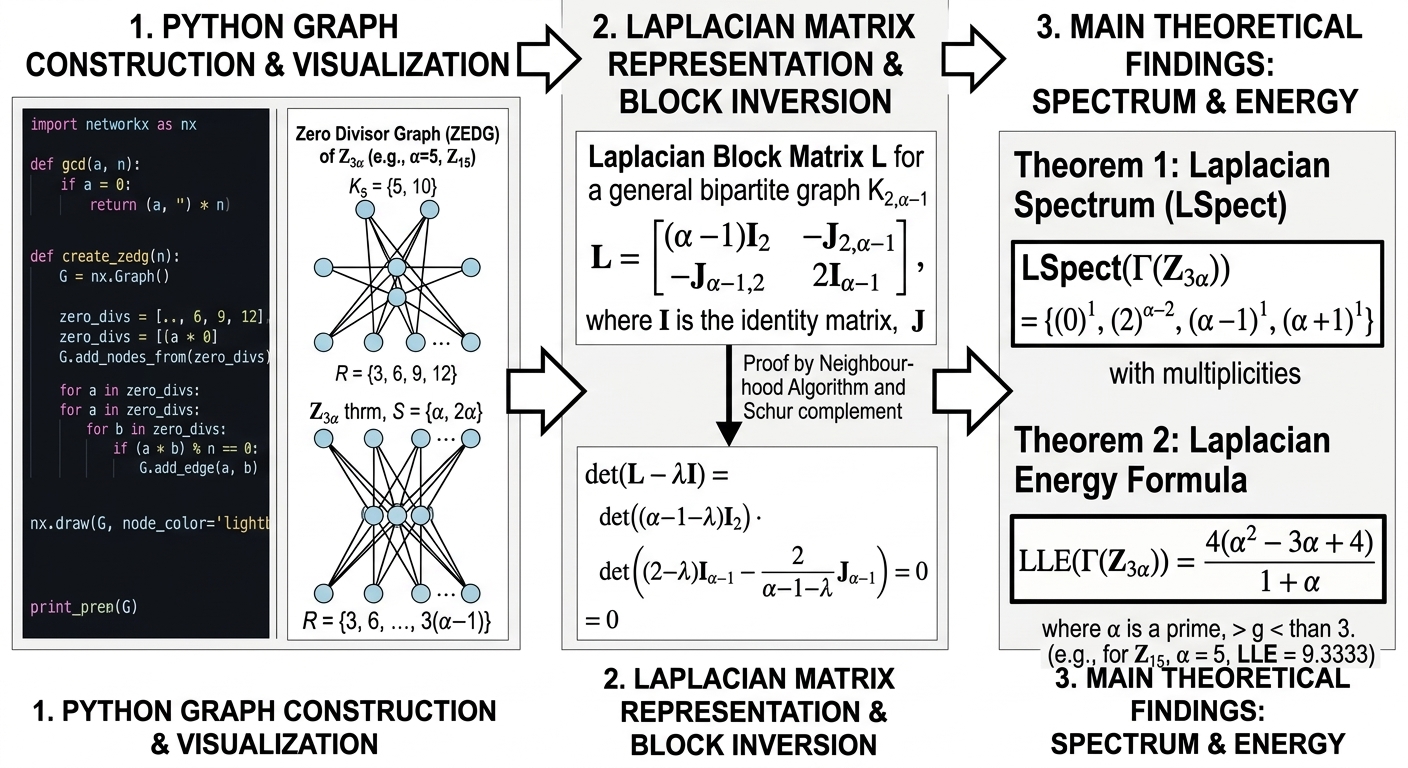
The Laplacian energy of a graph refers to the total absolute differences between its eigenvalues and the graph’s mean degree. These eigenvalues are derived from the Laplacian matrix, L which defined as a square matrix with entries Lii = di (the vertex degree of vi ), Lij=-1 if two distinct vertices are adjacent and otherwise Lij = 0. The graph is said to be the zero divisor graph of a commutative ring R is when all elements of nonzero zero divisors of R be its vertices and two distinct vertices are adjacent if and only if they are commute and equal to zero. This paper constructs the zero divisor graphs of Z3a where a=5,7,11,13 and 17 by using Python software. Subsequently, the general formula for the Laplacian spectrum and Laplacian energy are derived from the constructed graph, with an example provided to illustrate the main theorems.
References
Gutman, I. (1978). The energy of a graph. Berichte der Mathematisch-Statistischen Sektion im Forschungszentrum Graz, 103, 122.
Gutman, I., & Zhou, B. (2006). Laplacian energy of a graph. Linear Algebra and its Applications, 414(1), 29–37.
Hameed, A., Khan, Z. U., & Tyaglov, M. (2023). Laplacian energy and first Zagreb index of Laplacian integral graphs. An. Șt. Univ. Ovidius Constanța, 30(2), 133–160.
Yalçın, N. F. (2023). On Laplacian energy of r-uniform hypergraphs. Symmetry, 15(2), 382.
Dsouza, S., Nayak, S., & Bhat, P. (2021). Laplacian energy of partial complement of a graph. Materials Today: Proceedings, 54, 827–831. doi:10.1016/j.matpr.2021.11.109.
Mutlu Varlıoğlu, N., & Büyükköse, Ş. (2024). A note on the Laplacian energy of the power graph of a finite cyclic group. Sakarya University Journal of Science, 28(2), 431437.
Bhat, V., Singh, M., Sharma, K., Alkandari, M., & Hanna, L. (2024). On the Laplacian energy of an orbit graph of finite groups. Utilitas Mathematica, 119, 9–16.
Akbari, S., & Mohammadian, A. (2004). On the zero-divisor graph of a commutative ring. Journal of Algebra, 274(2), 847–855.
Mazlan, N. A., Hassim, H. I. M., Sarmin, N. H., & Khasraw, S. M. S. (2023). Distances of zero-divisor type graphs for some rings of integers modulo n. AIP Conference Proceedings, 2554, 010001.
Semil, G., Sarmin, N. H., Alimon, N. I., & Maulana, F. (2023). The first Zagreb index of the zero divisor graph for the ring of integers modulo power of primes. Malaysian Journal of Fundamental and Applied Sciences, 19(5), 892–900.
Magi, P. M., Jose, S. M., & Kishore, A. (2020). Spectrum of the zero-divisor graph on the ring of integers modulo n. Journal of Mathematical and Computer Science, 10(5), 1643–1666.
Pirzada, S., Wani, B. A., & Somasundaram, A. (2021). On the eigenvalues of zerodivisor graph associated to finite commutative ring. AKCE International Journal of Graphs and Combinatorics, 18(1), 1–6.
Beck, I. (1988). Coloring of commutative rings. Journal of Algebra, 116(1), 208–226. Doi:10.1016/0021-8693(88)90202-5.
Anderson, D. F., & Livingston, P. S. (1999). The zero-divisor graph of a commutative ring. Journal of Algebra, 217(1), 434–447. doi:10.1006/jabr.1998.7840.
Rather, B. A., Aijaz, M., Ali, F., Mlaiki, N., & Ullah, A. (2022). On distance signless Laplacian eigenvalues of zero divisor graph of commutative rings. AIMS Mathematics, 7(7), 12635–12649.
Mönius, K. (2021). Eigenvalues of zero-divisor graphs of finite commutative rings. Journal of Algebraic Combinatorics, 54(3), 787–802.
Mondal, S., Imran, M., De, N., & Pal, A. (2023). Topological indices of total graph and zero divisor graph of commutative ring: A polynomial approach. Complexity, 2023, Article ID 6815657. https://doi.org/10.1155/2023/6815657.
Zaid, N., Sarmin, N. H., & Khasraw, S. (2024). On the vertices of the zero divisor graph of some finite ring of matrices of dimension two. Proceedings of the 8th International Conference on Mathematics and Natural Sciences (ICMNS 2024), Bandung, Indonesia.
Kumar, R., & Prakash, O. (2024). Roman domination number of zero-divisor graphs over commutative rings. arXiv preprint arXiv:2412.07510.
Pirzada, S., & Altaf, A. (2025). Cliques in the extended zero-divisor graph of finite commutative rings. Communications in Combinatorics and Optimization, 10(1), 195–206.
Fraleigh, J. B. (2003). A first course in abstract algebra. Pearson Education India.
Saoub, K. R. (2021). Graph theory: An introduction to proofs, algorithms, and applications. CRC Press.
Bapat, R. B. (2014). Graphs and Matrices (2nd ed.). London: Springer. Doi:10.1007/978-1-4471-6569-9.
Ali, M. Y., & Khan, I. A. (2020). Computing determinants of block matrices.
Horn, R. A., & Johnson, C. R. (2012). Matrix analysis. Cambridge University Press.
Downloads
Published
Issue
Section
License
Copyright (c) 2025 Nur'Ain Adriana Mohd Rizal, Nur Idayu Alimon, Mathuri Selvarajoo, Nor Haniza Sarmin

This work is licensed under a Creative Commons Attribution-NonCommercial 4.0 International License.