
The Role of Mixed Alkaline Earth Effects on The Elastic Properties of xBaF2–(50 – x)CaF2–50B2O3 Fluoroborate Glasses: Comparative Analysis of Ultrasonic Measurements and Theoretical Models
DOI:
https://doi.org/10.11113/mjfas.v21n6.3892Keywords:
Mixed alkaline earth effects (MAEE), Elastic properties, Bulk compression model, Makishima-Mackenzie theory, Alkaline earth fluoride, Mixed modifier effects (MME)Abstract
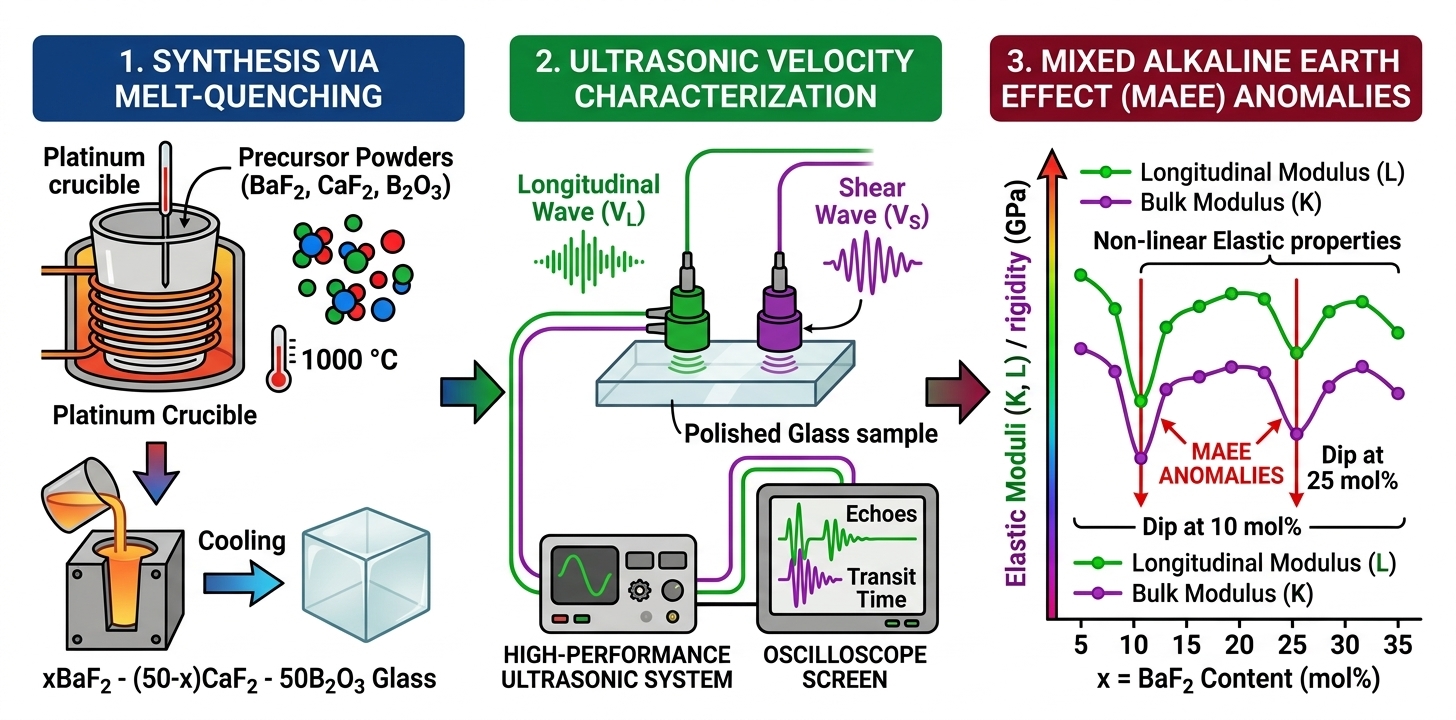
The incorporation of fluoride ions (F⁻) as glass modifiers in oxide glasses has garnered considerable interest due to their benefits in various advanced applications (solar energy conversion, laser systems, infrared fiber optics, electronic devices). A deeper understanding of the elastic properties of fluoroborate glasses is crucial for exploring the unique structural features they exhibit. In particular, studying the mixed alkaline earth effect (MAEE) is important, as it introduces compositional variations that alter both structure and mechanics of the glass network. This study focuses on the elastic behavior of xBaF2–(50 – x)CaF2–50B2O3 glasses (x = 5–35 mol%), synthesized via melt-quenching. Ultrasonic velocity measurements were used to probe the elastic moduli, providing key insights into material stability and performance. Three theoretical models (Makishima–Mackenzie, Bulk Compression, Ring Deformation) were employed to interpret the results. The elastic moduli, particularly longitudinal and bulk moduli, exhibit non-linear compositional trends with two distinct minima at 10 and 25 mol% BaF2. These deviations from linearity are attributed to MAEE-induced phase separation and disrupted cross-linking in the glass network. Such non-linearity reveals underlying structural heterogeneity; for example, certain mixed-cation compositions likely promote local phase separation or network fragmentation, which in turn softens the glass. Notably, the Makishima–Mackenzie model shows a drop in overall bond dissociation energy at 25 mol% BaF2, indicating a significant structural change at this composition. Meanwhile, the Bulk Compression model suggests that elasticity is governed by bond-length adjustments (without bond-angle changes), and the Ring Deformation model points to isotropic borate ring compression as the dominant elastic mechanism. Understanding these MAEE, driven anomalies is practically advantageous for materials engineers to pinpoint compositions that either maximize rigidity or, conversely, signal structural weaknesses. Our findings demonstrate that MAEE can be harnessed to tailor the elastic behaviour and mechanical stability of fluoroborate glasses, enhancing their potential for high-performance applications requiring robust and reliable glass materials.
References
Maniua, D., Iliescu, T., Ardelean, I., Cinta-Pinzaru, S., Tarcea, N., & Kiefer, W. (2003). Raman study on B₂O₃–CaO glasses. Journal of Molecular Structure, 485–488. https://doi.org/10.1016/S0022-2860(03)00129-7.
Kaur, G., Pandey, O. P., & Singh, K. (2012). Effect of modifiers field strength on optical, structural and mechanical properties of lanthanum borosilicate glasses. Journal of Non-Crystalline Solids, 358(18–19), 2589–2596. https://doi.org/10.1016/j.jnoncrysol.2012.06.006.
Sabri, N. S., Yahya, A. K., Abd-Shukor, R., & Talari, M. K. (2016). Anomalous elastic behaviour of xSrO–10PbO–(90–x)B₂O₃ glass system. Journal of Non-Crystalline Solids, 444, 55–63. https://doi.org/10.1016/j.jnoncrysol.2016.04.038.
Sabri, N. S., Yahya, A. K., & Talari, M. K. (2017). Anomalous optical properties of xSrO–10PbO–(90–x)B₂O₃ glass system. Transactions of the Indian Institute of Metals, 70(3), 557–565. https://doi.org/10.1007/s12666-017-1043-8.
Abousehly, A., Issa, S. A. M., El-Oyoun, M. A., & Afify, N. (2015). Electrical and mechanical properties of Li₂O–BaO–B₂O₃ glass system. Journal of Non-Crystalline Solids, 429, 148–152. https://doi.org/10.1016/j.jnoncrysol.2015.09.003.
Yiannopoulos, Y. D., Chryssikos, G. D., & Kamitsos, E. I. (2001). Structure and properties of alkaline earth borate glasses. Physics and Chemistry of Glasses.
Narayanan, M. K., & Shashikala, H. D. (2015). Thermal and optical properties of BaO–CaF₂–P₂O₅ glasses. Journal of Non-Crystalline Solids, 422, 6–11. https://doi.org/10.1016/j.jnoncrysol.2015.04.038.
Krishna Murthy, M., Murthy, K. S. N., & Veeraiah, N. (2000). Dielectric properties of NaF–B₂O₃ glasses doped with certain transition metal ions. Bulletin of Materials Science, 23(4), 285–293. https://doi.org/10.1007/BF02720084.
El-Egili, K., Doweidar, H., Ramadan, R., & Altawaf, A. (2016). Role of F⁻ ions in the structure and properties of BaF₂–B₂O₃ glasses. Journal of Non-Crystalline Solids, 449, 83–93. https://doi.org/10.1016/j.jnoncrysol.2016.07.014.
Doweidar, H., El-Damrawi, G., & Abdelghany, M. (2012). Structure and properties of CaF₂–B₂O₃ glasses. Journal of Materials Science, 47(9), 4028–4035. https://doi.org/10.1007/s10853-012-6256-y
Kamitsos, E. I., & Karakassides, M. A. (1988). A spectroscopic study of fluoride containing sodium borate glasses. Solid State Ionics, 28–30, 783–787.
Bih, L., Abbas, L., Mohdachi, S., & Nadiri, A. (2008). Thermal and electrical properties of mixed alkali in Li₂O–Na₂O–WO₃–P₂O₅ glasses. Journal of Molecular Structure, 891(1–3), 173–177. https://doi.org/10.1016/j.molstruc.2008.03.019.
Japari, S. J., Yahya, A. K., & Hisam, R. (2020). Effects of mixed-alkali oxides on AC conductivity and dielectric properties of xNa₂O–(20–x)K₂O–30V₂O₅–50TeO₂ glasses. Results in Physics, 16, 102905. https://doi.org/10.1016/j.rinp.2019.102905.
Calahoo, C., & Zwanziger, J. W. (2017). The mixed modifier effect in ionic conductivity and mechanical properties for xMgO–(50–x)CaO–50SiO₂ glasses. Journal of Non-Crystalline Solids, 460, 6–18. https://doi.org/10.1016/j.jnoncrysol.2017.01.017
Walia, T., & Singh, K. (2021). Mixed alkaline earth modifiers effect on thermal, optical and structural properties of SrO–BaO–SiO₂–B₂O₃–ZrO₂ glass sealants. Journal of Non-Crystalline Solids, 564, 120812. https://doi.org/10.1016/j.jnoncrysol.2021.120812.
Sahapini, N. F. M., Hisam, R., & Yahya, A. K. (2022). Structural and optical properties of mixed alkaline earth fluoroborate xBaF₂–(50–x)CaF₂–50B₂O₃ glass system. Applied Physics A, 128(3), 223. https://doi.org/10.1007/s00339-022-05360-z.
Inaba, S., Fujino, S., & Morinaga, K. (1999). Young’s modulus and compositional parameters of oxide glasses. Journal of the American Ceramic Society, 82(12), 3501–3507. https://doi.org/10.1111/j.1151-2916.1999.tb02272.x.
Mohamed, N. B., Yahya, A. K., Deni, M. S. M., Mohamed, S. N., Halimah, M. K., & Sidek, H. A. A. (2010). Effects of concurrent TeO₂ reduction and ZnO addition on elastic and structural properties of (90–x)TeO₂–10Nb₂O₅–xZnO glass. Journal of Non-Crystalline Solids, 356(33–34), 1626–1630. https://doi.org/10.1016/j.jnoncrysol.2010.06.031.
Shaaban, K. S., Sayed, M. A., Saddeek, Y. B., & Yahia, I. S. (2019). Structural analyses of halide alkali lead borate glasses. Silicon, 11(5), 2413–2419. https://doi.org/10.1007/s12633-016-9465-1
El-Moneim, A. A. (2018). Theoretical analysis for ultrasonic properties of vanadate glasses over a wide range of composition. Journal of Non-Crystalline Solids, 498, 134–144. https://doi.org/10.1016/j.jnoncrysol.2018.06.010.
El-Hofy, M., & Hager, I. Z. (2003). Ionic conductivity in lithium haloborate glasses. Physica Status Solidi A: Applied Research, 199(3), 448–456. https://doi.org/10.1002/pssa.200306670.
Patil, S. D., Jali, V. M., & Anavekar, R. V. (2009). Elastic properties of Na₂O–ZnO–ZnF₂–B₂O₃ oxyfluoride glasses. Bulletin of Materials Science, 32(6), 597–601.
Hager, I. Z. (2002). Elastic moduli of boron oxyfluoride glasses: Experimental determinations and application of Makishima and Mackenzie’s theory. Journal of Materials Science, 37, 1309–1313.
El-Mallawany, R., Afifi, H. A., El-Gazery, M., & Ali, A. A. (2018). Effect of Bi₂O₃ addition on the ultrasonic properties of pentaternary borate glasses. Measurement, 116, 314–317. https://doi.org/10.1016/j.measurement.2017.11.028.
Ismail, M., Supardan, S. N., Yahya, A. K., Yusof, M. I. M., & Halimah, M. K. (2016). Anomalous elastic and optical behaviours of mixed electronic-ionic of xAg₂O−(35−x)[0.5MoO₃−0.5V₂O₅]−65TeO₂ conductor glasses. Chalcogenide Letters, 13(11), 989–1005.
Umair, M. M., & Yahya, A. K. (2015). Effect of Nb₂O₅ network stabilizer on elastic and optical properties of xNb₂O₅–(20–x)BaO–80TeO₂ tellurite glass system. Journal of the American Ceramic Society, 12(6), 287–300. https://doi.org/10.1111/j.1551-2916.2006.01399.x.
Hisam, R., & Yahya, A. K. (2016). Anomalous behaviours of elastic moduli, DC conductivity and optical properties in mixed transition-metal-ion (20–x)MnO₂–xFe₂O₃–8TeO₂ tellurite glass system. Chalcogenide Letters, 13(4), 145–160.
Samsudin, N. M., Hisam, R., & Yahya, A. K. (2021). Structural, DC conductivity and elastic properties of (80–x)B₂O₃–xTeO₂–10Li₂O–10Al₂O₃ mixed glass former. Ionics, 27(2), 619–634. https://doi.org/10.1007/s11581-020-03859-0.
Samdani, G., Ramadevudu, M., Chary, M. N., & Shareefuddin, M. (2017). Physical and spectroscopic studies of Cr³⁺ doped mixed alkaline earth oxide borate glasses. Materials Chemistry and Physics, 186. https://doi.org/10.1016/j.matchemphys.2016.11.009.
Azianty, S., & Yahya, A. K. (2013). Enhancement of elastic properties by WO₃ partial replacement of TeO₂ in ternary (80–x)TeO₂–20PbO–xWO₃ glass system. Journal of Non-Crystalline Solids, 378, 234–240. https://doi.org/10.1016/j.jnoncrysol.2013.07.016.
Makishima, A., & Mackenzie, J. D. (1975). Calculation of bulk modulus, shear modulus and Poisson’s ratio of glass. Journal of Non-Crystalline Solids, 17(2), 147–157. https://doi.org/10.1016/0022-3093(75)90047-2.
Bridge, B., Patel, N. D., & Waters, D. N. (1983). On the elastic constants and structure of the pure inorganic oxide glasses. Physica Status Solidi (a), 77, 655–668.
Halimah, M. K., Daud, W. M., & Sidek, H. A. A. (2010). Elastic properties of TeO₂–B₂O₃–Ag₂O glasses. Ionics, 16(9), 807–813. https://doi.org/10.1007/s11581-010-0465-7.
Matecki, M., & Lucas, J. (1994). Elastic moduli of fluoride glasses: Application of Makishima and Mackenzie’s theory. Materials Research Bulletin, 29(5), 473–477.
Shi, Y., Tandia, A., Deng, B., Elliott, S. R., & Bauchy, M. (2020). Revisiting the Makishima–Mackenzie model for predicting the Young’s modulus of oxide glasses. Acta Materialia, 195, 252–262. https://doi.org/10.1016/j.actamat.2020.05.047.
Hager, I. Z. (2002). Elastic moduli of boron oxyfluoride glasses: Experimental determinations and application of Makishima and Mackenzie’s theory. Journal of Materials Science, 37(7), 1309–1313. https://doi.org/10.1023/A:1014552008442.
Batsanov, S. S., & Batsanov, A. S. (2013). Introduction to structural chemistry. Springer Netherlands. https://doi.org/10.1007/978-94-007-4771-5.
Abd El-Moneim, A. (2018). BaF₂-contained tellurite glasses: Quantitative analysis and prediction of elastic properties and ultrasonic attenuation–Part I. Journal of Fluorine Chemistry, 210, 156–165. https://doi.org/10.1016/j.jfluchem.2018.03.005
El-Moneim, A. A. (2019). Correlating bulk modulus and Poisson’s ratio of alkali fluoride and oxyfluoride glasses with compositional parameters. Journal of Fluorine Chemistry, 221, 48–55.
El-Mallawany, R., Hager, I. Z., & Poulain, M. (2002). Thermal properties of new molybdenum oxyfluoride glasses. Journal of Materials Science, 37, 3291–3297.
Kamitsos, E. I., & Chryssikos, G. D. (1991). Borate glass structure by Raman and infrared spectroscopies. Journal of Molecular Structure, 247, 1–16.
Wright, A. C., Vedishcheva, N. M., & Shakhmatkin, B. A. (1995). Vitreous borate networks containing superstructural units: A challenge to the random network theory? Journal of Non-Crystalline Solids, 192–193, 92–97.
Saddeek, Y. B. (2004). Ultrasonic study and physical properties of some borate glasses. Materials Chemistry and Physics, 83(2–3), 222–228. https://doi.org/10.1016/j.matchemphys.2003.09.051.
Saddeek, Y. B. (2004). Structural analysis of alkali borate glasses. Physica B: Condensed Matter, 344(1–4), 163–175. https://doi.org/10.1016/j.physb.2003.09.254.
Umair, M. M., & Yahya, A. K. (2013). Elastic and structural changes of xNa₂O–(35–x)V₂O₅–65TeO₂ glass system with increasing sodium. Materials Chemistry and Physics, 142(2–3), 549–555. https://doi.org/10.1016/j.matchemphys.2013.07.051.
Nishara Begum, A., & Rajendran, V. (2006). Structure and elastic properties of TeO₂–BaF₂ glasses. Journal of Physics and Chemistry of Solids, 67(8), 1697–1702. https://doi.org/10.1016/j.jpcs.2006.03.007.
Edukondalu, A., Ramadevudu, G., Chary, M. N., & Shareefuddin, M. (2012). Mixed alkali effect in physical and optical properties of Li₂O–Na₂O–WO₃–B₂O₃ glasses. Journal of Non-Crystalline Solids, 358(18–19), 2581–2588. https://doi.org/10.1016/j.jnoncrysol.2012.06.004.
Garza-Garcia, M., Lopez-Cuevas, J., Gutierrez-Chavarria, C. A., Rendon-Angeles, J. C., & Valle-Fuentes, J. F. (2007). Study of a mixed alkaline-earth effect on some properties of glasses of the CaO–MgO–Al₂O₃–SiO₂ system. Boletín de la Sociedad Española de Cerámica y Vidrio, 46(3), 153–162.
Seijo, L., Barandiarán, Z., & Huzinaga, S. (1991). Ab initio model potential study of the equilibrium geometry of alkaline earth dihalides: MX₂ (M = Mg, Ca, Sr, Ba; X = F, Cl, Br, I). Journal of Chemical Physics, 94(5), 3762–3773. https://doi.org/10.1063/1.459748.
Mohamed, S. N., & Yahya, A. K. (2018). Effects of V₂O₅ on elastic, structural, and optical properties of mixed ionic–electronic 20Na₂O–20CaO–(60–x)B₂O₃–xV₂O₅ glasses. Ionics, 24(9), 2647–2664. https://doi.org/10.1007/s11581-017-2396-z.
Guo, H. W., Wang, X. F., Gong, Y. X., & Gao, D. N. (2010). Mixed alkali effect in xK₂O–(30–x)Na₂O–30P₂O₅–40ZnO glasses. Journal of Non-Crystalline Solids, 356(41–42), 2109–2113. https://doi.org/10.1016/j.jnoncrysol.2010.07.060.
Downloads
Published
Issue
Section
License
Copyright (c) 2025 Noor Fadhilah Muhamad Sahapini, Rosdiyana Hisam, Mazlini Mazlan, Rabiatul Adawiyah Abdul Wahab, Maryam Mohammad

This work is licensed under a Creative Commons Attribution-NonCommercial 4.0 International License.