
Bayesian Bootstrap Confidence Interval for Mean based on Small Sample Sizes
DOI:
https://doi.org/10.11113/mjfas.v21n6.3479Keywords:
Confidence interval, Bootstrap, Bayesian BootstrapAbstract
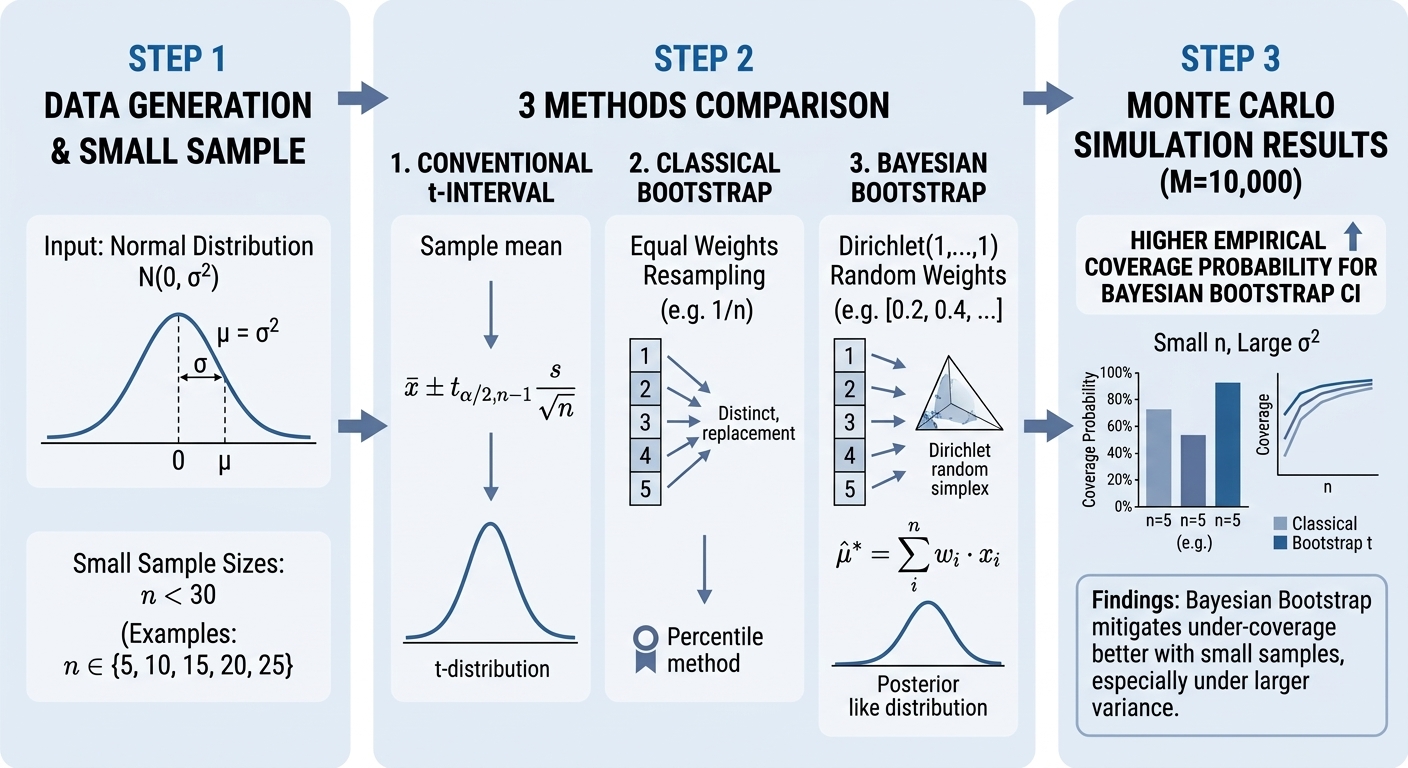
The primary objective of this research is to conduct a comprehensive comparison of confidence intervals (CIs) calculated to reflect a predetermined level of confidence. Specifically, we focus on investigating CIs derived from a normal distribution with known population mean and population variance . In this study, we introduce a novel approach for constructing CIs, termed the Bayesian Bootstrap CI, and evaluate its performance relative to both Bootstrap CI and conventional CI methodologies. Our analysis involves rigorous comparisons across various scenarios, particularly emphasizing cases with small sample sizes (n<30). Through extensive simulations, we systematically assess the accuracy, precision, and robustness of each CI method under different conditions. The results consistently demonstrate that the Bayesian Bootstrap CI exhibits superior performance compared to both Bootstrap CI and conventional CI, particularly in situations with limited sample sizes. The Bayesian Bootstrap CI emerges as a compelling choice for researchers and practitioners, offering enhanced reliability and accuracy in estimating population parameters, especially when dealing with small sample sizes. By incorporating Bayesian principles and Bootstrap resampling techniques, the Bayesian Bootstrap CI effectively leverages prior information and captures the true uncertainty surrounding the population parameters. Given the empirical evidence highlighting the advantages of the Bayesian Bootstrap CI, we recommend its adoption as the preferred method for constructing CIs in scenarios involving small sample sizes. This recommendation underscores the importance of leveraging innovative methodologies to enhance the quality and reliability of statistical inference in research and practical applications. Through the adoption of the Bayesian Bootstrap CI, researchers can mitigate potential biases and uncertainties associated with small sample sizes, thereby fostering more robust and credible scientific conclusions.
References
Altman, D. G., and Bland, J. M. (1999). "Statistics Notes: Confidence Intervals." BMJ, 318(7179), 1551-1552.
Stock, J. H., and Watson, M. W. (2003). "Forecasting Output and Inflation: The Role of Asset Prices." Journal of Economic Literature, 41(3), 788-829.
Hedges, L. V., and Olkin, I. (1985). "Statistical Methods for Meta-Analysis." Academic Press.
Davison, A. C., and Hinkley, D. V. (1997). Bootstrap methods and their applications. Cambridge University Press.
Efron, B., and Tibshirani, R. J. (1993). An introduction to the bootstrap. CRC press.
Manly, B. F. J. (1997). Randomization, bootstrap, and Monte Carlo methods in biology. CRC Press.
Gelman, A., Carlin, J. B., Stern, H. S., Dunson, D. B., Vehtari, A., and Rubin, D. B. (2013). "Bayesian Data Analysis." CRC Press.
McElreath, R. (2016). Statistical Rethinking: A Bayesian Course with Examples in R and Stan. CRC Press.
Kéry, M., and Schaub, M. (2011). Bayesian Population Analysis Using WinBUGS: A Hierarchical Perspective. Academic Press.
Rubin, D. B. (1981). The Bayesian bootstrap. The Annals of Statistics, 9(1), 130-134.
DiCiccio, T. J., and Efron, B. (1996). Bootstrap confidence intervals. Statistical Science, 11(3), 189-212.
Chen, J., & Shao, Q. M. (2000). A new bootstrap procedure for dependent data. Statistica Sinica, 17-40.
Downloads
Published
Issue
Section
License
Copyright (c) 2025 Noppakun Tongmual

This work is licensed under a Creative Commons Attribution-NonCommercial 4.0 International License.