
A Dual-Functional Color-Shiftable Ion Imprinted Polymer for Visual Detection and Online Preconcentration of Trace Cu2+
DOI:
https://doi.org/10.11113/mjfas.v22n5.5642Keywords:
Ion imprinted polymer, PAR, copper, flow injection analysis (FIA), DIC analysisAbstract
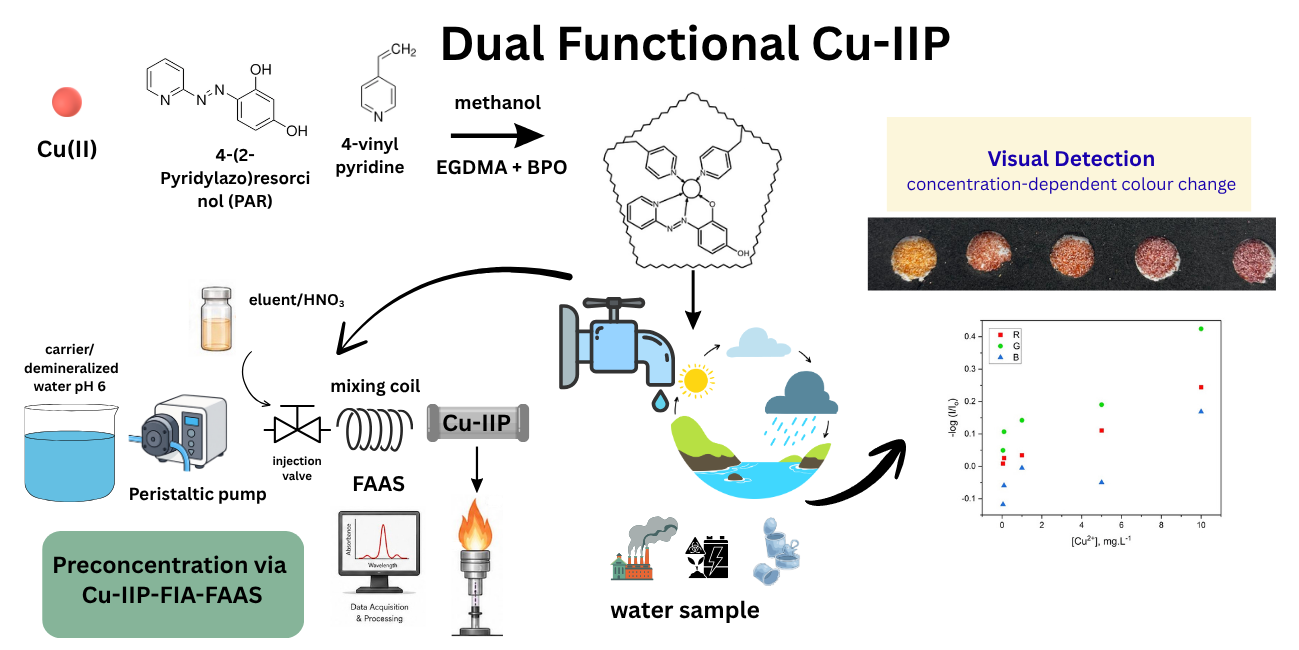
A dual-functional Cu-Ion Imprinted Polymer (Cu-IIP) was prepared using a facile imprinting method as a color-responsive adsorbent for simultaneous visual detection and selective online preconcentration of trace Cu2+ ions. Cu-IIP was obtained by bulk polymerization using the chromophore ligand 4-pyridylazo resorcinol (PAR), the functional monomer 4-vinyl pyridine, the crosslinker ethylene glycol dimethacrylate (EGDMA), the porogen methanol, and the initiator benzoyl peroxide (BPO) under mild condition (T 65 oC ) for 2h. The synthesized imprinted polymers exhibited a maximum adsorption capacity of 67.32 mg. g-1 for Cu2+ ions. Adsorption equilibrium followed Langmuir isotherm model (R2 0.9883), indicating homogeneous binding sites. The pseudo-second-order kinetic model (R2 0.9999) most accurately represents kinetic data, indicating significant chemical interactions between the metal ions and the sorbent. The thermodynamic parameters confirmed that the adsorption process is both spontaneous and exothermic (DG< 0). The Cu-IIP was integrated into an online Flow Injection Analysis (FIA) coupled with flame atomic absorption spectrometry (FIA-FAAS). The method showed a good linearity from 100-1000 mg. L-1 with R2 0.9919, a detection limit (LoD) of 3.07 mg. L-1, a LoQ of 9.03 mg. L-1, a preconcentration factor of 2.2, and a good precision 3.53%. Application of Cu-IIP-FIA-FAAS system to a water sample demonstrated high accuracy, with recovery values 102.9-105.5%. In addition, the incorporation of PAR demonstrated a distinct concentration-dependent color change, highlighting its dual functionality as both a selective
References
[1] V. Singh, G. Ahmed, S. Vedika, P. Kumar, S.K. Chaturvedi, S.N. Rai, E. Vamanu, A. Kumar, Sci. Rep. 14 (2024) 7595. https://doi.org/10.1038/s41598-024-58061-3.
[2] A. Alengebawy, S.T. Ahmed, R. Qureshi, W. Sundas, M.Q. Wang, Toxics 9 (2021) 42. https://doi.org/10.3390/toxics9030042.
[3] S. Kotnala, S. Tiwari, A. Nayak, B. Bhushan, S. Chandra, C.R. Medeiros, H.D.M. Coutinho, Sci. Total Environ. 987 (2025) 179785. https://doi.org/10.1016/j.scitotenv.2025.179785.
[4] Y. Zou, S. Wu, X. Xu, X. Tan, S. Yang, T. Chen, J. Zhang, S. Li, W. Li, F. Wang, Int. Immunopharmacol. 133 (2024) 112075. https://doi.org/10.1016/j.intimp.2024.112075.
[5] R. Manne, M.M.R.M. Kumaradoss, R.S.R. Iska, A. Devarajan, N. Mekala, Appl. Water Sci. 12 (2022) 27. https://doi.org/10.1007/s13201-021-01542-x.
[6] S. Joshi, R.K. Srivastava, Environ. Monit. Assess. 191 (2019) 615. https://doi.org/10.1007/s10661-019-7777-5.
[7] M. Li, M.Y. Li, C.G. Feng, Q.X. Zeng, Appl. Surf. Sci. 314 (2014) 1063–1069. https://doi.org/10.1016/j.apsusc.2014.06.038.
[8] M.A. Darweesh, M.Y. Elgendy, M.I. Ayad, A.M.M. Ahmed, N.M.K. Elsayed, W.A. Hammad, S. Afr. J. Chem. Eng. 40 (2022) 10–20. https://doi.org/10.1016/j.sajce.2022.01.002.
[9] M. Shahrashoub, S. Bakhtiari, Microporous Mesoporous Mater. 311 (2021) 10692. https://doi.org/10.1016/j.micromeso.2020.110692.
[10] G. Duan, X. Li, X. Ma, W. Zhong, S. Wang, Sci. Total Environ. 864 (2023) 160984. https://doi.org/10.1016/j.scitotenv.2022.160984.
[11] Z. Wang, W. Xu, F. Jie, Z. Zhao, K. Zhou, H. Liu, Sci. Rep. 11 (2021) 16878. https://doi.org/10.1038/s41598-021-96465-7.
[12] T.C. Egbosiuba, A.S. Abdulkareem, J. Mater. Res. Technol. 15 (2021) 2848–2872. https://doi.org/10.1016/j.jmrt.2021.09.094.
[13] P. Cao, V. Pichon, C. Dreanno, K. Boukerma, N. Delaunay, Talanta 256 (2023) 124295. https://doi.org/10.1016/j.talanta.2023.124295.
[14] T. Zhang, X. Yue, K. Zhang, F. Zhao, Y. Wang, K. Zhang, Hydrometallurgy 169 (2017) 599–606. https://doi.org/10.1016/j.hydromet.2017.04.005.
[15] Y. Pan, F. Zhang, W. Gao, Y. Sun, S. Zhang, H. Lian, L. Mao, Chin. J. Chromatogr. 40 (2022) 979–987. https://doi.org/10.3724/SP.J.1123.2022.07013.
[16] F.A. Mustafai, A. Balouch, Abdullah, N. Jalbani, M.I. Bhanger, M.S. Jagirani, A. Kumar, A. Tunio, Eur. Polym. J. 109 (2018) 133–142. https://doi.org/10.1016/j.eurpolymj.2018.09.041.
[17] Y. El Ouardi, A. Giove, M. Laatikainen, C. Branger, K. Laatikainen, J. Environ. Chem. Eng. 9 (2021) 106548. https://doi.org/10.1016/j.jece.2021.106548.
[18] S. Mishra, A. Tripathi, J. Environ. Chem. Eng. 8 (2020) 103656. https://doi.org/10.1016/j.jece.2020.103656.
[19] S. Rais, A. Islam, I. Ahmad, S. Kumar, A. Chauhan, H. Javed, Food Chem. 334 (2021) 127656. https://doi.org/10.1016/j.foodchem.2020.127563.
[20] A. Kocyła, A. Pomorski, A. Kręzel, J. Inorg. Biochem. 152 (2015) 82–92. https://doi.org/10.1016/j.jinorgbio.2015.08.024.
[21] D.K. Singh, S. Mishra, Chromatographia 70 (2009) 1539–1545. https://doi.org/10.1365/s10337-009-1379-2.
[22] B.-C. Iacob, A.E. Bodoki, L. Oprean, E. Bodoki, in: C. Saravanan, B. Biswas (Eds.), Ligand, IntechOpen, London, 2018, p. 1–28. https://doi.org/10.5772/intechopen.73407.
[23] X. Cai, J. Li, Z. Zhang, F. Yang, R. Dong, L. Chen, ACS Appl. Mater. Interfaces 6 (2014) 15739–15748. https://doi.org/10.1021/am4042405.
[24] A. Cihanbay, H. Sari, F.N. Al-Obaidi, H. Atabey, Russ. J. Inorg. Chem. 69 (2024) 1165–1172. https://doi.org/10.1134/S0036023623603458.
[25] E.Y. Bivián-Castro, A. Zepeda-Navarro, J.L. Guzmán-Mar, M. Flores-Alamo, B. Mata-Ortega, Polymers 15 (2023) 1186. https://doi.org/10.3390/polym15051186.
[26] Y. Jiang, B. Tang, P. Zhao, M. Xi, Y. Li, J. Inorg. Organomet. Polym. Mater. 31 (2021) 4628–4636. https://doi.org/10.1007/s10904-021-02065-3.
[27] T.P. Rao, R. Kala, S. Daniel, Anal. Chim. Acta 578 (2006) 105–116. https://doi.org/10.1016/j.aca.2006.06.065.
[28] S. Daniel, R.S. Praveen, T.P. Rao, Anal. Chim. Acta 570 (2006) 79–87. https://doi.org/10.1016/j.aca.2006.04.007.
[29] T. Bicim, M. Yaman, J. AOAC Int. 99 (2016) 1043–1048. https://doi.org/10.5740/jaoacint.16-0088.
[30] F. Fereidoonipour, H.R. Rajabi, New J. Chem. 41 (2017) 8828–8836. https://doi.org/10.1039/c7nj00893g.
[31] D.F. Moreira Naves, C. dos Reis Feliciano, M.G. Santos, Anal. Chim. Acta 1296 (2024) 342308. https://doi.org/10.1016/j.aca.2024.342308.
[32] A. Lamaoui, J.J. García-Guzmán, A. Amine, J.M. Palacios-Santander, L. Cubillana-Aguilera, in: S. Thomas, M.P. Patil (Eds.), Molecularly Imprinted Polymer Composites: Synthesis, Characterisation and Applications, Elsevier, Amsterdam, 2020, p. 49–91. https://doi.org/10.1016/B978-0-12-819952-7.00002-0.
[33] D. Qi, H. Zhang, Z. Zhou, Z. Ren, J. Environ. Chem. Eng. 11 (2023) 110804. https://doi.org/10.1016/j.jece.2023.110804.
[34] M. Behbahani, P.G. Hassanlou, M.M. Amini, H.R. Moazami, H.S. Abandansari, A. Bagheri, S.H. Zadeh, Food Anal. Methods 8 (2015) 558–568. https://doi.org/10.1007/s12161-014-9924-5.
[35] M. Boudias, A. Gourgiotis, C. Cazala, V. Pichon, N. Delaunay, Adv. Sample Prep. 5 (2023) 100049. https://doi.org/10.1016/j.sampre.2022.100049.
[36] T. Zhang, X. Yue, K. Zhang, J. Li, C. Zhu, L. Zhang, W. Chen, Mater. Des. 107 (2016) 372–377. https://doi.org/10.1016/j.matdes.2016.06.054.
[37] Z. Dahaghin, H.Z. Mousavi, L. Boutorabi, J. Mol. Liq. 243 (2017) 380–386. https://doi.org/10.1016/j.molliq.2017.08.018.
[38] Y. Sun, Y. Gu, P. Zhang, J. Hazard. Mater. 424 (2022) 127735. https://doi.org/10.1016/j.jhazmat.2021.127735.
[39] M.A. Al-Ghouti, D.A. Da’ana, J. Hazard. Mater. 393 (2020) 122383. https://doi.org/10.1016/j.jhazmat.2020.122383.
[40] E. Ghorbani, S. Bagheri Renani, P. Zahedi, New J. Chem. 48 (2024) 9794–9804. https://doi.org/10.1039/d4nj01254b.
[41] L. Zhou, C. Shang, Z. Liu, G. Huang, A.A. Adesina, J. Colloid Interface Sci. 366 (2012) 165–172. https://doi.org/10.1016/j.jcis.2011.09.069.
[42] J. Long, X. Luo, X. Yin, X. Wu, J. Environ. Chem. Eng. 4 (2016) 4776–4785. (Nota: Tiada DOI disediakan dalam fail sumber 2)
[43] N. Ambarsari, M.A. Zulfikar, M.B. Amran, Anal. Bioanal. Chem. Res. 10 (2023) 71–86. https://doi.org/10.22036/abcr.2022.345322.1782.
[44] Y. Li, C. Wang, J. Zhao, X. Liu, M. Ma, A. Gao, K. Sun, Anal. Methods 17 (2025) 5807–5830. https://doi.org/10.1039/d5ay00626k.
[45] U. Haseen, S. Kapoor, R.A. Khan, B.H. Koo, RSC Adv. 15 (2025) 8729–8739. https://doi.org/10.1039/d4ra08024f.
[46] M.B. Amran, N. Ambarsari, M.A. Zulfikar, A. Indrawati, R. Rusnadi, S. Hamdi, J. Anal. Test. 8 (2024) 180–190. https://doi.org/10.1007/s41664-024-00294-2.
[47] H. Liu, D. Kong, W. Sun, Q. Li, Z. Zhou, Z. Ren, Chem. Eng. J. 303 (2016) 348–358. https://doi.org/10.1016/j.cej.2016.06.004.
[48] G. de Carvalho Oliveira, C.C.S. Machado, D.K. Inácio, J.F. da Silveira Petruci, S.G. Silva, Talanta 241 (2022) 123244. https://doi.org/10.1016/j.talanta.2022.123244.
[49] Y. Fan, J. Li, Y. Guo, L. Xie, G. Zhang, Measurement 171 (2021) 108829. https://doi.org/10.1016/j.measurement.2020.108829.
[50] F.A. Cajamarca Suquila, L.A. Bertoldo, E. Lins, C.R.T. Tarley, Separations 10 (2023) 122. https://doi.org/10.3390/separations10020122.
[51] Y. Gao, R.Y. Zhou, L. Yao, W. Yin, J.X. Yu, Q. Yue, Z. Xue, H. He, B. Gao, J. Hazard. Mater. 424 (2022) 127203. https://doi.org/10.1016/j.jhazmat.2021.127203.
Downloads
Published
Issue
Section
License
Copyright (c) 2026 Dita Arifa Nurani, Untung Triadhi, Dian Ayu Setyorini, Muhammad Bachri Amran

This work is licensed under a Creative Commons Attribution-NonCommercial 4.0 International License.