
Extraction of Flavonoids from Angelica keiskei Leaves Using Ultrasound-Assisted Deep Eutectic Solvent Extraction: Optimization and Bioactivity Evaluation
DOI:
https://doi.org/10.11113/mjfas.v22n5.5629Keywords:
Angelica keiskei, Flavonoids, deep eutectic solvents, optimizationAbstract
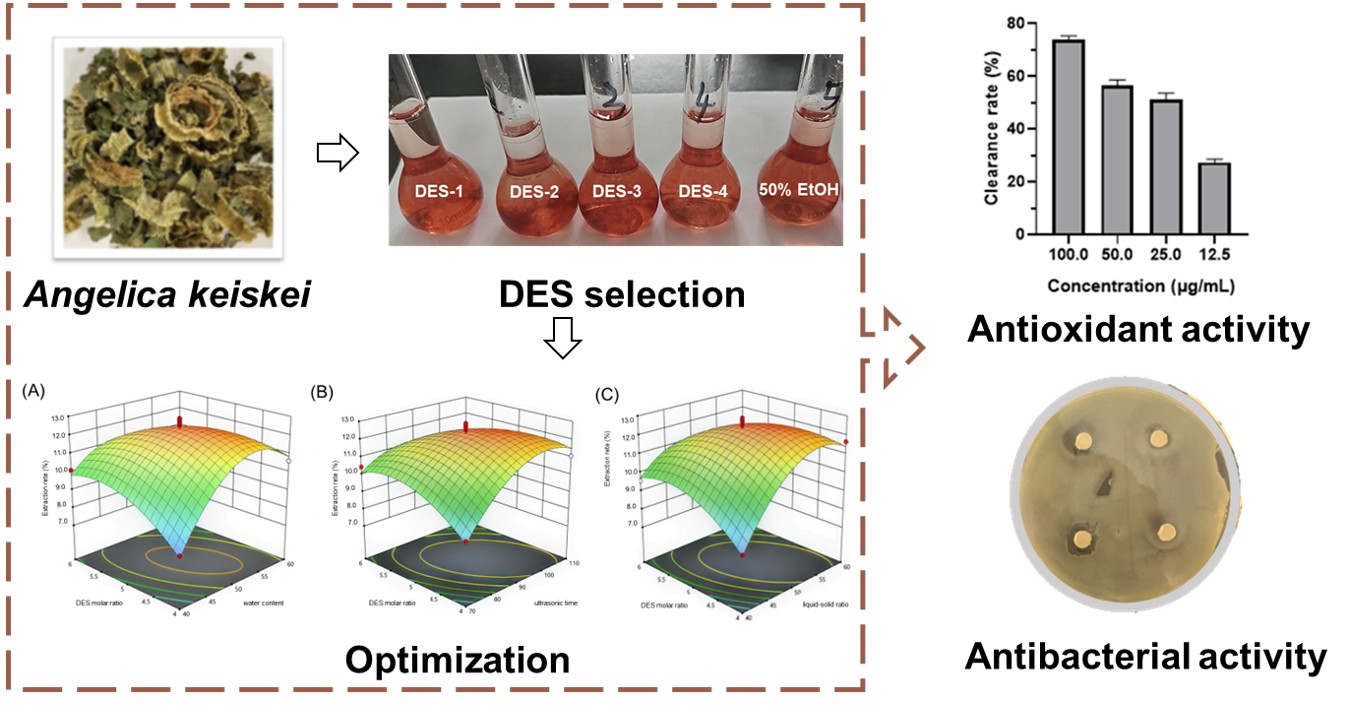
Angelica keiskei is a medicinal and edible herb rich in bioactive flavonoids, yet green and efficient extraction methods for these compounds remain underexplored. This study aimed to establish an ultrasound-assisted deep eutectic solvent extraction method for total flavonoids from the plant. Response surface methodology (RSM) was employed to optimize the extraction process for A. keiskei leaves. Single-factor and Box-Behnken design experiments were conducted to evaluate the influence of DES water content, ultrasonic time, liquid-solid ratio, and DES molar ratio on extraction efficiency. Results demonstrated that a total flavonoid content of 13.02% ± 0.15% was achieved under the optimal conditions of 50% DES water content, 100 min ultrasonic time, 50:1 liquid-solid ratio (w/v), and 4:1 DES molar ratio (1,2-ethanediol: choline chloride). Notably, the obtained extract exhibited strong antioxidant activity in vitro, with a DPPH· radical scavenging IC₅₀ value of 31.33 ± 1.35 μg/mL. Antibacterial tests revealed that the extract exhibited moderate sensitivity against Escherichia coli, producing inhibition zones exceeding 12 mm at an EC50 of 2.20 mg/mL. These findings demonstrate that UAE-DES is a green and efficient approach for flavonoid extraction from A. keiskei, and the resulting extract have potential to be used as natural functional additives in the field of food, cosmetics, and pharmaceuticals.
References
[1] Cao, S., Liang, J., Chen, M., Xu, C., Wang, X., Qiu, L., Zhao, X., & Hu, W. (2025). Comparative analysis of extraction technologies for plant extracts and absolutes. Frontiers in Chemistry, 13, 1536590.
[2] Shrivastav, G., Jyoti, T.P., Chandel, S., & Singh., R. (2024). Eco-friendly extraction: Innovations, principles, and comparison with traditional methods. Separation and Purification Reviews, 54, 241-257.
[3] Choi, Y.H., & Verpoorte, R. (2019). Green solvents for the extraction of bioactive compounds from natural products using ionic liquids and deep eutectic solvents. Current Opinion in Food Science, 26, 87–93.
[4] Ferreira, C., & Sarraguça, M. (2024) A comprehensive review on deep eutectic solvents and its use to extract bioactive compounds of pharmaceutical interest. Pharmaceuticals, 17(1),124.
[5] Marchel, M., Cieśliński, H., & Boczkaj, G. (2022). Thermal instability of choline chloride-based deep eutectic solvents and its influence on their toxicity important limitations of DESs as sustainable materials. Industrial and Engineering Chemistry Research, 61(30), 11288–11300.
[6] Negi, T., Kumar, A., Sharma, S.K., Rawat, N., Saini, D., Sirohi, R., Prakash, O., Dubey, A., & Dutta, A., Shahi, N.C. (2024). Deep eutectic solvents: Preparation, properties, and food applications. Heliyon, 10(7), e28784.
[7] Thilakarathna, R.C.N., Siow, L.F., Tang, T.K., & Lee, Y.Y. (2023). A review on application of ultrasound and ultrasound assisted technology for seed oil extraction. Journal of Food Science and Technology, 60(4), 1222-1236.
[8] Hu, Y., Li, M., Wang, Y., Xue, Q., Luo, X., Khan, A., Zhao, T., Liu, Y., Wang, Z., Wang, Y., & Cheng, G. (2023). Protective effect of hot-water and ethanol-aqueous extracts from Anneslea fragrans against acetaminophen-induced acute liver injury in mice. Food and Chemical Toxicology, 179(12), 113973.
[9] Shu, P., Wang, N., Fan, X., Zhang, Z., Yin, H., Meng, Y., Guo, T., Wei, X., Zhang, L., & Huang, J. (2026). Ultrasound-assisted extraction of flavonoids from Cercis chinensis flowers using deep eutectic solvents: Optimization, characterization, kinetics and bioactivity. Ultrasonics Sonochemistry, 126, 107756.
[10] Zhao, L., Zhang, Z., Li, J., Yu, H., & Jiang, G. (2025). Study on extraction and bioactivity of polysaccharides from Viburnum sargentii Koehne with deep eutectic solvent. Chemistry Biodiversity, 22(3), e202402185.
[11] Kil, Y.S., Pham S.T., Seo E.K., & Jafari M. (2017). Angelica keiskei, an emerging medicinal herb with various bioactive constituents and biological activities. Archives Pharmacal Research, 40(6), 655-675.
[12] Wahyuni, I., Aulifa, D.L., Rosdianto, A.M., & Levita, J. (2024). The pharmacology activities of Angelica keiskei Koidzumi and its efficacy and safety in humans. Heliyon, 10(2), e24119.
[13] Akihisa, T., Tokuda, H., Hasegawa, D., Ukiya, M., Kimura, Y., Enjo, F., Suzuki, T., & Nishino, H. (2006). Chalcones and other compounds from the exudates of Angelica keiskei and their cancer chemopreventive effects. Journal of Natural Products, 69(1), 38-42.
[14] Kil, Y., Kwon, J., Lee, D., & Seo, E.K. (2016). Three new chalcones from the aerial parts of Angelica keiskei. Helvetica Chimica Acta, 99(5), 393-397.
[15] Odongo, K., Abe, A., Kawasaki, R., Kawabata, K., & Ashida, H. (2024). Two prenylated chalcones, 4-hydroxyderricin, and xanthoangelol prevent postprandial hyperglycemia by promoting GLUT4 translocation via the LKB1/AMPK signaling pathway in skeletal muscle cells. Molecular Nutrition & Food Research, 68(5), e2300538.
[16] Zhang, W., Jin, Q., Luo, J., Wu, J., & Wang, Z. (2018). Phytonutrient and anti-diabetic functional properties of flavonoid-rich ethanol extract from Angelica Keiskei Leaves. Journal of Food Science and Technology, 55(11), 4406-4412.
[17] Zhang, L., Jiang, Y., Pang, X., Hua, P., Gao, X., Li, Q., & Li, Z. (2019). Simultaneous optimization of ultrasound-assisted extraction for flavonoids and antioxidant activity of Angelica keiskei using response surface methodology (RSM). Molecules, 24(19), 3461.
[18] Adnan, N.I., Bakti, N.S.H.M., Pauzan, M. A. B., Suhaimy, S.H.M., Aziz, M.H.A., Hubadillah, S.K., Arifin, N.F.T., & Abdullah, N. (2025). Utilization of response surface methodology to optimize ammoniacal nitrogen adsorption efficiency from palm oil mill secondary effluent using palm empty fruit bunch as adsorbent. Malaysian Journal of Fundamental and Applied Sciences, 21(5), 2538-2556.
[19] Phetkul, U., Prombanchong, T., Chaichan, K., Maungchanburi, S., Paosen, S., & Voravuthikunchai, S.P. (2025). Phytochemical analysis of Citrus grandis (Tubtim Siam) leaves and peels extracts and their biological potential. Malaysian Journal of Fundamental and Applied Sciences, 21(3), 2098-2110.
[20] Shahriar, M., Hossain, M.I., Bahar, A. N. M., Akhter, S., Haque, M.A., & Bhuiyan, M.A. (2012). Preliminary phytochemical screening, in-vitro antioxidant and cytotoxic activity of five different extracts of Moringa Oleifera leaf. Journal of Applied Pharmaceutical Science, 2(5), 65-68.
[21] Hao, Y., Pei, F., Huang, J., Li, G., & Zhong, C. (2024). Application of deep eutectic solvents on extraction of flavonoids. Journal of Separation Science, 47(9), 2300925.
[22] Nair, A., Maity, S., & Pai, V. (2026). Sustainable extraction: a comprehensive review of advancements beyond conventional methods. Microchemical Journal, 1 January.
[23] Jafari, H., Noaparast, M., Moghaddam, J., Mohseni, M., & Balesini, A.A. (2025). Effect of water on the deep-eutectic solvent based on the choline chloride and p-toluenesulfonic acid: MD, DFT and experimental studies. Journal of Molecular Liquids, 422, 126932.
[24] Liu, H., Wu, H., Wang, Y., Wang, F., Liu X., & Zhou, J. (2021). Enhancement on antioxidant and antibacterial activities of brightwell blueberry by extraction and purification. Applied Biological Chemistry, 64, 78.
[25] Liao, Y., Chen, F., Tang, H., Dessie, W., & Qin, Z. (2024). Combination of a deep eutectic solvent and macroporous resin for green recovery of iridoids, chlorogenic acid, and flavonoids from Eucommia ulmoides leaves. Molecules, 29(3), 737.
[26] Zhang, L., & Wang, M. (2020). Optimization of deep eutectic solvent-based ultrasonic-assisted extraction of polysaccharides from Dendrobium officinale using response surface methodology. Industrial Crops and Products, 151, 112456.
[27] Sun, G., Wang, J., Wang, N., Zhao, S., Zhao, Y., Yan, Y., Tang, S., & Li, Z. (2025). Effects of various physical field–assisted techniques and combination methods on extraction of flavonoids and polyphenols from Angelica keiskei. Separation Science Plus, 8, e70000.
[28] Luo, L., Wang, R., Wang, X., Ma, Z., & Li, N. (2012). Compounds from Angelica keiskei with NQO1 induction, DPPH scavenging and α-glucosidase inhibitory activities. Food Chemistry, 131(3), 992-998.
[29] Kil, Y.S., Pham, S.T., Seo, E.K., & Jafari, M. (2017). Angelica keiskei, an emerging medicinal herb with various bioactive constituents and biological activities. Archives of Pharmacal Research, 40(6), 655-675.
[30] Bendary, E., Francis, R.R., Ali, H.M.G., Sarwat, M.I., & El Hady, S. (2013). Antioxidant and structure–activity relationships (SARs) of some phenolic and anilines compounds. Annals of Agricultural Sciences, 58(2), 173-181.
[31] do Nascimento, J.B., & da Costa, J.G.M. (2025). Flavonoids: a review of antibacterial activity against gram‐negative bacteria. International Journal of Microbiology, 2025(1), 9961121.
[32] Cheng, W., Xu, T., Cui, L., Xue, Z., Liu, J., Yang, R., Qin, S., & Guo, Y. (2023). Discovery of amphiphilic xanthohumol derivatives as membrane-targeting antimicrobials against methicillin-resistant Staphylococcus aureus. Journal of Medicinal Chemistry, 66(1), 962-975.
[33] Cushnie, T.T., & Lamb, A.J. (2005). Antimicrobial activity of flavonoids. International Journal of Antimicrobial Agents, 26(5), 343-356.
[34] Scarano, A., Laddomada, B., Blando, F., De Santis, S., Verna, G., Chieppa, M., & Santino, A. (2023). The chelating ability of plant polyphenols can affect iron homeostasis and gut microbiota. Antioxidants, 12(3), 630.
Downloads
Published
Issue
Section
License
Copyright (c) 2026 Yuchen Zhu, Anbo Liu, Jianghao Zhou, Kainan Xian, Fubo Han, Yina Xiao

This work is licensed under a Creative Commons Attribution-NonCommercial 4.0 International License.