LC-TOF-MS/MS-Based Phytochemical Profiling and Antibacterial Activity of Nephelium lappaceum Leaf Extracts
DOI:
https://doi.org/10.11113/mjfas.v22n5.5530Abstract
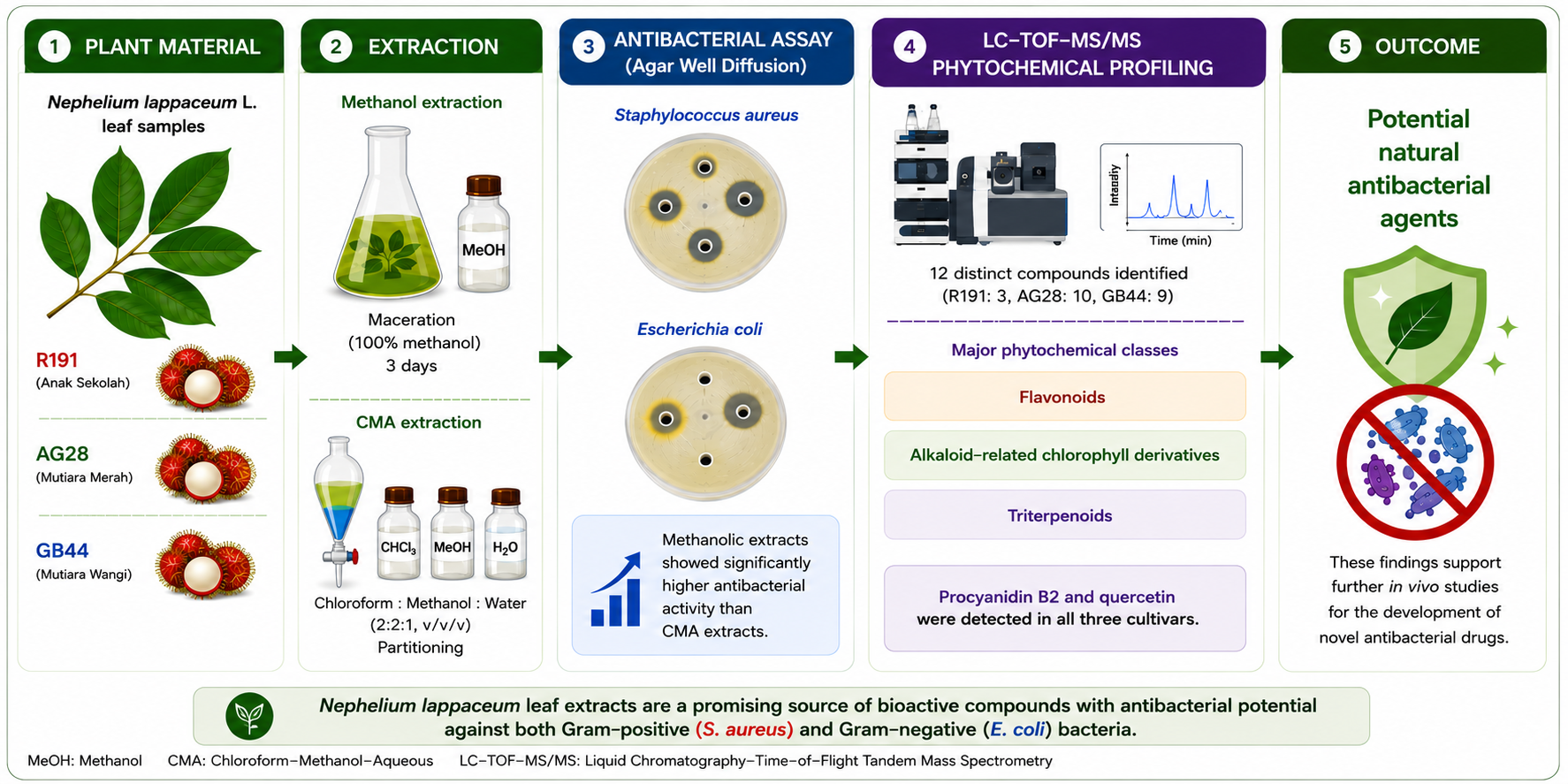
Medicinal plants are a valuable source of pharmaceuticals, as their phytochemical constituents exhibit diverse biological activities with fewer side effects and lower possibility of resistance development compared to synthetic drugs. This study investigated the antibacterial properties of methanolic and chloroform-methanol-water (CMA) extracts from the leaves of Nephelium lappaceum L. from three cultivars - R191, AG28, and GB44 against Staphylococcus aureus and Escherichia coli, using agar well diffusion method. The methanolic extracts exhibited significantly higher antibacterial activity compared to CMA extracts. To tentatively identify metabolites potentially associated with the observed antibacterial activity, the methanolic extracts were analysed using LC-TOF-MS/MS techniques. The Liquid Chromatography-Time-of-Flight Mass Spectrometry/Mass Spectrometry (LC-TOF-MS/MS) analysis tentatively identified three, ten, and nine compounds in R191, AG28, and GB44 respectively, which were subsequently categorized as flavonoids, tryptophan alkaloids, and triterpenoids. Two compounds, Procyanidin B2, and Quercetin were detected in all extracts. These findings highlight the potential of N. lappaceum leaf extracts as a source of natural antibacterial agents and warrant further in vivo studies for the development of novel antibacterial drugs.
References
[1] N. Thitilertdecha, A. Teerawutgulrag, J. D. Kilburn, N. Rakariyatham, Molecules 15 (2010) 1453.
[2] H. Jantapaso, P. Mittraparp-Arthorn, Antioxidants 11 (2022) 862.
[3] J. L. Tsong, L. P. W. Goh, J. A. Gansau, S. E. How, Molecules 26 (2021) 6835.
[4] A. B. Ahmad-Khair, N. A. A. Razak, A. H. Buniamin, A. N. Shuid, F. A. Nordin, D. Shahbuddin, Pak. J. Bot. 56 (2024) 2285.
[5] T. R. Walsh, R. Zahra, K. Iregbu, S. J. Peacock, A. Stewardson, Lancet 399 (2022) 2347.
[6] K. Ibrahim, M. Tahsin, A. Rahman, S. M. Rahman, M. M. Rahman, Int. J. Environ. Res. Public Health 21 (2024) 612.
[7] S. Chigurupati, S. Vijayabalan, K. Krishnan Selvarajan, N. E. Hashish, V. Mani, E. Sayed Ahmed, S. Das, Indian J. Tradit. Knowl. 18 (2019) 360.
[8] J. Azmir, I. S. M. Zaidul, M. M. Rahman, K. M. Sharif, A. Mohamed, F. Sahena, M. H. A. Jahurul, K. Ghafoor, N. A. M. Norulaini, A. K. M. Omar, J. Food Eng. 117 (2013) 426.
[9] R. t’Kindt, K. Morreel, D. Deforce, W. Boerjan, J. Van Bocxlaer, J. Chromatogr. B 877 (2009) 3572.
[10] J. L. Wolfender, M. Litaudon, D. Touboul, E. F. Queiroz, Nat. Prod. Rep. 36 (2019) 855.
[11] C. Kehelpannala, T. W. T. Rupasinghe, T. Hennessy, D. Bradley, B. Ebert, U. Roessner, Plant Methods 16 (2020) 155.
[12] O. Solomon, N. Isaac, Open Microbiol. J. 12 (2018) 397.
[13] N. Gurnani, D. Mehta, B. Kumar Mehta, M. Gupta, R. Shrivastava, Indian J. Nat. Prod. Resour. 7 (2016) 32.
[14] S. F. Mamat, K. A. Azizan, S. N. Baharum, N. M. Noor, W. M. Aizat, Data Brief 17 (2018) 1074.
[15] N. Thitilertdecha, A. Teerawutgulrag, N. Rakariyatham, LWT - Food Sci. Technol. 41 (2008) 2029.
[16] R. S. Bhat, S. Al-daihan, J. King Saud Univ. Sci. 26 (2014) 79.
[17] C. Penna, S. Marino, E. Vivot, M. C. Cruañes, J. De Muñoz, D. Cruañes, G. Ferraro, G. Gutkind, V. Martino, J. Ethnopharmacol. 77 (2001) 37.
[18] D. Ma, Y. Guo, I. Ali, J. Lin, Y. Xu, M. Yang, Plant Physiol. Biochem. 215 (2024) 108960.
[19] P. Pant, S. Pandey, S. Dall'Acqua, Chem. Biodivers. 18 (2021) e2100345.
[20] T. Isah, Biol. Res. 52 (2019) 39.
[21] M. Wink, Phytochemistry 64 (2003) 3.
[22] Y. Xie, W. Yang, F. Tang, X. Chen, L. Ren, Curr. Med. Chem. 22 (2015) 132.
[23] G. Selvaraj, S. Kaliamurthi, R. Thirungnasambandam, L. Vivekanandan, T. Balasubramanian, Biomed. Environ. Sci. 27 (2014) 295.
[24] A. Nile, S. H. Nile, C. L. Cespedes-Acuña, J.-W. Oh, Food Chem. Toxicol. 154 (2021) 112327.
[25] N. Vaou, E. Stavropoulou, C. Voidarou, C. Tsigalou, E. Bezirtzoglou, Microorganisms 9 (2021) 2041.
[26] H. Schroeter, C. Heiss, J. Balzer, P. Kleinbongard, C. L. Keen, N. K. Hollenberg, H. Sies, C. Kwik-Uribe, H. H. Schmitz, M. Kelm, Proc. Natl. Acad. Sci. U.S.A. 103 (2006) 1024.
[27] S. Kim, H. Lee, S. Lee, Y. Yoon, K.-H. Choi, PLoS ONE 10 (2015) e0118800.
[28] T. A. K. Prescott, L. P. Rigby, N. C. Veitch, M. S. J. Simmonds, Phytochemistry 101 (2014) 116.
[29] I. Sifaoui, A. López-Arencibia, C. M. Martín-Navarro, M. Reyes-Batlle, M. Mejri, B. Valladares, J. Lorenzo-Morales, M. Abderabba, J. E. Piñero, Iran. J. Pharm. Res. 16 (2017) 1190.
[30] P. Muthenna, G. Raghu, P. A. Kumar, M. V. Surekha, G. B. Reddy, Chem. Biol. Interact. 222 (2014) 68.
[31] T. L. A. Nguyen, D. Bhattacharya, Molecules 27 (2022) 2494.
[32] C. Wang, Z. Qu, L. Kong, L. Xu, M. Zhang, J. Liu, Z. Yang, Exp. Mol. Pathol. 108 (2019) 1.
Downloads
Published
Issue
Section
License
Copyright (c) 2026 Dahlia Shahbuddin, Leow Yen Ling, Mohamad Nurul Azmi Mohamad Taib, Munirah Shahbuddin, Husna Zulkipli

This work is licensed under a Creative Commons Attribution-NonCommercial 4.0 International License.