Phytochemical Composition, Antioxidant Potential and Antibacterial Efficacy of Cucumis melo L., Citrus sinensis, and Musa spp Peels Ecoenzyme
DOI:
https://doi.org/10.11113/mjfas.v22n4.5429Keywords:
Ecoenzyme, FRAP assay, phytochemical screening, Antibacteria activity, sustainable agricultureAbstract
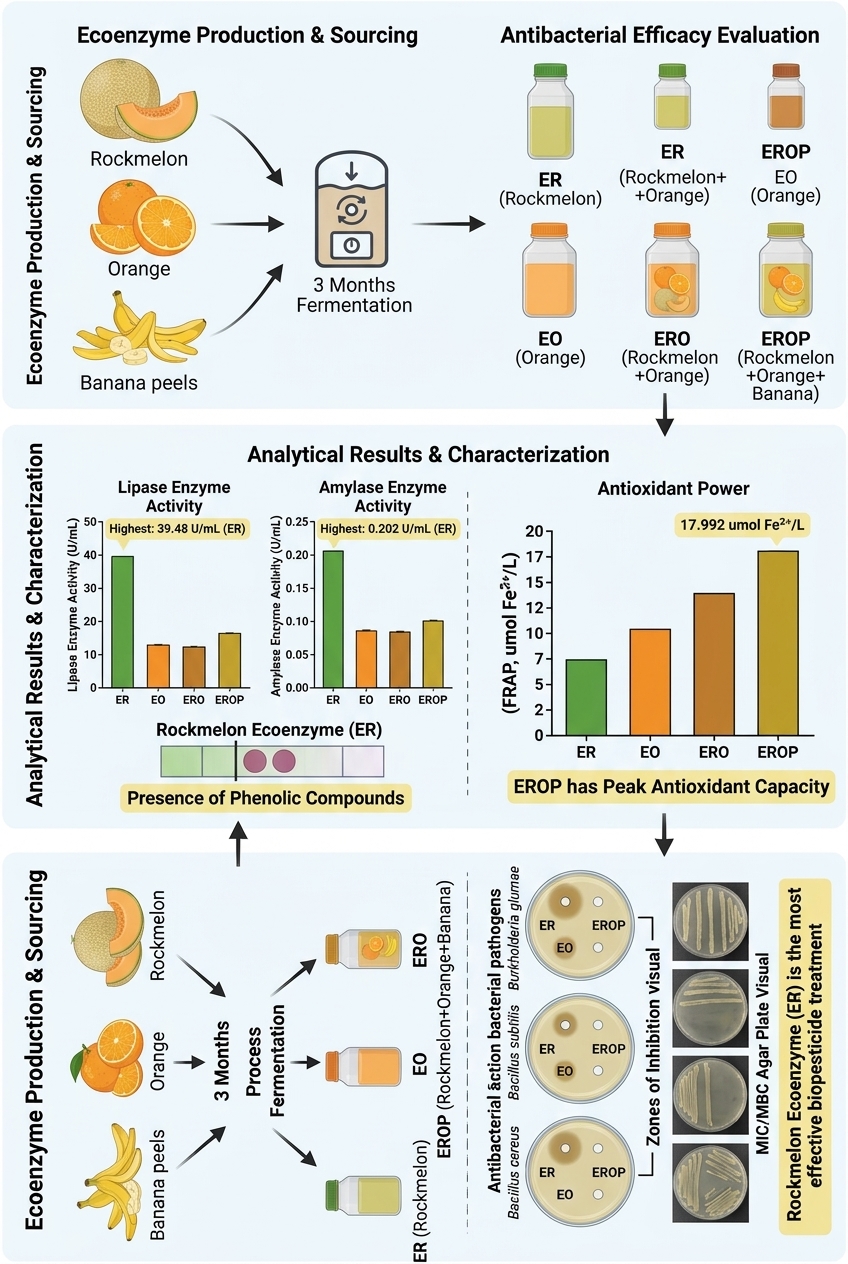
Fruit peel waste offers an eco-friendly alternative to synthetic pesticides for bacterial disease management.This study evaluated Rokmelon (Cucumis melo L.), Orange (Citrus sinensis), and Banana (Musa spp.) peels for their phytochemical composition, enzymatic activity such as amylase and lipase, antioxidant capacity using Ferric Reducing Antioxidant Power (FRAP) assay, and antibacterial efficacy against Burkholderia glumae, Bacillus cereus, and Bacillus subtilis using agar well diffusion, Minimum Inhibitory Concentration (MIC) and Minimum Bactericidal Concentration (MBC) assays. Rockmelon ecoenzyme (ER) showed the highest bioactivity with lipase (39.48 U/mL) and amylase (0.202 U/mL) activity. Phytochemical screening showed that phenolic compounds were strongly present (++) only in the rockmelon-based ecoenzyme (ER), but absent (–) in EO, ERO, and EROP samples. Meanwhile for flavonoids and alkaloids, each sample shows (+) result. The mixed formulation of rockmelon, orange and banana (EROP) exhibited peak antioxidant activity (17.992 μmol Fe²⁺/L). Antibacterial assays revealed rockmelon ecoenzyme (ER) as the most effective. ER demonstrated strongest activity against B. glumae (19.67 mm ZOI, p=0.014; MIC=4.17% v/v, MBC=8.33% v/v). All treatments showed significant antibacterial effects versus controls (p<0.05). The results demonstrate that single-fruit ecoenzymes, particularly from rockmelon, outperform mixed formulations and exhibit reliable antibacterial activity against key plantation pathogens. These findings support the use of fruit peel-derived ecoenzymes as sustainable, effective alternatives to chemical pesticides in plantation management.
References
[1] M. Tudi et al., “Agriculture Development, Pesticide Application and Its Impact on the Environment,” Int. J. Environ. Res. Public Health, vol. 18, no. 3, p. 1112, Jan. 2021, doi: 10.3390/ijerph18031112.
[2] S. Raheem, A. Ali, M. Al-Saffar, Z. Ayad, and O. Hadi, “Antibacterial activity of orange peel extract against Staphylococcus aureus in vitro,” Open Vet. J., vol. 15, no. 12, p. 6224, 2025, doi: 10.5455/OVJ.2025.v15.i12.6.
[3] W. A. Abdel Wahab, S. A. Ahmed, A. M. M. Kholif, S. Abd El Ghani, and H. R. Wehaidy, “Rice straw and orange peel wastes as cheap and eco-friendly substrates: A new approach in β-galactosidase (lactase) enzyme production by the new isolate L. paracasei MK852178 to produce low-lactose yogurt for lactose-intolerant people,” Waste Management, vol. 131, pp. 403–411, Jul. 2021, doi: 10.1016/j.wasman.2021.06.028.
[4] R. Kaushik, S. Morya, O. Bashir, J. H. Bhadha, and L. M. Kasankala, “Valorization of Fruit Waste Through Reutilization Approach: A Comprehensive Review,” eFood, vol. 6, no. 4, Aug. 2025, doi: 10.1002/efd2.70073.
[5] Y. Du et al., “Whole Genome Sequencing Reveals Novel Insights about the Biocontrol Potential of Burkholderia ambifaria CF3 on Atractylodes lancea,” Microorganisms, vol. 12, no. 6, p. 1043, May 2024, doi: 10.3390/microorganisms12061043.
[6] F. Saeed et al., “Comparative study of nutritional composition, antioxidant activity and functional properties of Cucumis melo and Citrullus lanatus seeds powder,” Cogent Food Agric., vol. 10, no. 1, Dec. 2024, doi: 10.1080/23311932.2023.2293517.
[7] R. Gómez-García, D. A. Campos, C. N. Aguilar, A. R. Madureira, and M. Pintado, “Valorization of melon fruit (Cucumis melo L.) by-products: Phytochemical and Biofunctional properties with Emphasis on Recent Trends and Advances,” Trends Food Sci. Technol., vol. 99, pp. 507–519, May 2020, doi: 10.1016/j.tifs.2020.03.033.
[8] N. Durmus, Z. Gulsunoglu‐Konuskan, and M. Kilic‐Akyilmaz, “Recovery, Bioactivity, and Utilization of Bioactive Phenolic Compounds in Citrus Peel,” Food Sci. Nutr., vol. 12, no. 12, pp. 9974–9997, Dec. 2024, doi: 10.1002/fsn3.4570.
[9] M. G. Shehata, T. S. Awad, D. Asker, S. A. El Sohaimy, N. M. Abd El- Aziz, and M. M. Youssef, “Antioxidant and antimicrobial activities and UPLC-ESI-MS/MS polyphenolic profile of sweet orange peel extracts,” Curr. Res. Food Sci., vol. 4, pp. 326–335, 2021, doi: 10.1016/j.crfs.2021.05.001.
[10] E. A. Ali, D. M. Mohammed, F. A. El Gawad, M. A. Orabi, R. K. Gupta, and P. P. Srivastav, “Valorization of food processing waste byproducts for essential oil production and their application in food system,” Waste Management Bulletin, vol. 3, no. 3, p. 100200, Sep. 2025, doi: 10.1016/j.wmb.2025.100200.
[11] P. C. Bhargava, N. Kamal, D. Chaurasia, S. Singh, and A. Singh, “Agro-Residues’ Waste to Wealth for a Circular Economy and Sustainable Development,” in Waste-to-Wealth: Resource Recovery and Value-Added Products for Sustainable Development, CRC Press, 2024, pp. 200–217. doi: 10.1201/9781003327646-14.
[12] B. O. Oyeyinka and A. J. Afolayan, “Potentials of Musa Species Fruits against Oxidative Stress-Induced and Diet-Linked Chronic Diseases: In Vitro and In Vivo Implications of Micronutritional Factors and Dietary Secondary Metabolite Compounds,” Molecules, vol. 25, no. 21, p. 5036, Oct. 2020, doi: 10.3390/molecules25215036.
[13] N. S. Mohd Zaini, N. Zainuddin, N. A. S. Ahmad Fauzi, M. A. R. Nor-Khaizura, and M. H. Abd Rahim, “Agricultural Waste–Derived Biofertilizers for Sustainable Mushroom Cultivation: A Case Study Using Banana Peel,” Malaysian Journal of Fundamental and Applied Sciences, vol. 21, no. 5, pp. 2747–2758, Nov. 2025, doi: 10.11113/mjfas.v21n5.3517.
[14] W. A. Alhemaid, E. E. Babiker, I. A. Mohamed Ahmed, and F. Y. Al Juhaimi, “Optimization of Some Quality Parameters of Functional Pumpkin Puree Enriched with Banana Peel Powder Using Response Surface Methodology,” Beverages, vol. 11, no. 4, p. 106, Jul. 2025, doi: 10.3390/beverages11040106.
[15] M. Hashim, A. Akbar, Z. Gul, M. Bilal Sadiq, J. Khan Achakzai, and N. Ahmad Khan, “Fermentation impact: A comparative study on the functional and biological properties of Banana peel waste,” Heliyon, vol. 10, no. 16, p. e36095, Aug. 2024, doi: 10.1016/j.heliyon.2024.e36095.
[16] T. F. Soares, R. C. Alves, and M. B. P. P. Oliveira, “Agri-Food Biowaste Bioactives for Biopesticides: A Circular Economy Solution with Industry 4.0?,” Molecules, vol. 31, no. 6, p. 996, Mar. 2026, doi: 10.3390/molecules31060996.
[17] M. Lobato-Gómez et al., “Valorization of transgenic Tomaffron-based products enriched in saffron apocarotenoids,” Food Chem., vol. 488, p. 144828, Oct. 2025, doi: 10.1016/j.foodchem.2025.144828.
[18] H. A. R. Suleria, C. J. Barrow, and F. R. Dunshea, “Screening and Characterization of Phenolic Compounds and Their Antioxidant Capacity in Different Fruit Peels,” Foods, vol. 9, no. 9, p. 1206, Sep. 2020, doi: 10.3390/foods9091206.
[19] N. Nirmal et al., “Valorization of Fruit Waste for Bioactive Compounds and Their Applications in the Food Industry,” Foods, vol. 12, no. 3, p. 556, Jan. 2023, doi: 10.3390/foods12030556.
[20] K. Fisher and C. Phillips, “Potential antimicrobial uses of essential oils in food: is citrus the answer?,” Trends Food Sci. Technol., vol. 19, no. 3, pp. 156–164, Mar. 2008, doi: 10.1016/j.tifs.2007.11.006.
[21] J. Ribeiro et al., “Phenolic Compounds from Pyrus communis Residues: Mechanisms of Antibacterial Action and Therapeutic Applications,” Antibiotics, vol. 14, no. 3, p. 280, Mar. 2025, doi: 10.3390/antibiotics14030280.
[22] V. Sharma et al., “Flavonoids as Antimicrobial Agents: A Comprehensive Review of Mechanisms and Therapeutic Potential,” Curr. Pharm. Biotechnol., vol. 26, Jul. 2025, doi: 10.2174/0113892010384002250628163849.
[23] P. C. Dathan, D. Nallaswamy, S. Rajeshkumar, S. Joseph, S. Ismail, and N. Rashid, “Evaluation of Anti-inflammatory, Antioxidant and Antimicrobial Activity of Pomegranate Peel Extract: An In-vitro Study,” Journal of Clinical and Diagnostic Research, 2024, doi: 10.7860/JCDR/2024/69878.19463.
[24] R. Suhag et al., “Fruit peel bioactives, valorisation into nanoparticles and potential applications: A review,” Crit. Rev. Food Sci. Nutr., vol. 63, no. 24, pp. 6757–6776, Sep. 2023, doi: 10.1080/10408398.2022.2043237.
[25] O. O.V., O. F.L., O. B.I., S. D.M., and D. V. M., “Exploring the Therapeutic Potential of Bromelain from Pineapple Fruit Peel: Enzymatic Activity and Antibiotic Synergy,” Int. J. Biochem. Res. Rev., vol. 34, no. 3, pp. 118–127, May 2025, doi: 10.9734/ijbcrr/2025/v34i3991.
[26] A. Abbasi et al., “Comparative Assessment of Phenolic Content and in Vitro Antioxidant Capacity in the Pulp and Peel of Mango Cultivars,” Int. J. Mol. Sci., vol. 16, no. 6, pp. 13507–13527, Jun. 2015, doi: 10.3390/ijms160613507.
[27] U. Y. Bandara, C. Witharana, and P. Soysa, “Extraction, Total phenol Content, Flavonoid content, Free Radical Scavenging Capacity and phytochemical screening of the Parts of Sri Lankan Pomegranate (Punica granatum L.) Fruit,” Curr. Trends Biotechnol. Pharm., vol. 14, no. 1, pp. 70–80, Jan. 2020, doi: 10.5530/ctbp.2020.1.8.
[28] R. K. Saini et al., “Bioactive Compounds of Citrus Fruits: A Review of Composition and Health Benefits of Carotenoids, Flavonoids, Limonoids, and Terpenes,” Antioxidants, vol. 11, no. 2, p. 239, Jan. 2022, doi: 10.3390/antiox11020239.
[29] H. A. R. Suleria, C. J. Barrow, and F. R. Dunshea, “Screening and Characterization of Phenolic Compounds and Their Antioxidant Capacity in Different Fruit Peels,” Foods, vol. 9, no. 9, p. 1206, Sep. 2020, doi: 10.3390/foods9091206.
[30] P. A. N. K. Permatananda, I. G. S. Pandit, D. P. C. Udiyani, and Wimpy, “Antioxidant Activity Of Kintamani Siamese Orange Peel Extract (Citrus Nobilis) With Different Polar Solvent: An In Vitro Experimental Study,” Multidisciplinary Science Journal, vol. 6, no. 2, p. 2024020, Aug. 2023, doi: 10.31893/multiscience.2024020.
[31] S. A. S. Muhamad, B. Jamilah, A. R. Russly, and A. Faridah, “The antibacterial activities and chemical composition of extracts from Carica papaya cv. Sekaki/Hong Kong seed,” 2017.
[32] A. Sharma, L. Kumar, M. Malhotra, A. P. Singh, and A. P. Singh, “Ananas comosus (Pineapple): A Comprehensive Review of Its Medicinal Properties, Phytochemical Composition, and Pharmacological Activities,” Journal of Drug Delivery and Therapeutics, vol. 14, no. 5, pp. 148–157, May 2024, doi: 10.22270/jddt.v14i5.6557.
[33] L. A. Sivasamugham, V. Nimalan, and G. Subramaniam, “Antibacterial effects of Musa sp. ethanolic leaf extracts against methicillin-resistant and susceptible Staphylococcus aureus,” S. Afr. J. Chem. Eng., vol. 35, pp. 107–110, Jan. 2021, doi: 10.1016/j.sajce.2020.09.007.
[34] JD Buah, “Antibacteria Activities of Guava (Psidium guajava) and Orange (Citrus sinensis) Leaves Extracts on Staphylococcus aureus and Escherichia coli,” Sahel Journal of Life Sciences FUDMA, vol. 1, no. 1, pp. 130–136, Dec. 2023, doi: 10.33003/sajols-2023-0101-014.
[35] E. Scaglione et al., “Antimicrobial efficacy of Punica granatum Lythraceae peel extract against pathogens belonging to the ESKAPE group,” Front. Microbiol., vol. 15, Apr. 2024, doi: 10.3389/fmicb.2024.1383027.
[36] P. Rabiee, A. Faraz, S. Ajlouni, and M. A. Hussain, “Microbial Contamination and Disease Outbreaks Associated with Rockmelons (Cucumis melo): Implications for Public Health Protection,” Foods, vol. 13, no. 14, p. 2198, Jul. 2024, doi: 10.3390/foods13142198.
[37] I. Nurlatifah, D. Agustine, and E. Puspasari, “Production and Characterization of Eco-Enzyme from Fruit Peel Waste,” in Proceedings of the 1st International Conference on Social, Science, and Technology, ICSST 2021, 25 November 2021, Tangerang, Indonesia, EAI, 2022. doi: 10.4108/eai.25-11-2021.2318816.
[38] J. Julinar, D. Uswati, F. Riyanti, and E. Musifa, “Ecoenzyme Characterization of Fruit Peel Waste Mixture and Test of Antibacterial Activity against Bacteria Causing Dental Caries,” Indonesian Journal of Fundamental and Applied Chemistry, vol. 10, no. 3, pp. 186–197, Oct. 2025, doi: 10.24845/ijfac.v10.i3.186.
[39] D. A. SetiyaNingrum, E. D. Nutfindiani, Z. Margaretha, and M. R. S. Efendi, “The Implementation of FT-IR Method for Compound Detection in Eco-Enzyme Applied as Hydrogel Patch,” Indonesian Journal of Chemical Research, vol. 12, no. 1, pp. 55–63, May 2024, doi: 10.30598/ijcr.2024.12-set.
[40] A. H. Ramadani, R. Karima, and R. S. Ningrum, “Indonesian Journal of Chemical Research Antibacterial Activity of Pineapple Peel (Ananas comosus) Eco-enzyme Against Acne Bacteria (Staphylococcus aureus and Propionibacterium acnes),” J. Chem. Res, vol. 9, no. 3, pp. 201–207, 2022, doi: 10.30598//ijcr.
[41] K. Godlewska, P. Pacyga, A. Najda, and I. Michalak, “Investigation of Chemical Constituents and Antioxidant Activity of Biologically Active Plant-Derived Natural Products,” Molecules, vol. 28, no. 14, p. 5572, Jul. 2023, doi: 10.3390/molecules28145572.
[42] A. Itam, M. S. Wati, V. Agustin, N. Sabri, R. A. Jumanah, and M. Efdi, “Comparative Study of Phytochemical, Antioxidant, and Cytotoxic Activities and Phenolic Content of Syzygium aqueum (Burm. f. Alston f.) Extracts Growing in West Sumatera Indonesia,” The Scientific World Journal, vol. 2021, pp. 1–9, Jun. 2021, doi: 10.1155/2021/5537597.
[43] M. Spiegel et al., “Antioxidant Activity of Selected Phenolic Acids–Ferric Reducing Antioxidant Power Assay and QSAR Analysis of the Structural Features,” Molecules, vol. 25, no. 13, p. 3088, Jul. 2020, doi: 10.3390/molecules25133088.
[44] T. E. Tallei et al., “Antibacterial and Antioxidant Activity of Ecoenzyme Solution Prepared from Papaya, Pineapple, and Kasturi Orange Fruits: Experimental and Molecular Docking Studies,” J. Food Process. Preserv., vol. 2023, pp. 1–11, Mar. 2023, doi: 10.1155/2023/5826420.
[45] R. Hulankova, “Methods for Determination of Antimicrobial Activity of Essential Oils In Vitro—A Review,” Plants, vol. 13, no. 19, p. 2784, Oct. 2024, doi: 10.3390/plants13192784.
[46] G. G. Gumilar, “Ecoenzyme Production, Characteristics, and Applications: A Review,” Jurnal Kartika Kimia, vol. 6, no. 1, Jun. 2023, doi: 10.26874/jkk.v6i1.186.
[47] S. Sethi, “Agro waste based adsorbents: Application in cleaning of pharmaceuticals and personal care products from wastewater,” in Development in Wastewater Treatment Research and Processes, Elsevier, 2024, pp. 115–140. doi: 10.1016/B978-0-443-19207-4.00006-9.
[48] N. Benny, R. Shams, K. K. Dash, V. K. Pandey, and O. Bashir, “Recent trends in utilization of citrus fruits in production of eco-enzyme,” J. Agric. Food Res., vol. 13, p. 100657, Sep. 2023, doi: 10.1016/j.jafr.2023.100657.
[49] H. Triyatdipa, A. Agustien, and M. Marlina, “A Analysis of Ecoenzyme Characteristics from Combination of Fruit Peel Waste,” Biospecies, vol. 18, no. 2, pp. 11–19, Jul. 2025, doi: 10.22437/biospecies.v18i2.44214.
[50] L. Ode Sumarlin, D. Mulyadi, and Y. Asmara, “Identifikasi Potensi Enzim Lipase dan Selulase pada Sampah Kulit Buah Hasil Fermentasi (Identification of Potential Lipase and Cellulase on Waste of Skin Fruit by Fermentation),” 2013.
[51] S. A. S. Muhamad, B. Jamilah, A. R. Russly, and A. Faridah, “The antibacterial activities and chemical composition of extracts from Carica papaya cv. Sekaki/Hong Kong seed,” 2017.
[52] M. Venetikidou et al., “Proteolytic Enzyme Activities of Bromelain, Ficin, and Papain from Fruit By-Products and Potential Applications in Sustainable and Functional Cosmetics for Skincare,” Applied Sciences, vol. 15, no. 5, p. 2637, Feb. 2025, doi: 10.3390/app15052637.
[53] “Characterization and Enzymatic Evaluation of Ecoenzyme Derived from Fruit and Vegetable Waste: An Effort to Achieve Zero Waste Concept,” Baghdad Science Journal, 2024, doi: 10.21123/bsj.2024.10707.
[54] A. da S. Pereira, G. C. Fontes-Sant’Ana, and P. F. F. Amaral, “Mango agro-industrial wastes for lipase production from Yarrowia lipolytica and the potential of the fermented solid as a biocatalyst,” Food and Bioproducts Processing, vol. 115, pp. 68–77, May 2019, doi: 10.1016/j.fbp.2019.02.002.
[55] M. Venetikidou et al., “Proteolytic Enzyme Activities of Bromelain, Ficin, and Papain from Fruit By-Products and Potential Applications in Sustainable and Functional Cosmetics for Skincare,” Applied Sciences, vol. 15, no. 5, p. 2637, Feb. 2025, doi: 10.3390/app15052637.
[56] A. Kiran et al., “Using fruit peel as a substrate for the isolation, biosynthesis, and optimization of glucoamylase by Bacillus sp. under submerged fermentation,” Italian Journal of Food Science, vol. 37, no. 4, pp. 139–148, Oct. 2025, doi: 10.15586/ijfs.v37i4.3051.
[57] B. Samantaray, S. Mohapatra, R. R. Mishra, B. C. Behera, and H. Thatoi, “Bioethanol production from agro-wastes: a comprehensive review with a focus on pretreatment, enzymatic hydrolysis, and fermentation,” Int. J. Green Energy, vol. 21, no. 6, pp. 1398–1424, May 2024, doi: 10.1080/15435075.2023.2253871.
[58] B. Yilmaz et al., “The Impacts of Lactiplantibacillus plantarum on the Functional Properties of Fermented Foods: A Review of Current Knowledge,” Microorganisms, vol. 10, no. 4, p. 826, Apr. 2022, doi: 10.3390/microorganisms10040826.
[59] S. Šafranko, D. Šubarić, I. Jerković, and S. Jokić, “Citrus By-Products as a Valuable Source of Biologically Active Compounds with Promising Pharmaceutical, Biological and Biomedical Potential,” Pharmaceuticals, vol. 16, no. 8, p. 1081, Jul. 2023, doi: 10.3390/ph16081081.
[60] H. Baati, M. Siala, C. Azri, E. Ammar, and M. Trigui, “Hydrolytic enzyme screening and carotenoid production evaluation of halophilic archaea isolated from highly heavy metal-enriched solar saltern sediments,” Brazilian Journal of Microbiology, vol. 53, no. 4, pp. 1893–1906, Dec. 2022, doi: 10.1007/s42770-022-00855-6.
[61] B. Samantaray, S. Mohapatra, R. R. Mishra, B. C. Behera, and H. Thatoi, “Bioethanol production from agro-wastes: a comprehensive review with a focus on pretreatment, enzymatic hydrolysis, and fermentation,” Int. J. Green Energy, vol. 21, no. 6, pp. 1398–1424, May 2024, doi: 10.1080/15435075.2023.2253871.
[62] M. E. Sá et al., “Compositional analysis of melon seeds: Insights into the development of sustainable value-added products,” Bioresources, vol. 20, no. 4, pp. 10872–10892, Oct. 2025, doi: 10.15376/biores.20.4.10872-10892.
[63] A. Hussain et al., “Physicochemical and phytochemical analysis of three melon fruit (canary melon, watermelon, and muskmelon) peels, and their valorization in biscuits development,” Front. Sustain. Food Syst., vol. 8, Sep. 2024, doi: 10.3389/fsufs.2024.1444017.
[64] N. Morsy, “Phytochemical analysis of biologically active constituents of medicinal plants,” Main Group Chemistry, vol. 13, no. 1, pp. 7–21, Feb. 2014, doi: 10.3233/MGC-130117.
[65] Z. Liu et al., “Development of Phenolic-Rich Functional Foods by Lactic Fermentation of Grape Marc: A Review,” Food Reviews International, vol. 40, no. 6, pp. 1756–1775, Aug. 2024, doi: 10.1080/87559129.2023.2230278.
[66] R. Gómez-García, D. A. Campos, C. N. Aguilar, A. R. Madureira, and M. Pintado, “Valorization of melon fruit (Cucumis melo L.) by-products: Phytochemical and Biofunctional properties with Emphasis on Recent Trends and Advances,” Trends Food Sci. Technol., vol. 99, pp. 507–519, May 2020, doi: 10.1016/j.tifs.2020.03.033.
[67] P. Nannipieri, L. Giagnoni, L. Landi, and G. Renella, “Role of Phosphatase Enzymes in Soil,” 2011, pp. 215–243. doi: 10.1007/978-3-642-15271-9_9.
[68] A. H. Ghazali, S. A. Ariffin, W. Z. Wan Mohd Zain, N. Windayani, and F. Salim, “HPLC quantification of bioactives and antioxidant activity in whey kefir-enriched ecoenzyme from rockmelon (Cucumis melo) and orange (Citrus sinensis) peels,” Asia Pacific Journal of Molecular Biology and Biotechnology, pp. 23–31, Jun. 2025, doi: 10.35118/apjmbb.2025.033.2(Special).03.
[69] T. C. Vianna et al., “Incorporation of Limonene Oligomers into Poly(itaconic acid)/Starch Blend Films for Antimicrobial and Antioxidant Packaging Applications,” ACS Sustain. Chem. Eng., vol. 12, no. 23, pp. 8752–8764, Jun. 2024, doi: 10.1021/acssuschemeng.4c01406.
[70] Z. Breijyeh, B. Jubeh, and R. Karaman, “Resistance of Gram-Negative Bacteria to Current Antibacterial Agents and Approaches to Resolve It,” Molecules, vol. 25, no. 6, p. 1340, Mar. 2020, doi: 10.3390/molecules25061340.
[71] V. Sharma, A. Sheershwal, and S. Bisht, “Rhizobacteria Revolution: Amplifying Crop Resilience and Yield in a Changing Climate Through Plant Growth Promotion,” J. Basic Microbiol., vol. 65, no. 9, Sep. 2025, doi: 10.1002/jobm.70039.
[72] W. Thongphichai, V. Pongkittiphan, A. Laorpaksa, W. Wiwatcharakornkul, and S. Sukrong, “Antimicrobial Activity against Foodborne Pathogens and Antioxidant Activity of Plant Leaves Traditionally Used as Food Packaging,” Foods, vol. 12, no. 12, p. 2409, Jun. 2023, doi: 10.3390/foods12122409.
[73] M. Draveny and M. Masi, “Targeting of the Gram-Negative Outer Membrane for Antibiotic Discovery and Potentiation,” ACS Infect. Dis., vol. 12, no. 3, pp. 1010–1023, Mar. 2026, doi: 10.1021/acsinfecdis.5c01108.
[74] H. A. K. Mavani et al., “Antimicrobial Efficacy of Fruit Peels Eco-Enzyme against Enterococcus faecalis: An In Vitro Study,” Int. J. Environ. Res. Public Health, vol. 17, no. 14, p. 5107, Jul. 2020, doi: 10.3390/ijerph17145107.
[75] R. Oktiansyah and U. H. Habısukan, “The bioactivities of ecoenzymes derived from fruit peels and their secondary metabolites,” International Journal of Secondary Metabolite, vol. 13, no. 1, pp. 263–272, Mar. 2026, doi: 10.21448/ijsm.1707893.
[76] A. Mohammad, S. A. Ariffin, A. H. Ghazali, and W. Z. W. M. Zain, “Biological application of fruit peels fermentation: A sustainable approach to biomedical,” Bioresource Technology Reports, vol. 33, Feb. 2026. doi: 10.1016/j.biteb.2026.102589.
[77] N. Benny, R. Shams, K. K. Dash, V. K. Pandey, and O. Bashir, “Recent trends in utilization of citrus fruits in production of eco-enzyme,” J. Agric. Food Res., vol. 13, p. 100657, Sep. 2023, doi: 10.1016/j.jafr.2023.100657.
[78] J. Julinar, D. Uswati, F. Riyanti, and E. Musifa, “Ecoenzyme Characterization of Fruit Peel Waste Mixture and Test of Antibacterial Activity against Bacteria Causing Dental Caries,” Indonesian Journal of Fundamental and Applied Chemistry, vol. 10, no. 3, pp. 186–197, Oct. 2025, doi: 10.24845/ijfac.v10.i3.186.
[79] S. C. Das et al., “Evaluating the biocatalytic potential of fruit peel-derived eco-enzymes for sustainable textile wastewater treatment,” Results in Engineering, vol. 21, p. 101898, Mar. 2024, doi: 10.1016/j.rineng.2024.101898.
Downloads
Published
Issue
Section
License
Copyright (c) 2026 Amyra Hazwani Ghazali, Wan Zuraida, Fatien Pawatang, AFIQAH MOHAMMAD, SITI ALWANI ARIFFIN

This work is licensed under a Creative Commons Attribution-NonCommercial 4.0 International License.