Natural Control of MRSA: Antibacterial and Virulence Gene Modulatory Effects of Persicaria minor Aqueous Extract
DOI:
https://doi.org/10.11113/mjfas.v22n4.5428Keywords:
medicinal plant, natural therapeutic agents, antimicrobial resistance bacteria, virulence genes, resistance genesAbstract
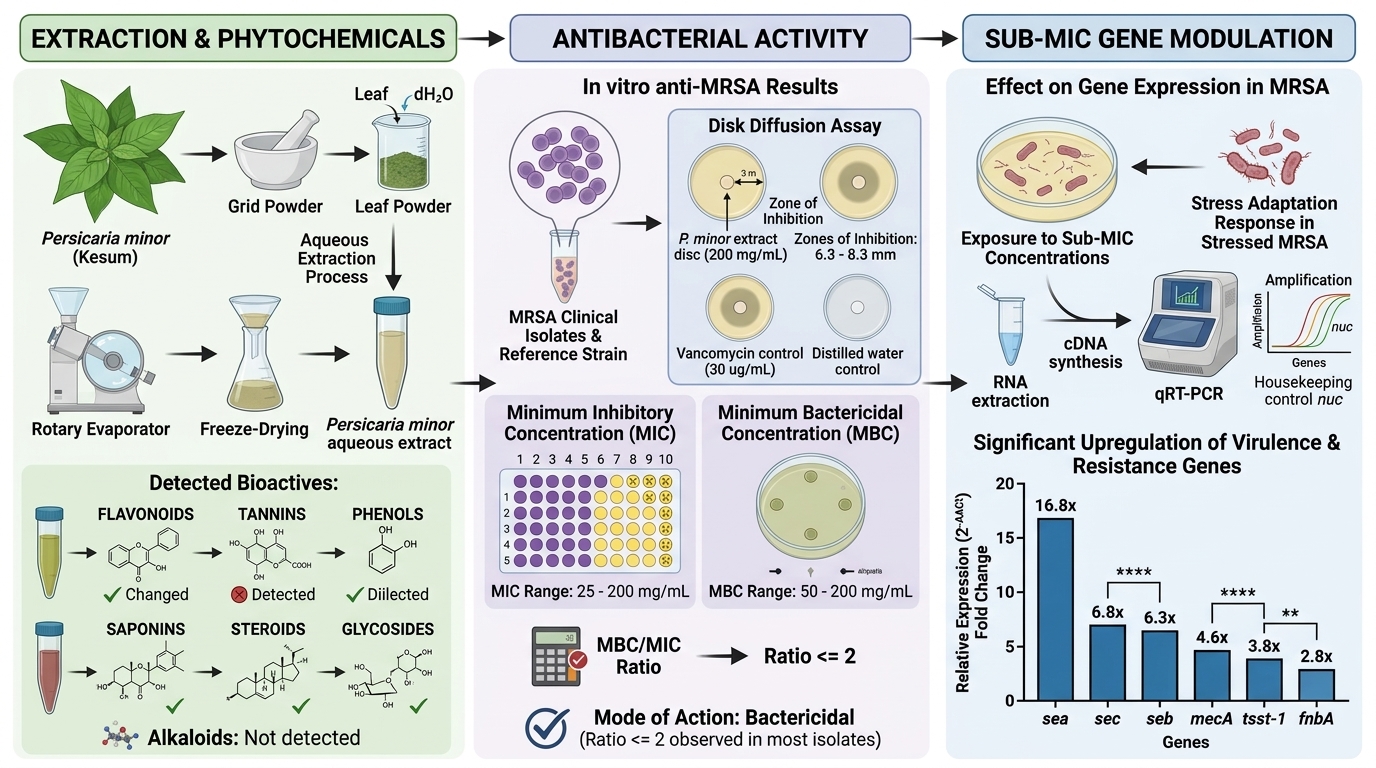
The emergence of antibiotic-resistant bacteria, particularly methicillin-resistant Staphylococcus aureus (MRSA), poses a major public health challenge and highlights the urgent need for alternative antimicrobial agents. Persicaria minor, a medicinal plant widely used in traditional medicine, is known to contain diverse bioactive phytochemicals with potential antimicrobial properties. This study evaluated the phytochemical composition, antibacterial activity, and effects on gene expression of the aqueous extract of P. minor against clinical MRSA isolates. Qualitative phytochemical screening revealed the presence of saponins, steroids, tannins, flavonoids, phenols, and glycosides, whereas alkaloids were not detected. Antibacterial activity was assessed against eight clinical MRSA isolates and Staphylococcus aureus ATCC 25923 using disk diffusion, minimum inhibitory concentration (MIC), and minimum bactericidal concentration (MBC) assays. The extract produced inhibition zones ranging from 6.3 to 8.3 mm, with MIC values between 25 and 200 mg/mL and MBC values ranging from 50 to 200 mg/mL. An MBC/MIC ratio of 2 observed in most isolates suggested a bactericidal mode of action. Quantitative real-time PCR (qRT-PCR) analysis demonstrated significant upregulation of virulence-associated genes (sea, seb, sec, tsst-1, and fnbA) and the methicillin resistance gene (mecA) following exposure to sub-MIC concentrations of the extract. The highest expression was observed for sea (16.8-fold), followed by sec (6.8-fold), seb (6.3-fold), mecA (4.6-fold), tsst-1 (3.8-fold), and fnbA (2.8-fold). These findings suggest that although P. minor aqueous extract exhibits measurable anti-MRSA activity, sub-inhibitory concentrations may induce bacterial stress-adaptation responses associated with virulence and resistance. Further studies are required to isolate the active compounds, investigate the molecular mechanisms involved, and evaluate the in vivo efficacy and safety of the extract before its development as a potential natural antimicrobial agent.
References
[1] National Cancer Institute, NCI Dictionary of Cancer Terms: Antibacterial, National Cancer Institute, Bethesda, 2024.
[2] B.J. Werth, Overview of antibacterial medications, in: MSD Manual Professional Edition, MSD Manuals, Kenilworth, 2024.
[3] A.K. Yahya, N.Z. Abd Wahab, N. Ibrahim, Malays. J. Chem. 26 (2024) 123–136.
[4] A.K. Yahya, N.Z. Abd Wahab, M. Abdul Ghani, Malays. J. Med. Health Sci. 20 (2024) 262–272.
[5] N. Zainal, N.Z. Abd Wahab, M. Abdul Ghani, Malays. J. Med. Health Sci. 20 (2024) 252–261.
[6] N.Z. Abd Wahab, N. Ibrahim, Molecules 27 (2022) 4566.
[7] H.A. Hemeg, I.M. Moussa, S. Ibrahim, T.M. Dawoud, J.H. Alhaji, A.S. Mubarak, S.A. Kabli, R.A. Alsubki, A.M. Tawfik, S.A. Marouf, Saudi J. Biol. Sci. 27 (2020) 3221–3227.
[8] M.F. Asanai, N. Haron, S.N. Camalxaman, E. Mohamed, A.S. Rambely, Healthscope 3 (2020) 44–50.
[9] S. SeyedAlinaghi, E. Mehraeen, P. Mirzapour, S. Yarmohammadi, S. Dehghani, S. Zare, S. Gholami, N. Attarian, A. Abiri, F. Farahani Rad, A. Tabari, S. Afroughi, A. Gholipour, M.M. Roozbahani, S. Jahanfar, Eur. J. Med. Res. 30 (2025) 525.
[10] M. Che, C.C. Yeo, S.M. Puah, K.H. Chua, C.H. Chew, Antibiotics 8 (2019) 128.
[11] K. Sukri, N. Mohamed, I. Isahak, A. Marwan, Malays. J. Med. Health Sci. 19 (2023) 2636–2636.
[12] A.S. Lee, H. de Lencastre, J. Garau, J. Kluytmans, S. Malhotra-Kumar, A. Peschel, S. Harbarth, Nat. Rev. Dis. Primers 4 (2018) 33.
[13] Institute for Medical Research, National Antibiotic Resistance Surveillance Report (NSAR) 2023, Ministry of Health Malaysia, Kuala Lumpur, 2023.
[14] A.A. Abebe, A.G. Birhanu, Infect. Drug Resist. 16 (2023) 7641–7662.
[15] P. Angelini, Antibiotics 13 (2024) 746.
[16] N.Z. Abd Wahab, A.H.A. Abd Rahman, J. Pure Appl. Microbiol. 16 (2022) 2568–2575.
[17] N.Z. Abd Wahab, A. Azizul, N. Ibrahim, Iran. J. Microbiol. 12 (2020) 460–465.
[18] S. Haida, K. Bakkouche, A.R. Kribii, A. Kribii, Biochem. Res. Int. 2021 (2021) 6669877.
[19] N. Kancherla, A. Dhakshinamoorthi, K. Chitra, R.B. Komaram, Maedica 14 (2019) 350–356.
[20] D.A. Okuna, C.I. Nyamwange, H. Nyandieka, Kabarak J. Res. Innov. 14 (2024) 230–241.
[21] .Z. Abd Wahab, S.N.A. Noor Azam, S.M.S.F. Sayed Abdul Kadir, M.H. Abdullah, Trop. J. Nat. Prod. Res. 9 (2025) 14–23.
[22] N.Z. Abd Wahab, M.N. Maizatul Najwa Malza, Y. Rukayadi, Hayati J. Biosci. 31 (2024) 903–915.
[23] N.Z. Abd Wahab, S.M.S.F. Sayed Abdul Kadir, K.S. Kamal Rul Azrul, N.A.N. Mohd Yuseri, A.K. Yahya, F. Si Wei, M.H. Abdullah, Bacteria 5 (2026) 13.
[24] K.J. Livak, T.D. Schmittgen, Methods 25 (2001) 402–408.
[25] X. Huang, Z. Zhou, X. Lin, Biostat. Bioinforma. Biomath. 3 (2013) 71–80.
[26] I.I. Tatli Cankaya, E.I. Somuncuoglu, Evid.-Based Complement. Altern. Med. 2021 (2021) 6814215.
[27] L. Zhang, X. Huang, Z. Zhou, X. Lin, Y. Wang, Pharmaceutics 16 (2024) 170.
[28] Q. Huang, X. Liu, G. Zhao, T. Hu, Anim. Nutr. 4 (2018) 137–150.
[29] J.B. do Nascimento, J.G.M. da Costa, Int. J. Microbiol. 2025 (2025) 9961121.
[30] N.F. Shamsudin, Q.U. Ahmed, S. Mahmood, S.A. Ali Shah, A. Khatib, S. Mukhtar, M.A. Alsharif, H. Parveen, Z.A. Zakaria, Molecules 27 (2022) 1149.
[31] A. Lobiuc, N.E. Pavăl, I.I. Mangalagiu, R. Gheorghiță, G.C. Teliban, D. Amăriucăi-Mantu, V. Stoleru, Molecules 28 (2023) 1114.
[32] K. Rachwał, K. Gustaw, Appl. Sci. 15 (2025) 6774.
[33] B. Khameneh, M. Iranshahy, B.S. Fazly Bazzaz, Antibiotics 10 (2021) 1044.
[34] Y. Liu, J. Zhu, Z. Liu, Y. Zhi, C. Mei, H. Wang, Int. J. Mol. Sci. 26 (2025) 2455.
[35] J. Huang, M. Zaynab, Y. Sharif, J. Khan, R. Al-Yahyai, M. Sadder, M. Ali, S.R. Alarab, S. Li, Toxicon 247 (2024) 107812.
[36] B.M. Kyaw, S. Arora, C.S. Lim, Braz. J. Microbiol. 43 (2012) 938–945.
[37] R.D. Wojtyczka, M. Kępa, D. Idzik, R. Kubina, A. Kabała-Dzik, A. Dziedzic, J. Stojko, R. Stojko, T.J. Wasik, Molecules 18 (2013) 9623–9640.
[38] D.B. Whyte, The minimum bactericidal concentration of antibiotics, BMG Labtech, Ortenberg, 2024.
[39] H. Zhou, L. Chen, K. Ouyang, Q. Zhang, W. Wang, Front. Microbiol. 13 (2022) 1103476.
[40] M. Takó, E.B. Kerekes, C. Zambrano, A. Kotogán, T. Papp, J. Krisch, C. Vágvölgyi, Antioxidants 9 (2020) 165.
[41] E.T. Jeong, S.K. Park, D.M. Jo, F. Khan, T.H. Choi, T.M. Yoon, Y.M. Kim, J. Microbiol. Biotechnol. 31 (2021) 1288–1294.
[42] E. Viedma, D. Pérez-Montarelo, J. Villa, I. Muñoz-Gallego, N. Larrosa, N. Fernández-Hidalgo, J. Gavaldà, B. Almirante, F. Chaves, BMC Infect. Dis. 18 (2018) 177.
[43] J. Chen, H. Zhou, J. Huang, R. Zhang, X. Rao, J. Adv. Res. 31 (2021) 165–175.
[44] J. Schelin, Y.B. Susilo, S. Johler, Toxins 9 (2017) 401.
[45] X. Wu, H. Wang, J. Xiong, G.X. Yang, Biofilm 7 (2024) 100175.
[46] R. Touaitia, N. Ibrahim, E. Abdullah Almuqri, N.S. Basher, T. Idres, A. Touati, Toxins 17 (2025) 323.
[47] G. Ménard, C. Silard, M. Suriray, A. Rouillon, Y. Augagneur, Int. J. Mol. Sci. 23 (2022) 7346.
[48] K. Evans, A.R. Horswill, Microbiol. Mol. Biol. Rev. 84 (2020) e00026-19.
[49] J.J. Evans, D.D. Bolz, Curr. Opin. Infect. Dis. 32 (2019) 217–222.
[50] L. Chen, Z. Wang, T. Xu, H. Ge, F. Zhou, X. Zhu, X. Li, D. Qu, C. Zheng, Y. Wu, K. Zhao, Front. Microbiol. 12 (2021) 727104.
[51] B.L. Bilyk, V.V. Panchal, M. Tinajero-Trejo, J.K. Hobbs, S.J. Foster, Microbiol. Mol. Biol. Rev. 86 (2022) e00159-21.
[52] C. Jenul, A.R. Horswill, Microbiol. Spectr. 7 (2019) GPP3-0031-2018.
Downloads
Published
Issue
Section
License
Copyright (c) 2026 NOOR ZARINA ABD WAHAB

This work is licensed under a Creative Commons Attribution-NonCommercial 4.0 International License.