
The Diversity and Abundance of Bacterial Community in Pepper, the "King of Spices" (Piper nigrum)
DOI:
https://doi.org/10.11113/mjfas.v22n4.5381Keywords:
Plant-microbe interaction, 16S amplicon sequencing, rhizosphere microbiome, Piper nigrumAbstract
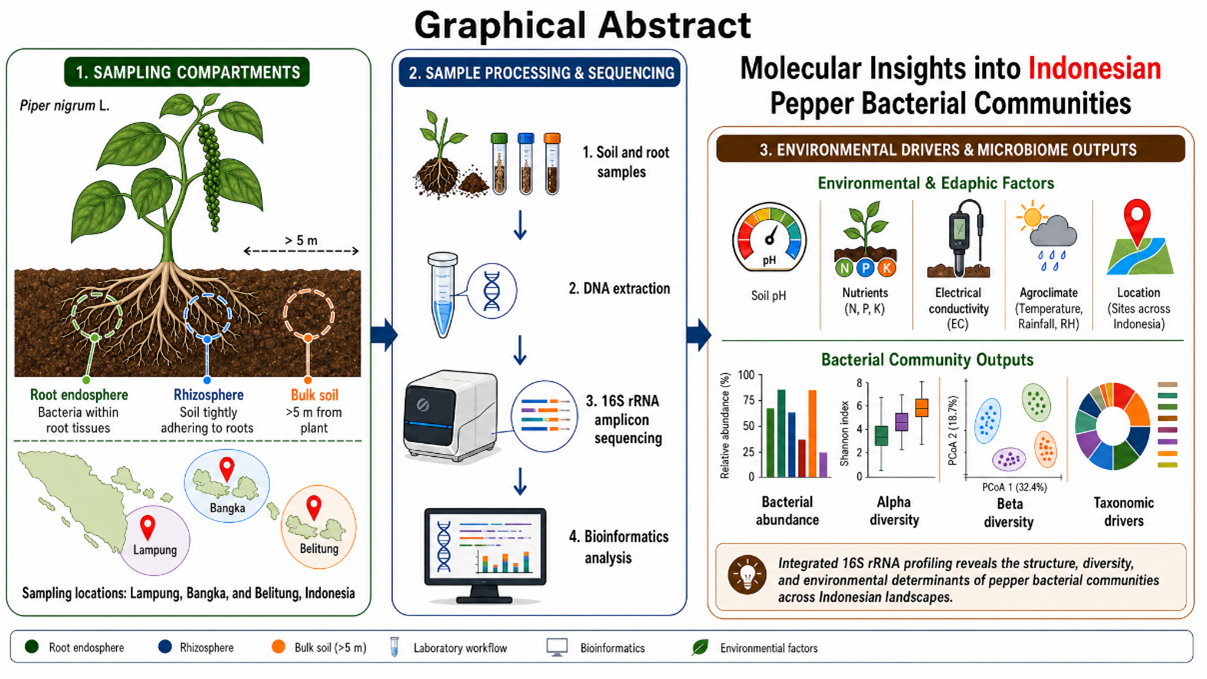
Pepper (Piper nigrum L.) is one of the most widely consumed spices. Indonesia has become a significant producer and exporter of high-quality pepper, known for its unique flavour. The interactions between plants and microbes have been widely studied. However, comprehensive information on Indonesian pepper biotic (microbiome) and abiotic (soil and climate) factors has not been reported in detail. This study investigated bacterial diversity, abundance, and community structure in pepper plantations from three major production regions—Lampung, Bangka, and Belitung—across root endosphere, rhizosphere, and bulk soil compartments using 16S rRNA gene amplicon sequencing of the V3–V4 region. Sequencing generated sufficient high-quality data, with final nonchimeric read counts ranging from 43,972 ± 2,564 to 66,171 ± 819 across sample groups. Soil properties differed among regions, with Lampung showing higher rhizosphere pH (6.00), NH₄ (11.91 ppm), K (106.24 ppm), Ca (2918.73 ppm), Mn (129.12 ppm), Cu (0.57 ppm), and Zn (1.32 ppm), whereas Bangka showed higher organic C (3.27%), total N (0.25%), EC (246.33 µS/cm), Fe (8.98 ppm), and Sn (5.656 ppm). A total of 25 bacterial phyla were detected, with Proteobacteria dominating root endosphere (60–78%) and rhizosphere samples (44–56%), while Acidobacteriota was more abundant in bulk soil (36–41%). At the genus level, Acinetobacter was enriched in plant-associated compartments, reaching approximately 68% in Rhizosphere_Lampung, 50% in Rhizosphere_Belitung, and 38% in Root EC_Bangka. Other dominant genera showed compartment- and location-specific patterns, including Enterobacter and Klebsiella in Root EC_Belitung, Burkholderia–Caballeronia–Paraburkholderia, Bacillus, and Chryseobacterium in Rhizosphere_Bangka, and Sinomonas and Acidothermus in bulk soil. Alpha diversity showed that the rhizosphere was the main hotspot of diversity, with median Observed ASVs of 810–860 and the highest shared richness among regions (258 ASVs). Weighted UniFrac PCoA revealed clear community separation, with PCoA1 and PCoA2 explaining 31.86% and 15.32% of variation, respectively. PCA and RDA further indicated that Proteobacteria, Acidobacteriota, Actinobacteriota, Chloroflexi, Acinetobacter, Chryseobacterium, Enterobacter, and Sinomonas contributed to bacterial community differentiation. These findings indicate that Indonesian pepper bacterial communities are structured by plant compartment and regional edaphic heterogeneity.
References
Andrews, J. H., & Harris, R. F. (2000). The ecology and biogeography of microorganisms on plant surfaces. Annual Review of Phytopathology 38(1):145–180.
Bellemain, E., Carlsen, T., Brochmann, C., Coissac, E., Taberlet, P., & Kauserud, H. (2010). ITS as an environmental DNA barcode for fungi: An in silico approach reveals potential PCR biases. BMC Microbiology 10:1–9.
Breidenbach, B., Pump, J., & Dumont, M. G. (2016). Microbial community structure in the rhizosphere of rice plants. Frontiers in Microbiology 6:1537.
Bulgarelli, D., Rott, M., Schlaeppi, K., Ver Loren van Themaat, E., Ahmadinejad, N., Assenza, F., Rauf, P., Huettel, B., Reinhardt, R., & Schmelzer, E. (2012). Revealing structure and assembly cues for Arabidopsis root-inhabiting bacterial microbiota. Nature 488(7409): 91–95.
Carrión, V. J., Perez-Jaramillo, J., Cordovez, V., Tracanna, V., De Hollander, M., Ruiz-Buck, D., Mendes, L. W., van Ijcken, W. F., Gomez-Exposito, R., & Elsayed, S. S. (2019). Pathogen-induced activation of disease-suppressive functions in the endophytic root microbiome. Science 366(6465):606–612.
Compant, S., Samad, A., Faist, H., & Sessitsch, A. (2019). A review on the plant microbiome: Ecology, functions, and emerging trends in microbial application. Journal of Advanced Research 19: 29–37.
Dastogeer, K. M., Tumpa, F. H., Sultana, A., Akter, M. A., & Chakraborty, A. (2020). Plant microbiome–an account of the factors that shape community composition and diversity. Current Plant Biology 23:100161.
Dawkins, K., & Esiobu, N. (2018). The invasive brazilian pepper tree (Schinus terebinthifolius) is colonized by a root microbiome enriched with Alphaproteobacteria and unclassified Spartobacteria. Frontiers in Microbiology 9:876.
Edet, U., Antai, S., Brooks, A., Asitok, A., Enya, O., & Japhet, F. (2017). An overview of cultural, molecular and metagenomic techniques in description of microbial diversity. Journal of Advances in Microbiology 7(2):1–19.
Edwards, J., Johnson, C., Santos-Medellín, C., Lurie, E., Podishetty, N. K., Bhatnagar, S., Eisen, J. A., & Sundaresan, V. (2015). Structure, variation, and assembly of the root-associated microbiomes of rice. Proceedings of the National Academy of Sciences 112(8):E911–E920.
Eviati, Sulaeman Y., Herawaty, L., Anggria, L., Usman, Tantika, H. E., Prihatini, R., & Wuningrum, P. (2023). Petunjuk Teknis Analisis Kimia Tanah, Tanaman, Air dan Pupuk (Technical Guidelines for Chemical Analysis of Soil, Plants, Water and Fertilizers). BPSI Tanah dan Pupuk. https://repository.pertanian.go.id/handle/123456789/24650.
Fadiji, A. E., Ayangbenro, A. S., & Babalola, O. O. (2021). Shotgun metagenomics reveals the functional diversity of root-associated endophytic microbiomes in maize plant. Current Plant Biology 25:100195.
Fadiji, A. E., & Babalola, O. O. (2020). Metagenomics methods for the study of plant-associated microbial communities: A review. Journal of Microbiological Methods 170:105860.
Fonseca-García, C., Coleman-Derr, D., Garrido, E., Visel, A., Tringe, S. G., & Partida-Martínez, L. P. (2016). The cacti microbiome: Interplay between habitat-filtering and host-specificity. Frontiers in Microbiology 7:150.
Ghabban, H., Albalawi, D. A., Al-Otaibi, A. S., Alshehri, D., Alenzi, A. M., Alatawy, M., Alatawi, H. A., Alnagar, D. K., & Bahieldin, A. (2024). Investigating the bacterial community of gray mangroves (Avicennia marina) in coastal areas of Tabuk region. Peer J 12:e18282.
Hameed, A., Yeh, M. W., Hsieh, Y. T., Chung, W. C., Lo, C. T., & Young, L.S. (2015). Diversity and functional characterization of bacterial endophytes dwelling in various rice (Oryza sativa L.) tissues, and their seed-borne dissemination into rhizosphere under gnotobiotic P-stress. Plant and Soil 394:177–197.
Hinsinger, P., Herrmann, L., Lesueur, D., Robin, A., Trap, J., Waithaisong, K., & Plassard, C. (2015). Impact of roots, microorganisms and microfauna on the fate of soil phosphorus in the rhizosphere. Annual Plant Reviews 48: Phosphorus Metabolism in Plants 48:375–407.
Jiang, X., Li, X., Yang, L., Liu, C., Wang, Q., Chi, W., & Zhu, H. (2019). How microbes shape their communities? A microbial community model based on functional genes. Genomics, Proteomics and Bioinformatics 17(1):91–105.
Kour, D., Rana, K. L., Yadav, N., Yadav, A. N., Kumar, A., Meena, V. S., Singh, B., Chauhan, V. S., Dhaliwal, H. S., & Saxena, A. K. (2019). Rhizospheric microbiomes: Biodiversity, mechanisms of plant growth promotion, and biotechnological applications for sustainable agriculture. Plant Growth Promoting Rhizobacteria for Agricultural Sustainability: From Theory to Practices. Springer, pp 19–65.
Lagos, L., Maruyama, F., Nannipieri, P., Mora, M., Ogram, A., & Jorquera, M. (2015). Current overview on the study of bacteria in the rhizosphere by modern molecular techniques: A mini‒review. Journal of Soil Science and Plant Nutrition 15(2):504–523.
Leggett, M. J., McDonnell, G., Denyer, S. P., Setlow, P., & Maillard, J. (2012). Bacterial spore structures and their protective role in biocide resistance. Journal of Applied Microbiology 113(3):485–498.
Li, X., Jousset, A., de Boer, W., Carrión, V. J., Zhang, T., Wang, X., & Kuramae, E. E. (2019). Legacy of land use history determines reprogramming of plant physiology by soil microbiome. The ISME Journal 13(3):738–751.
Martin, M. (2011). Cutadapt removes adapter sequences from high-throughput sequencing reads. EMBnet. Journal 17(1):10–12.
Naumoff, D. G., & Dedysh, S. N. (2012). Lateral gene transfer between the Bacteroidetes and Acidobacteria: The case of α-L-rhamnosidases. FEBS Letters 586(21):3843–3851.
Peiffer, J. A., Spor, A., Koren, O., Jin, Z., Tringe, S. G., Dangl, J. L., Buckler, E. S., & Ley, R. E. (2013). Diversity and heritability of the maize rhizosphere microbiome under field conditions. Proceedings of the National Academy of Sciences 110(16):6548–6553.
Philippot, L., Chenu, C., Kappler, A., Rillig, M. C., & Fierer, N. (2024). The interplay between microbial communities and soil properties. Nature Reviews Microbiology 22(4):226–239.
Prayoga, G. I., Ropalia, R., Aini, S. N., Mustikarini, E. D., & Rosalin, Y. (2020). Diversity of black pepper plant (Piper nigrum) in Bangka Island (Indonesia) based on agro-morphological characters. Biodiversitas Journal of Biological Diversity 21(2).
Rana, K. L., Kour, D., Kaur, T., Sheikh, I., Yadav, A. N., Kumar, V., Suman, A., & Dhaliwal, H. S. (2020). Endophytic microbes from diverse wheat genotypes and their potential biotechnological applications in plant growth promotion and nutrient uptake. Proceedings of the National Academy of Sciences, India Section B: Biological Sciences 90:969–979.
Salles, J. F., van Veen, J. A., & van Elsas, J. D. (2004). Multivariate analyses of Burkholderia species in soil: Effect of crop and land use history. Applied and Environmental Microbiology 70(7):4012–4020.
Saryanah, N. A., Sulastri, Himawati, S., Bidara, I. S., Roswanjaya, Y. P., Asiani, N., Sukmadi, R. B., & Irawati, A. F. C. (2023). Salinity stress mitigation on Zea mays L. seedling by halotolerant bacteria. Proceedings of IOP Conference Series: Earth and Environmental Science 1160 012004:1-9.
Schlaeppi, K., Dombrowski, N., Oter, R. G., Ver Loren van Themaat, E., & Schulze-Lefert, P. (2014). Quantitative divergence of the bacterial root microbiota in Arabidopsis thaliana relatives. Proceedings of the National Academy of Sciences 111(2):585–592.
Schreiter, S., Ding, G. C., Heuer, H., Neumann, G., Sandmann, M., Grosch, R., Kropf, S., & Smalla, K. (2014). Effect of the soil type on the microbiome in the rhizosphere of field-grown lettuce. Frontiers in Microbiology 5:144.
Sessitsch, A., Hardoim, P., Döring, J., Weilharter, A., Krause, A., Woyke, T., Mitter, B., Hauberg-Lotte, L., Friedrich, F., & Rahalkar, M. (2012). Functional characteristics of an endophyte community colonizing rice roots as revealed by metagenomic analysis. Molecular Plant-Microbe Interactions 25(1):28–36.
Shakya, M., Gottel, N., Castro, H., Yang, Z. K., Gunter, L., Labbé, J., Muchero, W., Bonito, G., Vilgalys, R., & Tuskan, G. (2013). A multifactor analysis of fungal and bacterial community structure in the root microbiome of mature Populus deltoides trees. PloS One 8(10):e76382.
Shaliha, M. B., Jahroh, S., & Johar, S. (2022). Strategi Pengembangan Agribisnis Lada Putih di Provinsi Kepulauan Bangka Belitung (White Pepper Agribusiness Development Strategy in the Bangka Belitung Islands Province). Jurnal Pendidikan Tambusai 6(2):13718–13724.
Sharma, S. K., Ramesh, A., Sharma, M. P., Joshi, O. P., Govaerts, B., Steenwerth, K. L., & Karlen, D. L. (2011). Microbial community structure and diversity as indicators for evaluating soil quality. Biodiversity, Biofuels, Agroforestry and Conservation Agriculture 5:317–358.
Spain, A. M., Krumholz, L. R., & Elshahed, M. S. (2009). Abundance, composition, diversity and novelty of soil Proteobacteria. The ISME Journal 3(8):992–1000.
Srinivasan, K. (2007). Black pepper and its pungent principle-piperine: A review of diverse physiological effects. Critical Reviews in Food Science and Nutrition 47(8):735–748.
Sulastri, S., Herliana, L., Saryanah, N. A., Roswanjaya, Y. P., Sukmadi, R. B., Irawati, A. F. C., Asiani, N., & Sedijani, P. (2025). Dynamics of Root-Associated Microbiomes in Ratooning Sugarcane: Insights from Shotgun Metagenomic. Malaysian Journal of Fundamental and Applied Sciences, 21(3), 2194–2207.
Takhelmayum, P. D., Sahoo, D., Setti, A., Sharma, C., Kalita, M., & Sarangthem, I. D. (2020). Bacterial rhizosphere community profile at different growth stages of Umorok (Capsicum chinense) and its response to the root exudates. International Microbiology 23:241–251.
Taulé, C., Vaz-Jauri, P., & Battistoni, F. (2021). Insights into the early stages of plant–endophytic bacteria interaction. World Journal of Microbiology and Biotechnology 37:1–9.
Tiemann, L., Grandy, A. S., Atkinson, E., Marin‐Spiotta, E., & McDaniel, M. (2015). Crop rotational diversity enhances belowground communities and functions in an agroecosystem. Ecology Letters 18(8):761–771
Tran, D. M., Nguyen, T. H., Huynh, T. U., Do, T. O., Nguyen, Q. V., & Nguyen, A. D. (2022). Analysis of endophytic microbiome dataset from roots of black pepper (Piper nigrum L.) cultivated in the Central Highlands region, Vietnam using 16S rRNA gene metagenomic next-generation sequencing. Data in Brief 42:108108.
Walkley, A., & Black, I. A. (1934). An examination of the Degtjareff method for determining soil organic matter, and a proposed modification of the chromic acid titration method. Soil Science 37(1):29–38.
Wieland, G., Neumann, R., & Backhaus, H. (2001). Variation of microbial communities in soil, rhizosphere, and rhizoplane in response to crop species, soil type, and crop development. Applied and Environmental Microbiology 67(12):5849–5854.
Wolf, B. (1982). An improved universal extracting solution and its use for diagnosing soil fertility. Communications in Soil Science and Plant Analysis 13(12):1005–1033.
Xin W., Zhang, J., Yu, Y., Tian, Y., Li, H., Chen, X., Li, W., Liu, Y., Lu, T., & He, B. (2024). Root microbiota of tea plants regulate nitrogen homeostasis and theanine synthesis to influence tea quality. Current Biology 34(4):868–880.
Yang, T., Siddique, K. H., & Liu, K. (2020). Cropping systems in agriculture and their impact on soil health-A review. Global Ecology and Conservation 23:e01118.
Yang, Y., Qiu, K., Xie, Y., Li, X., Zhang ,S., Liu, W., Huang, Y., Cui, L., Wang, S., & Bao, P. (2023). Geographical, climatic, and soil factors control the altitudinal pattern of rhizosphere microbial diversity and its driving effect on root zone soil multifunctionality in mountain ecosystems. Science of the Total Environment 904:166932.
Zhou, Y., Wei, Y., Zhao, Z., Li, J., Li, H., Yang, P., Tian, S., Ryder, M., Toh, R., & Yang, H. (2022). Microbial communities along the soil-root continuum are determined by root anatomical boundaries, soil properties, and root exudation. Soil Biology and Biochemistry 171:108721.
Downloads
Published
Issue
Section
License
Copyright (c) 2026 Nia Asiani, Ana Feronika Irawati, Yuda Purwana Roswanjaya, Ahmed IbrahimAlrashid Yousif, Sulastri, Bambang Sukmadi, Ahmad Arivin Rivaie, Rita Harni, Tri Lestari, Nurmalinda, Nur Alfi Saryanah, Iskandar Zulkarnaen, Muhammad Zulhiyadi Nanda

This work is licensed under a Creative Commons Attribution-NonCommercial 4.0 International License.