A Modified Single-Stacked Ensemble Regression Framework for Data-Driven Rice Yield Forecasting in Southeast Asia
DOI:
https://doi.org/10.11113/mjfas.v22n5.5288Keywords:
Rice yield prediction, Ensemble regression, Data-driven forecasting, Food security, Sustainable Development GoalsAbstract
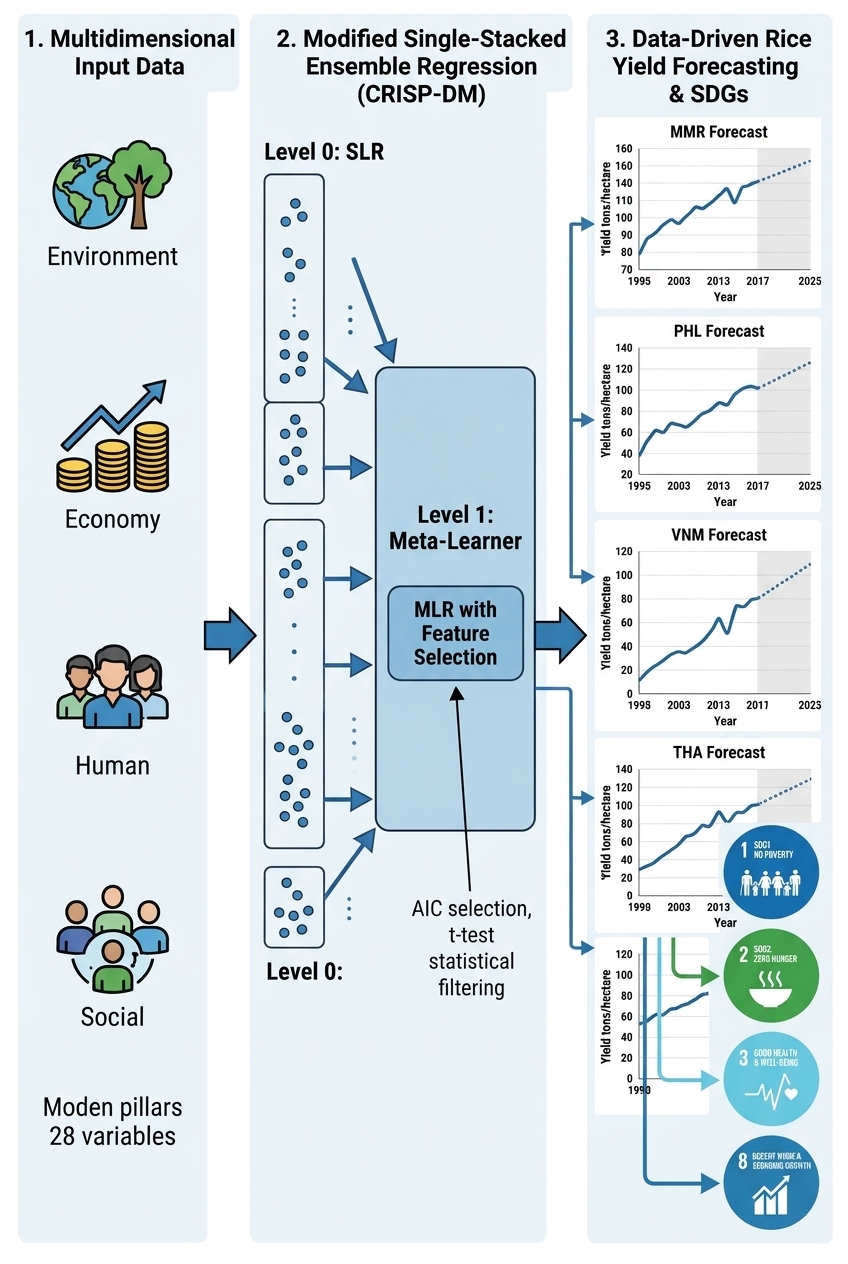
Food insecurity in Southeast Asia has intensified in recent years, highlighting the urgent need for reliable and interpretable quantitative methods for agricultural yield forecasting under data-limited conditions. This study develops a modified single-stacked ensemble statistical framework that integrates Simple Linear Regression (SLR) and Multiple Linear Regression (MLR) to enhance predictive robustness and interpretability. The proposed framework is implemented within the Cross Industry Standard Process for Data Mining (CRISP-DM), ensuring systematic data preparation, algorithm construction, and validation across five Southeast Asian nations, utilizing 28 potential determinants. From a numerical statistics perspective, the ensemble configuration is designed to improve predictive stability and reduce variance while maintaining algorithm transparency under constrained sample conditions. Comparative evaluation against selected conventional Artificial Intelligence (AI) algorithms demonstrates that the proposed regression-based ensemble achieves competitive and, in several cases, superior forecasting performance in terms of accuracy, generalizability, and computational efficiency. The results further quantify the interconnected effects of geographical characteristics, climate variables, and macro-structural factors on rice yield dynamics. By providing a scalable and computationally efficient modeling approach, this framework offers a practical foundation for applied mathematical and statistical applications in data-driven agricultural decision-making. The findings also offer actionable insights to support evidence-based policymaking and related strategic investment, contributing indirectly to the advancement of regional food security and related Sustainable Development Goals (SDGs), including SDG1 (No Poverty), SDG2 (Zero Hunger), SDG3 (Good Health and Well-being), and SDG8 (Decent Work and Economic Growth).
References
[1] U.S. Department of Agriculture, Production-rice,
https://www.fas.usda.gov/data/production/commodity/0422110
[2] P. Sathya, P. Gnanasekaran, Appl. Artif. Intell. 37(1) (2023) 2175113.
[3] S. Sahoo, C. Singha, A. Govind, J. Agric. Food Res. 18 (2024) 101424.
[4] A. Sharma, J. Kumar, M. Redhu, P. Kumar, M. Godara, P. Ghiyal, P. Fu, M. Rahimi, Sci. Rep. 14 (2024) 12626.
[5] A. Amarasinghee, I. Sangarasekara, N. De Silva, M. Ariyaratne, R. Amarasinghe, J. Bogahawatte, J. Alawatugoda, D. Herath, Discov. Appl. Sci. 6 (2024) 603.
[6] H. Mo, Y. Zhang, F. Liu, Y. Zheng, in: Proc. Journal of Physics: Conference Series, 1952 (2021) 042033.
[7] D. V. Pheakdey, T. D. Xuan, T. D. Khanh, AIMS Geosci. 3(4) (2017) 561-575.
[8] M. C. V. David, Univ. J. Agric. Res. 11(5) (2023) 836-848.
[9] R. G. Baltazar, Int. J. Agric. Nat. Resour. 51(1) (2024) 10-26.
[10] T. Nguyen, P. T. Ho, H. X. Pham, Cogent Econ. Finance 12(1) (2024) 2421894.
[11] Aziz, A. Aziz, Komariah, D. P. Ariyanto, Sumani, Sci. Horiz. 26(7) (2023) 149-159.
[12] R. E. Putri, A. Yahya, N. M. Adam, S. Abd Aziz, Food Res. 3(2) (2019) 171-176.
[13] B. T. Tan, P. S. Fam, R. B. R. Firdaus, M. L. Tan, M. S. Gunaratne, Agriculture 11 (2021) 569.
[14] M. Marong, N. A. Husin, M. Zolkepli, L. S. Affendey, Int. J. Adv. Comput. Sci. Appl. 15(3) (2024) 362-370.
[15] K. Saithanu, J. Mekparyup, P. Phodjanawichaikul, Glob. J. Pure Appl. Math. 11(4) (2015) 2181-2186.
[16] Z. L. Chuan, D. C. T. Wei, A. S. B. A. Aminuddin, S. -F. Fam, T. L. Ken, in: AIP Conf. Proc. 3150 (2024) 050008.
[17] Z. L. Chuan, T. R. Sheng, T. C. Cheng, A. L. B. Sern, D. L. K. Luen, C. Y. Sai, Multidiscipl. Appl. Res. Innov. 6(2) (2025) 1-17.
[18] J. Garcia-Arteaga, J. Zambrano-Zambrano, J. Parraga-Alava, J. Rodas-Silva, Comput. Speech Lang. 84 (2024) 101579.
[19] Z. L. Chuan, N. Japashov, S. K. Yuan, T. W. Qing, N. Ismail, Akademika 94(2) (2024) 232-251.
[20] Z. L. Chuan, D. C. T. Wei, A. Akhmedov, L. T. Man, T. E. Hiae, A. A. Hamizula, J. Kejuruteraan 37(2) (2025) 967-976.
[21] Z. L. Chuan, O. S. Jie, T. Y. Hin, S. N. S. B. M. Zain, Y. A. B. A. Rashid, A. N. B. Kamarudin, Int. J. Built Environ. Sustain. 12(1) (2025) 9-21.
[22] Z. L. Chuan, L. K. Tan, A. W. C. Chyin, Y. H. Tham, S. J. Ong, J. Y. Low, C. Y. Sai, MATEMATIKA 40(3) (2025) 143-167.
[23] O. Lohaj, J. Paralič, P. Bednár, Z. Paraličová, M. Huba, Mach. Learn. Knowl. Extr. 5(4) (2023) 1266-1281.
[24] Z. L. Chuan, D. C. T. Wei, C. L. W. Yan, M. F. A. Nasser, N. A. M. Ghani, A. A. Jemain, C. -Y. Liong, Malays. J. Fundam. Appl. Sci. 19(4) (2023) 525-538.
[25] A. Cheng, Finan. Res. Lett. 55 (2023) 103966.
[26] A. Alodah, Sustainability 15(20) (2023) 14674.
[27] C. L. S. Cedric, W. Y. H. Adoni, R. Aworka, J. T. Zoueu, F. K. Mutombo, M. Krichen, C. L. M. Kimpolo, Smart Agric. Technol. 2 (2022) 100049.
[28] R. C. A. Achterbergh, I. McGovern, M. Haag, Vaccines 12(2) (2024) 216.
[29] T. Alamo, D. G. Reina, M. Mammarella, A. Abella, Electronics 9(5) (2020) 827.
[30] A. Costantiello, A. Leogrande, Discov. Glob. Soc. 2 (2024) 1.
[31] A. Johri, M. Asif, P. Tarkar, W. Khan, Rahisha, M. Wasiq, Humanit. Soc. Sci. Commun. 11 (2024) 361.
[32] B. Ceballos, D. A. Pelta, M. T. Lamata, Int. J. Inf. Technol. Decis. Mak. 17(2) (2018) 513-525.
[33] Z. L. Chuan, A. L. B. Sern, R. S. Tham, D. L. K. Luen, C. C. Tan, J. Qual. Meas. Anal. 21(4) (2025) 55-76.
[34] Z. L. Chuan, S.-F. Fam, Q. H. Lee, J. S. Kok, M. N. B. M. Azam, Data Anal. Appl. Math. 3(2) (2022) 1-12.
[35] Agricultural Training Institute, Rice Competitiveness Enhancement Fund,
https://www.da.gov.ph/rice-competitiveness-enhancement-fund/
[36] Ministry of Agriculture, Fisheries and Agrarian Reform, Rice Program, https://mafar.bangsamoro.gov.ph/rice-program/
[37] Consultative Group on International Agricultural Research, Low-emission Technologies Transform Vietnam’s Rice Sector, Annual Performance Report 2020.
[38] O. Nguyen, Vietnam Investment Review (2023, Nov. 30).
[39] V. T. Nhung, Rikolto (2025, June 17).
Downloads
Published
Issue
Section
License
Copyright (c) 2026 Dr. Zun Liang Chuan, Mr. Tham Ren Sheng, Mr. Abraham Lim Bing Sern, Mr. David Lau King Luen, Mr. Tan Chek Cheng, Dr. Chong Yeh Sai

This work is licensed under a Creative Commons Attribution-NonCommercial 4.0 International License.