
Gunshot Residue Distribution Pattern of 9 mm Calibre at Different Distances and Angles on Two Different Substrates Using Observational and Statistical Analysis
DOI:
https://doi.org/10.11113/mjfas.v22n5.5037Keywords:
Gunshot residue, GSR distribution pattern, GSR particle distribution, cardboard substrate, meat substrate, statistical analysisAbstract
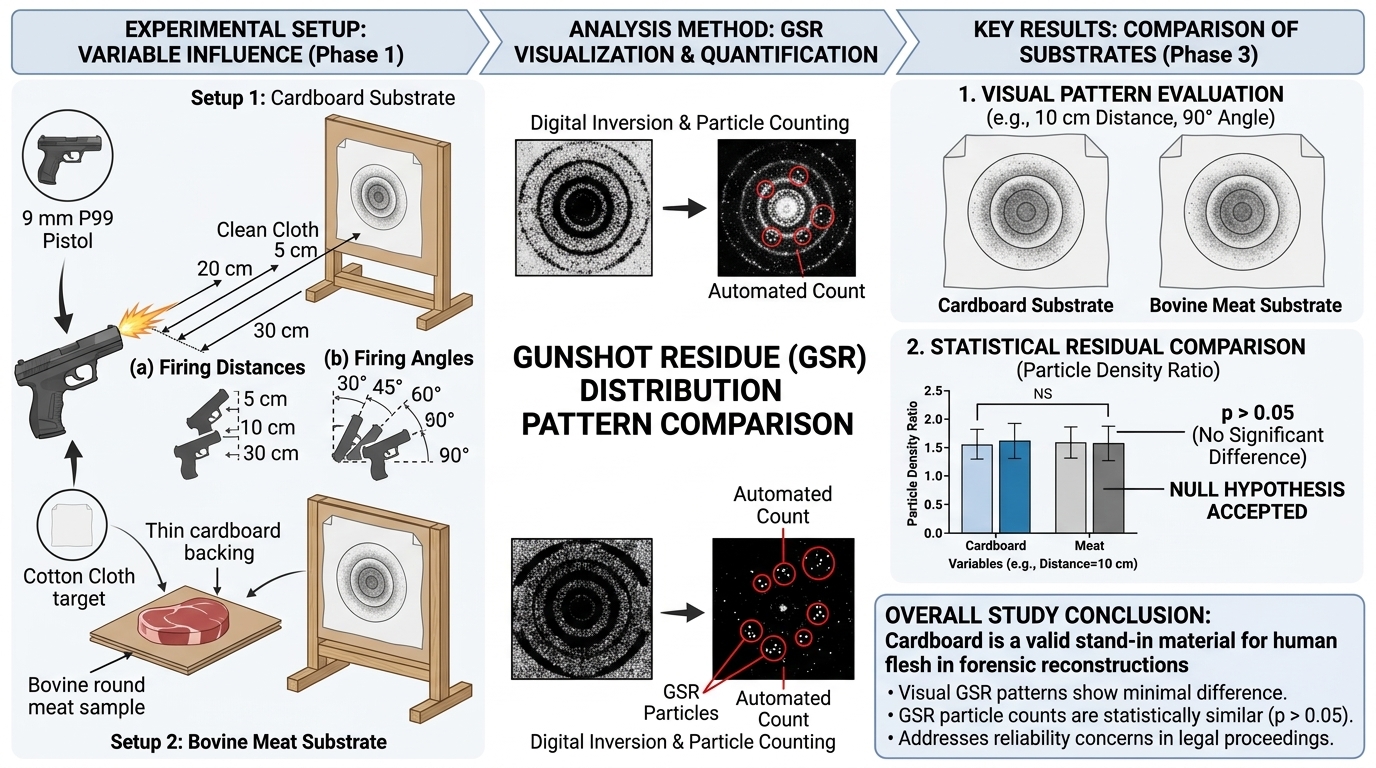
In investigations involving firearms, crime scene reconstruction plays a crucial role in establishing the circumstances and details surrounding the incident. Typically, cardboard is used as a substitute substrate during such reconstructions to simulate the gunfire impact distribution pattern. However, this practice may raise questions in legal proceedings, particularly regarding the accuracy and reliability of using cardboard to represent human flesh. Such concerns could potentially undermine the evidentiary value of the reconstruction and its ability to meet the standard of proof beyond a reasonable doubt for any criminal investigation. Considering this, the objective of the present study is to evaluate whether significant differences exist in gunshot residue (GSR) distribution patterns and particle distribution between cardboard and meat substrates, thereby assessing the validity of using cardboard as a stand-in material in forensic reconstructions. Bovine meat was used as the meat substitute to test residue GSR patterns. A P99 automatic pistol with 9 mm ammunition was used, and the person who fired the gun was right-handed, between 165–175 cm tall and weighed between 80–90 kg. The experiment was conducted in two parts. In the first part, the gun was fired at 4 different distances and in the second part, the gun was fired at 4 different angles. Each distance and angle were tested five times on both cardboard and meat. Altogether, the experiment involved 70 samples. The results were evaluated by visually examining the GSR distribution patterns and statistically analysing the GSR particle distribution using statistical tests of significance. The visual analysis showed no major differences between cardboard and meat at most distances, except at 5 cm, where a noticeable difference in the GSR pattern was observed. However, the analysis showed that the p-values were above 0.05, which means there was no significant difference between the groups, so the null hypothesis was accepted. Overall, the study found no significant differences in GSR patterns or particle counts between cardboard and meat substrates, regardless of the distance or angle of the shots. This finding is important for crime scene reconstruction, as it addresses concerns about the reliability of using cardboard in gunshot reenactments. While concerns have been raised regarding the suitability of cardboard as a tissue simulant, the present findings indicate no significant difference in GSR distribution between cardboard and meat substrates under the tested conditions.
References
[1] L.S. Blakey, G.P. Sharples, K. Chana, J.W. Birkett, J. Forensic Sci. 63 (2018) 9–19.
[2] S. Charles, N. Geusens, B. Nys, Forensic Sci. Int. Synergy 6 (2023) 100311.
[3] V.R. Minzière, A. Gassner, M. Gallidabino, C. Roux, C. Weyermann, WIREs Forensic Sci. 5 (2023) e1462.
[4] V.P. Ananth, U. Kalthom Ahmad, V. Ananth, S. Me Tong, Malays. J. Forensic Sci. 2 (2011) 1–8.
[5] C. Vander Pyl, K. Morris, L. Arroyo, T. Trejos, Forensic Chem. 19 (2020) 100250.
[6] P. Shrivastava, V.K. Jain, S. Nagpal, Egypt. J. Forensic Sci. 11 (2021) 12.
[7] F.S. Romolo, P. Margot, Forensic Sci. Int. 119 (2001) 195–211.
[8] M.D. Gallidabino, C. Weyermann, Forensic Sci. Int. 311 (2020) 110287.
[9] Z. Brozek-Mucha, Forensic Sci. Int. 183 (2009) 33–44.
[10] J. French, R. Morgan, Forensic Sci. Int. 247 (2015) 14–17.
[11] T. Plattner, B. Kneubuehl, M. Thali, U. Zollinger, Forensic Sci. Int. 138 (2003) 68–74.
[12] L. Fojtášek, J. Vacínová, P. Kolář, M. Kotrlý, Forensic Sci. Int. 132 (2003) 99–105.
[13] Z.M. Zain, S.N. Jaluddin, M.I.A. Halim, M.S.M. Subri, Egypt. J. Forensic Sci. 11 (2021) 28.
[14] M. Abedi, D.O.M. Bonsu, I.K. Badu, R. Afoakwah, P. Ahuja, Egypt. J. Forensic Sci. 11 (2021) 41.
[15] M. Ristova, M. Skenderovska, Z. Skulic, Z. Brożek-Mucha, Sci. Justice 63 (2023) 396–405.
[16] S. Fabbris, A. Profumo, G. Alberini, S. Bonomi, C. Milanese, M. Donghi, A. Amadasi, M. Patrini, L. Cucca, D. Merli, Talanta Open 2 (2020) 100013.
[17] W. Kerkhoff, A. Bolck, I. Alberink, E.J.A.T. Mattijssen, R. Hermsen, F. Riva, Forensic Sci. Int. 289 (2018) 270–276.
[18] A. Gradaščević, I. Soldatović, A. Jogunčić, M. Milosevic, N. Sarajlić, Srp. Arh. Celok. Lek. 148 (2020) 350–356.
[19] Y.C. Chia, S.M. Ching, P.B. Ooi, H.C. Beh, M.T. Chew, F.F.L. Chung, N. Kumar, H.M. Lim, PLoS ONE 18 (2023) e0280145.
[20] R. Gauriot, L. Gunaratnam, R. Moroni, T. Reinikainen, J. Corander, J. Forensic Sci. 58 (2013) 1149–1155.
[21] J. Jurečková, J. Picek, Comput. Stat. Data Anal. 51 (2007) 5184–5191.
[22] A.C. Elliott, L.S. Hynan, Comput. Methods Programs Biomed. 102 (2011) 75–80.
[23] Malaysian Meteorological Department, Humidity and Temperature Report, Ministry of Natural Resources and Environmental Sustainability, Kuala Lumpur, 2024.
[24] J.A. Rodriguez-Pascual, A. Doña-Fernández, F.J. Hernández-Crespo, Y. Loarce-Tejada, P.S. Sanchez, E. Gutiérrez-Redomero, F.J. Gomez-Laina, Forensic Sci. Int. 355 (2024) 111928.
[25] N. Lucas, H. Brown, M. Cook, K. Redman, T. Condon, H. Wrobel, K.P. Kirkbride, H. Kobus, Forensic Sci. Int. 262 (2016) 150–155.
[26] H. Ditrich, Forensic Sci. Int. 220 (2012) 85–90.
[27] R. Hofer, S. Graf, S. Christen, Forensic Sci. Int. 273 (2017) 10–19.
Downloads
Published
Issue
Section
License
Copyright (c) 2026 Lokkhesh Ramadass, Mohamad Afiq Mohamed Huri, Ts. Dr. Naji Arafat bin Haji Mahat, Nur Shamimi Mohd Sheffol Azri, Mohd Mustaffa Yaacob, Qurrota A'yuni

This work is licensed under a Creative Commons Attribution-NonCommercial 4.0 International License.