
Temporal Influences on Proximate Composition, Physicochemical Properties and Sensory Acceptability of Coconut Sap
Temporal Impacts on Chemical and Sensory Attributes of Coconut Sap
DOI:
https://doi.org/10.11113/mjfas.v22n5.5000Keywords:
Coconut sap, nutritional content, tapping period, seasonal beveragesAbstract
Coc
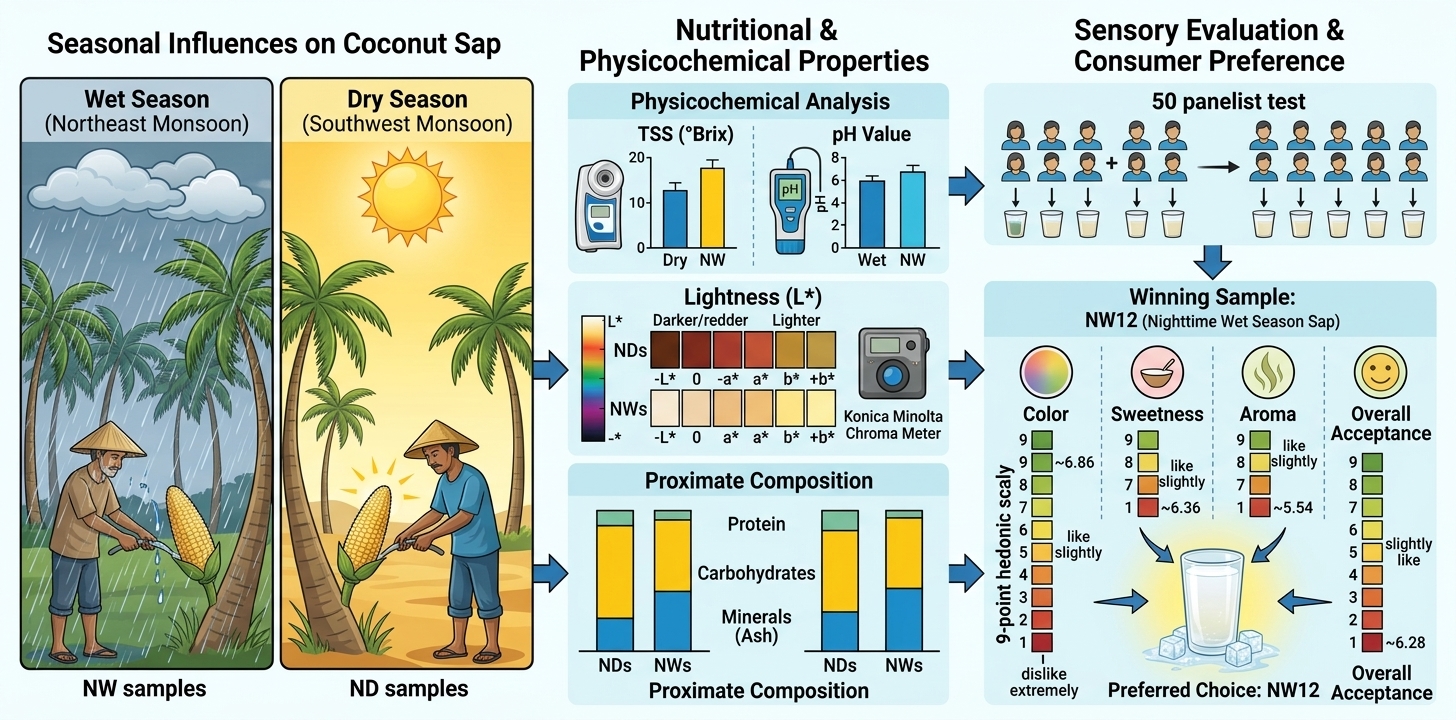
Coconut sap, locally known as neera, is a sweet, oyster-white liquid collected from the unblossomed spadix of the coconut tree (Cocos nucifera). Although the sap has economic importance and is well-known for its outstanding nutritional profile, studies on the influence of collection times and seasonal variation on its properties remain limited in Malaysia. It is important to know how the seasons and tapping time can affect its nutritional quality and consumer acceptance. Therefore, the objectives of this study were to evaluate the physicochemical characteristics, proximate composition and sensory attributes of the coconut sap collected at different sampling times (8 am, 5 pm and 12 am) from both wet Northeast Monsoon (NW) and dry Southwest Monsoon (ND) seasons. The physicochemical analyses (pH, total soluble solids (TSS) and colour), proximate composition (moisture, ash, crude protein, crude fat and carbohydrate) and food energy determination were conducted. The acceptance test was evaluated by 50 untrained panelists using a 9-point hedonic scale. The findings demonstrated that NWs (86.85%-88.10%) and NDs (85.93%-86.89%) did not significantly differ in terms of moisture content during both seasons. In contrast, NW8 has the lowest ash content (0.22±0.01%), crude protein (0.15±0.01%), and carbohydrates (11.51±0.05%) across the seasons and sampling times. The crude fat content is not significantly different across all samples. Meanwhile, the pH, TSS and colour of all samples are not significantly different by sampling times but vary across seasons. NWs have a higher pH (6.85±0.67) than NDs (5.94±0.18), and NDs possessed a higher value of TSS (15.89±4.21°Brix) than NWs (14.2±1.80°Brix). The colour determination was done using CIE Lab* colour system. NWs exhibited a lighter color as indicated by a higher L* value (37.21±0.72) than NDs (17.69±1.07). Sensory evaluation further indicated that NW samples were more acceptable, particularly in terms of color, sweetness and aftertaste, with NW12 (6.28 ± 1.80) having the “slightly like” score. Thus, this study highlights that the proximate and physicochemical values of coconut sap vary between seasons, but not by different sampling times.
References
[1] K.V. Reddy, D.P. Kumar, D.S. Rao, IOSR J. Bus. Manage. 19 (2017) 68–72.
[2] Agricultural Geospatial and Statistics Unit, Strategic Planning Division and Department of Agriculture Peninsular Malaysia, Crop Statistics Booklet (Food Crops Sub-sector), Department of Agriculture Malaysia, Kuala Lumpur, 2020.
[3] R.F.B. Maria, N. Malhija, M.T. Sherin, T. Kumaran, J. Basic Appl. Res. Biomed. 6 (2020) 50–52.
[4] Y. Kusumawaty, E. Maharani, S. Edwina, Agribusiness in Marketing 5 (2012) 1–13.
[5] K. Ysidor, K. Jean-Louis, K. Roger, A. Rachel, O. Joelle, I. Emmanuel, B. Marius, Am. J. Exp. Agric. 5 (2015) 352–365.
[6] D.-L. Ngo-Hoang, Qeios (2023) 1–5.
[7] J. Wrage, S. Burmester, J. Kuballa, S. Rohn, LWT 112 (2019) 108227.
[8] A.D. Saputro, D. Van De Walle, R.P. Aidoo, M.A. Mensah, C. Delbaere, N. De Clercq, J. Van Durme, K. Dewettinck, Eur. Food Res. Technol. 243 (2016) 177–191.
[9] P. Naknean, M. Meenune, G. Roudaut, Int. Food Res. J. 17 (2010) 977–986.
[10] M.T. Asghar, Y.A. Yusof, M.N. Mokhtar, M.E. Ya’acob, M.H. Ghazali, L.S. Chang, Y.N. Manaf, Food Sci. Nutr. 8 (2020) 1777–1787.
[11] K.B. Hebbar, R. Pandiselvam, M.R. Manikantan, M. Arivalagan, S. Beegum, P. Chowdappa, Sugar Tech 20 (2018) 621–634.
[12] Mustaufik, L. Sutiarso, S. Rahayoe, K.H. Widodo, IOP Conf. Ser.: Earth Environ. Sci. 653 (2021) 012015.
[13] S.A. Bariagabre, G. Tsegay, A. Berhe, D. Woldegebriel, Discov. Food 5 (2025) 430.
[14] D.C. Okafor, B.C. Ijioma, C.E. Ofoedu, J.C. Nwosu, E.U. Onyeka, N.C. Ihediohanma, T.I. Okafor, Asian J. Agric. Food Sci. 5 (2017) 1–10.
[15] L.S. Magwaza, U.L. Opara, Scientia Horticulturae 184 (2015) 179–192.
[16] H. William, W.L.G. George, AOAC International, Official Methods of Analysis of AOAC International, AOAC International, Gaithersburg, 2011.
[17] B. Walther, D. Guggisberg, R. Badertscher, L. Egger, R. Portmann, S. Dubois, M. Haldimann, K. Kopf-Bolanz, P. Rhyn, O. Zoller, R. Veraguth, S. Rezz, Front. Nutr. 9 (2022) 988707.
[18] A. Gámbaro, M.B. McSweeney, Advances in Food and Nutrition Research, Academic Press, Cambridge, 2020, p. 295–337.
[19] S. Muzzaffar, R. Jan, I.A. Wani, F.A. Masoodi, M.M. Bhat, T.A. Wani, G.R. Wani, Cogent Food Agric. 2 (2016) 1157920.
[20] Kemp, Hollowood, Hoart, Sensory Evaluation: A Practical Handbook, John Wiley & Sons, Chichester, 2009, p. 1–150.
[21] P. Haryanti, S. Supriyadi, D.W. Marseno, U. Santoso, Jurnal Agritech 38 (2019) 295–302.
[22] J. Chandrapala, C.M. Oliver, S. Kentish, M. Ashokkumar, Food Rev. Int. 29 (2012) 67–91.
[23] M. Chen, X. Wang, Y. Liu, P. Li, R. Wang, L. Jiang, Molecules 27 (2022) 7139.
[24] V.V. Priya, M. Balakrishnan, S. Karthikeyan, P. Rajkumar, M.R. Manikantan, K. Gurusamy, R. Pandiselvam, Sugar Tech 25 (2023) 906–915.
[25] N. Xia, Afr. J. Biotechnol. 10 (2011) 14999–15005.
[26] A.P. Okwukwe, S.E. Kakulu, M. Dauda, Int. J. Sci. Res. Publ. 12 (2022) 215–222.
[27] P. Haryanti, Supriyadi, M.D. Wiseso, U. Santoso, Int. J. Sci. Technol. 5 (2017) 52–57.
[28] A. Sharma, M. Meghwal, J. Nutr. Food Processing 8 (2021) 1–5.
[29] P. Shetty, A. D’Souza, S. Poojari, J. Narayana, P. Rajeeva, Int. J. Appl. Sci. Biotechnol. 5 (2017) 375–381.
[30] H. Lantemona, A.L. Abadi, A. Rachmansyah, J. Pontoh, IOSR J. Environ. Sci. Toxicol. Food Technol. 4 (2013) 42–48.
[31] Z. Liang, Z. Fang, A. Pai, J. Luo, R. Gan, Y. Gao, J. Lu, P. Zhang, Crit. Rev. Food Sci. Nutr. 62 (2022) 215–243.
[32] S. Louw, Anal. Sci. Adv. 2 (2021) 157–170.
[33] G. Wijonarko, I.S.M. Purbowati, T. Widjojoko, A. Maksum, Indonesian J. Food Technol. 1 (2022) 41–48.
[34] A.C. Hoffman, R.V. Salgado, C. Dresler, R.W. Faller, C. Bartlett, Tobacco Control 25 (2016) 32–39.
[35] K.B. Hebbar, M. Arivalagan, M.R. Manikantan, R. Pandiselvam, S. Beegum, P. Chowdappa, J. Food Sci. Technol. 52 (2015) 8142–8149.
[36] W. Ahrens, Flavour 4 (2015) 8.
[37] W. Liu, J. Su, S. Li, X. Lang, X. Huang, Sci. Rep. 8 (2018) 1083.
Downloads
Published
Issue
Section
License
Copyright (c) 2026 Nur Syakira Haslina Mohamed, Nur Izzatul Atiqah Mat Mawi, Nurul Hadhirah Yusoff, Zalilawati Mat Rashid

This work is licensed under a Creative Commons Attribution-NonCommercial 4.0 International License.