
Eco-Friendly Synthesis of Silver Nanoparticles Using Plumeria acuminata L. for Colorimetric Detection of Pb²⁺ in Lipstick Samples
DOI:
https://doi.org/10.11113/mjfas.v22n4.5557Keywords:
AgNPs; colorimetric biosensor; green synthesis; Pb detection; Plumeria acuminata L.Abstract
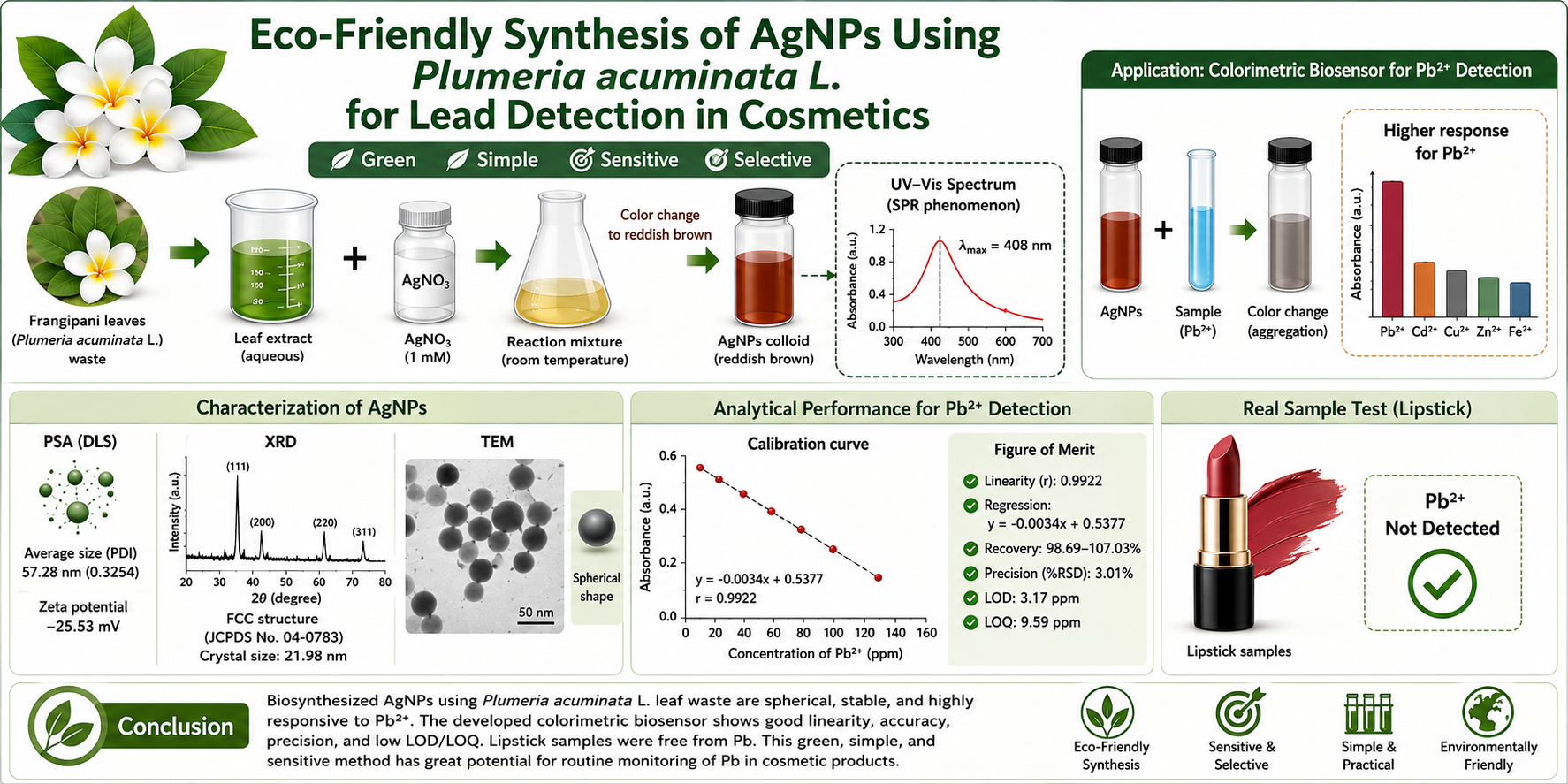
Exposure to heavy metals such as lead (Pb) in cosmetic products is a concern because it can cause toxic health effects with long-term use. This study aims to synthesize silver nanoparticles (AgNPs) using a green synthesis method from the waste extract of frangipani leaves (Plumeria acuminata L.) and evaluate their potential as biosensors for Pb detection in lipstick samples. The formation of AgNPs is characterized by a change in the solution's color to reddish-brown and confirmed by UV–Vis analysis, which shows a maximum absorption peak at 408 nm due to the surface plasmon resonance (SPR) phenomenon. PSA results show an average particle size of 57.28 nm, a PDI of 0.3254, and a zeta potential of −25.53 mV. XRD and TEM analyses show that AgNPs have a face-centered cubic (FCC) crystal structure, a size of 21.98 nm, and a spherical shape. The selectivity test results show that AgNPs exhibit a stronger response to Pb metal than to other metals. Analytical performance evaluation showed good linearity with a regression equation of y = -0.0034x + 0.5377 and R2 value of 0.9922. The developed method also showed good accuracy and precision, with a recovery of 98.69-107.03% and %RSD of 3.01%, as well as LOD and LOQ values of 3.17 ppm and 9.59 ppm, respectively. Tests on authentic lipstick cosmetic samples showed that no Pb²⁺ response was detected under the experimental conditions. Overall, the green-synthesized AgNPs have the potential to serve as a simple, environmentally friendly colorimetric biosensor for detecting Pb in cosmetic products.
References
[1] Jităreanu, A., Trifan, A., Caba, I. C., Mârțu, I., and Agoroaei, L. (2025). An Overview of Heavy Metals in Cosmetic Products and Their Toxicological Impact. Appl. Sci., 15(24), 1–42, doi: 10.3390/app152412883
[2] BPOM, “Kepala BPOM Rilis Daftar Kosmetik Mengandung Bahan Berbahaya dan atau Dilarang Hasil Intensifikasi Pengawasan di Awal Tahun 2025,” Badan Pengawas Obat dan Makanan Indones., no. April, p. Nomor HM.01.1.2.04.25.100 Tanggal 22 April 2025, 2025, [Online]. Available: https://www.pom.go.id/siaran-pers/kepala-bpom-rilis-daftar-kosmetik-mengandung-bahan-berbahaya-dan-atau-dilarang-hasil-intensifikasi-pengawasan-di-awal-tahun-2025
[3] Saah, S. A., Boadi, N. O., Sakyi, P. O., and Smith, E. Q. (2024). Human health risks of lead, cadmium, and other heavy metals in lipsticks. Heliyon, 10(23), p. e40576, doi: 10.1016/j.heliyon.2024.e40576
[4] Anis, I. (2020). Biofarmasetikal Tropis Biofarmasetikal Tropis. Trop. J. Biopharm., 2(2), 158–169
[5] Arifiyana, D. (2018). Identifikasi Cemaran Logam Berat Timbal (Pb) pada Lipstik yang Beredar di Pasar Darmo Trade Center (DTC) Surabaya dengan Reagen Sederhana. Journal Pharm. Sci., 3(1), 13–16 doi: 10.53342/pharmasci.v3i1.68
[6] Raj, K., and Das, A. P. (2023). Lead pollution: Impact on environment and human health and approach for a sustainable solution. Environ. Chem. Ecotoxicol., 5, 79–85, doi: 10.1016/j.enceco.2023.02.001
[7] World Health Organization, “Lead poisoning,” 2024. [Online]. Available: https://www.who.int/news-room/fact-sheets/detail/lead-poisoning-and-health
[8] Jin, M., Yuan, H., Liu, B., Peng, J., Xu, L., and Yang, D. (2020). Review of the distribution and detection methods of heavy metals in the environment. Anal. Methods, 12(48), 5747–5766, doi: 10.1039/d0ay01577f.
[9] Nuttall, K. L., Gordon, W. H., and Ash, K. O. (1995). Inductively coupled plasma mass spectrometry for trace element analysis in the clinical laboratory. Ann. Clin. Lab. Sci., 25(3), 264–271
[10] Ibrahim, N. H., Taha, G. M., Hagaggi, N. S. A., and Moghazy, M. A. (2024). Green synthesis of silver nanoparticles and its environmental sensor ability to some heavy metals. BMC Chem., 18(1), 1–34, doi: 10.1186/s13065-023-01105-y
[11] Khan, S. R., Sharma, B., Chawla, P. A., and Bhatia, R. (2022). Inductively Coupled Plasma Optical Emission Spectrometry (ICP-OES): a Powerful Analytical Technique for Elemental Analysis. Food Anal. Methods, 15(3), 666–688, doi: 10.1007/s12161-021-02148-4
[12] Sudarman, F., Shiddiq, M., Armynah, B., and Tahir, D. (2023). Silver nanoparticles (AgNPs) synthesis methods as heavy-metal sensors: a review. Int. J. Environ. Sci. Technol., 20(8), 9351–9368, doi: 10.1007/s13762-022-04745-0
[13] Roy, A., Datta, S., Luthra, R., Khan, M. A., Gacem, A., Hasan, M. A., Yadav, K. K., Ahn, Y. and Jeon, B-H. (2022). Green synthesis of metalloid nanoparticles and its biological applications: A review. Front. Chem, 10, 994724, doi: 10.3389/fchem.2022.994724
[14] Nguyen, N. P. U., Dang, N. T., Doan, L., and Nguyen, T. T. H. (2023). Synthesis of Silver Nanoparticles: From Conventional to ‘Modern’ Methods—A Review. Processes, 11(9), doi: 10.3390/pr11092617
[15] Sujarwo, W., Caneva, G., and Zuccarello, V. (2020). Patterns of plant use in religious offerings in bali (Indonesia). Acta Bot. Brasilica, 34(1), 40–53, https://doi.org/10.1590/0102-33062019abb0110
[16] Widiyaningtiyas, M. I., Putra, R. A., Ekawati, E. R., Herawati, D. and Mustika, A. (2025). The Effect of a Combination of Ethanol Extract from Leaves and Flowers of Plumeria acuminata L. Against Aedes aegypti Larvae. J. Multidiscip. Appl. Nat. Sci., 5(1), 18–31, https://doi.org/10.47352/jmans.2774-3047.225
[17] Sari, N. K. Y., Sintia, P. L., Deswiniyanti, N. W., Permatasari, A. A. A. P. (2023). Aktivitas Antimikroba Infusa Dan Ekstrak Bunga Kamboja Putih (Plumeria acuminata) Secara In Vitro. Jurnal Kesehatan Terpadu, 7(1), 19–24
[18] Widiyaningtiyas, M. I., Putra, R. A., Ekawati, E. R., Herawati, D., Mustika, A. (2024). The effect of a combination of ethanol extract from leaves and flowers of Plumeria acuminata L. against Aedes aegypti larvae. Journal of Multidisciplinary Applied Natural Science, 5(1), 18–31. https://doi.org/10.47352/jmans.2774-3047.225
[19] Dube, E., Juanga-Labayen, J. P., Labayen, M. (2024). From plant metabolites to functional nanomaterials: Advances in phytochemical-mediated silver nanoparticle synthesis and applications. Chemistry, 6(2), 40–62. https://doi.org/10.3390/chemistry6020040
[20] Kafesa, A. (2024). Fundamentals of the nanosilver reaction in green synthesis. IntechOpen. https://doi.org/10.5772/intechopen.1240238
[21] Omer Abdulazeez, T., Alrasheid, A. A., Kabbashi, A. S., and Ayoub, S. M. H. (2023). Green Synthesis of Silver Nanoparticles from Psidium guajava Leaf Extract: Characterization and Evaluation of Antibacterial Activity Against Common Pathogens. Am. J. Nano Res. Appl., 11(2), 19–25, 2023, https://doi.org/10.11648/j.nano.20231102.11
[22] Zannotti, M., Piras, S., Rita, L., Biesuz, R., and Giovannetti, R. (2024). Spectrochimica Acta Part A : Molecular and Biomolecular Spectroscopy Silver nanoparticles from orange peel extract : Colorimetric detection of Pb2+ and Cd2+ ions with a chemometric approach. Spectrochim. Acta Part A Mol. Biomol. Spectrosc, 323, 124881, https://doi.org/10.1016/j.saa.2024.124881
[23] Sulistyarti, H., Mashuri, M., Ari, U., Fadhila, M., and Cahyaningrum, A. (2022). Green synthesis of silver nanoparticles using Coffea canephora fruit skin extract and its application for mercury detection in face cream samples. Anal. Sci., 39(3), 335–346, https://doi.org/10.1007/s44211-022-00237-w.
[24] Sevinc-Sasmaz, C., Erci, F., Torlak, E., and Yöntem, M. (2025). Characterization of Silver Nanoparticles Synthesized Using Hypericum perforatum L. and Their Effects on Staphylococcus aureus. Microsc. Res. Tech., 88(8),. 2321–2332, https://doi.org/10.1002/jemt.24862
[25] Erliyanti, R. P. N. K., Wira, G. R., Maharani, H. P., Pujiastuti, C. (2025). Biosynthesis of Silver Nanoparticles Using Black Pepper (Piper nigrum L.) Essential Oil as a Bioreductor. Jurnal Rekayasa Kimia & Lingkungan, 20(1), 112–125.
[26] International Conference on Harmonisation (ICH), “Validation of Analytical Procedures: Text and Methodology Q2(R1),” 2005.
[27] Eker, F., Akdaşçi, E., Duman, H., Bechelany, M., and Karav, S. (2025). Green Synthesis of Silver Nanoparticles Using Plant Extracts: A Comprehensive Review of Physicochemical Properties and Multifunctional Applications. Int. J. Mol. Sci., 26(13), 1–50, https://doi.org/10.3390/ijms26136222.
[28] Widiyaningtiyas, M. I., Putra, R. A., Ekawati, E. R., Herawati, D., and Mustika, A. (2025). The effect of a combination of ethanol extract from leaves and flowers of Plumeria acuminate L. against Aedes aegypti larvae. Journal of Multidisciplinary Applied Natural Science, 5(1), 168–176
[29] Barleany, D. R., Saleh, A. I., and Pitaloka, A. B. (2025). Green Synthesis of Silver Nanoparticles Using Caulerpa racemosa Extract as Bioreductor : Characterization and Antibacterial Activity. J. Rekayasa Kim. Lingkung., 20(2), 250–260, https://doi.org/10.23955/rkl.v20i2.276.
[30] Lestari, G. A. D., Kempen, N. W. N. K. V., Cahyadi, K. D., Esati, N.K. (2024). Penggunaan Bioreduktor Ekstrak Air Daun Sirsak (Annona mucirata L.) Untuk Fitosintesis Nanopartikel Perak (Npag) Dengan Berbagai Variasi Rasio Campuran. Inovasi Teknik Kimia, 9(3), 169-176
[31] Gupta, P., Ilyas, H., Raghav, D. S., and Tomar, S. (2025). “Sustainable synthesis of silver nanoparticles via hordeum vulgare seed extract : catalysis , antioxidant , anti-cancerous and antimicrobial potential. Discov. Mater., 5, https://doi.org/10.1007/s43939-025-00342-3.
[32] Negri, C., Colombo, R., Bracconi, M., Atzori, C., and Donazzi, A. (2024). “Operando UV-vis spectroscopy for real-time monitoring of nanoparticle size in reaction conditions: a case study on rWGS over Au nanoparticles. Catal. Sci. Technol., 1318–1327, https://doi.org/10.1039/d3cy01392h.
[33] Iravani, S., Korbekandi, H., Mirmohammadi, S. V., and Zolfaghari, B. (2013). Synthesis of silver nanoparticles : chemical , physical and biological methods. Res. Pharm. Sci., 9, 385–406.
[34] Baran, A., Ghorbanzadeh, V., Doğan, Y., Ahmadian, E., and Zulfugarova, P. (2026). “Green synthesis of silver nanoparticles from Elaeagnus angustifolia extract : characterization and evaluation of antibacterial and cytotoxic properties. Discov. Nano, https://doi.org/10.1186/s11671-025-04423-3.
[35] Shejawal, K. P., Randive, D. S., Bhinge, S. D., Bhutkar, M. A., Wadkar, G. H., and Jadhav, N. R. (2020). Green synthesis of silver and iron nanoparticles of isolated proanthocyanidin : its characterization , antioxidant , antimicrobial , and cytotoxic activities against COLO320DM and HT29. J. Genet. Eng. Biotechnol., 18(1), 43, https://doi.org/10.1186/s43141-020-00058-2.
[36] Zhang, X., Liu, Z., Shen, W., and Gurunathan, S. (2016). Silver Nanoparticles : Synthesis , Characterization , Properties, Applications, and Therapeutic Approaches. Int. J. Mol. Sci. Rev., https://doi.org/10.3390/ijms17091534.
[37] Abbas, R., Luo, J., Qi, X., Naz, A., Khan, I. A., Liu, H., Yu, S., Wei, J. (2024). Silver Nanoparticles: Synthesis, Structure, Properties and Applications. Nanomaterials, 14(17), 1425. https://doi.org/10.3390/nano14171425
[38] John, R., Monpara, J., Swaminathan, S., and Kalhapure, R. (2024). Chemistry and Art of Developing Lipid Nanoparticles for Biologics Delivery : Focus on Development and Scale-Up. Pharmaceutics, https://doi.org/10.3390/pharmaceutics16010131.
[39] Udepurkar, A. P., Mampaey, L., Clasen, C., and Kuhn, S. (2024). Reaction Chemistry & Engineering enabled by an ultrasonic microreactor. 2208–2217, https://doi.org/10.1039/d4re00107a.
[40] Viana, T. (2022). Redispersible 3D printed nanomedicines : An original application of the semisolid extrusion technique. Int. J. Pharm., 624, 122029, https://doi.org/10.1016/j.ijpharm.2022.122029.
[41] Patriciaa, A. G. J. (2022). An Investigation of Novel Nano Material Silver Nano Dots Synthesis and Characterization Using Simple Sugar Fructose. J. Mater. Sci. Eng., 11, 4–7, https://doi.org/10.37421/ 2169-0022.2022.11.12.
[42] Roopan, S. M., Madhumitha, G., Rahuman, A. A., Kamaraj, C., Bharathi, A., & Surendra, T. V. (2013). Low-cost and eco-friendly phyto-synthesis of silver nanoparticles using Cocos nucifera coir, characterization and larvicidal activity. Industrial Crops and Products, 43, 631-635, https://doi.org/10.1016/j.indcrop.2012.08.004
[43] Lotfy, W. A., Alkersh, B. M., Sabry, S. A., Ghozlan, H. A., and Castro, G. R. (2021). Biosynthesis of Silver Nanoparticles by Aspergillus terreus : Characterization , Optimization, and Biological Activities. Front. Bioeng. Biotechnol., 9, https://doi.org/10.3389/fbioe.2021.633468.
[44] Asif, M., Yasmin, R., Asif, R., Ambreen, A., Mustafa, M., & Umbreen, S. (2022). Green synthesis of silver nanoparticles (AgNPs), structural characterization, and their antibacterial potential. Dose-Response, 20(2), https://doi.org/10.1177/15593258221088709
[45] Kurra, H., Velidandi, A., Sarvepalli, M., Pabbathi, N. P. P., & Godishala, V. (2025). Aqueous Cymbopogon citratus extract mediated silver nanoparticles: Part I. Influence of synthesis parameters, characterization, and biomedical studies. Nanomaterials, 15(5), 328, https://doi.org/10.3390/nano15050328
[46] Tamanna, N. J., Hossain, M. S., Bahadur, N. M., Ahmed, S. (2026). Green synthesis and characterization of silver (Ag) nanoparticles: Crystallographic analysis from X-ray diffraction. Chemistry of Inorganic Materials, 8, 100144, https://doi.org/10.1016/j.cinorg.2026.100144
[47] Ojha, I. (2025). Plant mediated synthesis of silver nanoparticles using Alcea rosea leaf aqueous extract and evaluation of the biological activities. Sci. Rep., 16, 1–22, https://doi.org/10.1038/s41598-026-37480-4.
[48] Ali, A., Chiang, Y. W., & Santos, R. M. (2022). X-ray Diffraction Techniques for Mineral Characterization: A Review for Engineers of the Fundamentals, Applications, and Research Directions. Minerals, 12(2), 205, https://doi.org/10.3390/min12020205
[49] Syarifah, S., Imawan, C., Handayani, W., & Djuhana, D. (2018). Biosynthesis of ferric oxide nanoparticles using Pometia pinnata J.R.Frost. & G.Forst. leaves water extract. AIP Conference Proceedings, 2024(1). https://doi.org/10.1063/1.5064051
[50] Kelly, K. L., Coronado, E., Zhao, L. L., and Schatz, G. C. (2003). The Optical Properties of Metal Nanoparticles: The Influence of Size, Shape, and Dielectric Environment. J. Phys. Chem. B, 107(3), 668–677, https://doi.org/10.1021/jp026731y.
[51] Vilela, D., González, M. C., and Escarpa, A. (2012). Sensing colorimetric approaches based on gold and silver nanoparticles aggregation : Chemical creativity behind the assay. A review. Anal. Chim. Acta, 751, 24–43, https://doi.org/10.1016/j.aca.2012.08.043
[52] Kołątaj, K., Krajczewski, J., and Kudelski, A. (2020). Plasmonic nanoparticles for environmental analysis. Environ. Chem. Lett., 529–542, https://doi.org/10.1007/s10311-019-00962-1.
[53] Choudhury, R., and Misra, T. K. (2018). Gluconate Stabilized Silver Nanoparticles as a Colorimetric Sensor for Pb2+. Colloids Surfaces A Physicochem. Eng. Asp., 545, 179–187, https://doi.org/10.1016/j.colsurfa.2018.02.051.
[54] Almaquer, F. E. P., Ricacho, J. S. Y., and Ronquillo, R. L. G. (2019). Simple and rapid colorimetric sensing of Ni ( II ) ions in tap water based on aggregation of citrate-stabilized silver nanoparticles. Sustain. Environ. Res., 29, 1–10, https://doi.org/10.1186/s42834-019-0026-3.
[55] Zannotti, M., Piras, S., Remia, L., Appignanesi, D., Giovannetti, R. (2024). Selective ColorimetricDetection of Pb(II) Ions by Using Green Synthesized Gold Nanoparticles with Orange Peel Extract. Chemosensors, 12(33), https://doi.org/10.3390/chemosensors12030033
[56] Srikhao, N., Ounkaew, A., Kasemsiri, P., Theerakulpisut, S., Okhawilai, M., and Hiziroglu, S. (2022). Green synthesis of silver nanoparticles using the extract of spent coffee used for paper-based hydrogen peroxide sensing device. Scientific Reports, 12(1). https://doi.org/10.1038/s41598-022-22067-6
[57] Ibrahim, N. H., Taha, G. M., Hagaggi, N. S. A., and Moghazy, M. A. (2024). Green synthesis of silver nanoparticles and its environmental sensor ability to some heavy metals. BMC Chemistry, 18(1). https://doi.org/10.1186/s13065-023-01105-y
[58] Cheon, J., and Park, W. (2016). Green synthesis of silver nanoparticles stabilized with mussel-inspired protein and colorimetric sensing of lead(II) and copper(II) ions. International Journal of Molecular Sciences, 17(12), 2006. https://doi.org/10.3390/ijms17122006
[59] Annadhasan, M., Muthukumarasamy, N., Senthil Kumar, P., and Rajendran, V. (2014). Green synthesized silver and gold nanoparticles for colorimetric detection of Hg2+, Pb2+, and Mn2+ in aqueous medium. ACS Sustainable Chemistry & Engineering, 2(7), 1646–1655. https://doi.org/10.1021/sc400500z
[60] Berrow M. L., and Stein, W. M. (1983). Extraction of metals from soils and sewage sludges by refluxing with aqua regia. Analyst, 108(1283), 277–285, https://doi.org/10.1039/AN9830800277
[61] Desales, B., Duerme, K. I., Fundador, E. O. V., and Fundador, N. G. V. (2025). Colorimetric Detection of Pb2+ Using Green Synthesized AgNPs. Solid State Phenom., 370, 17–21, https://doi.org/10.4028/p-d0maaD
[62] Thakur, D., Dubey, N. P., and Singh, R. (2024). A Review on Spike and Recovery Method in Analytical Method Development and Validation. Crit. Rev. Anal. Chem., 54(7), 2053–2071, https://doi.org/10.1080/10408347.2022.2152275
[63] Kicińska, A., Kowalczyk, M. (2025). Health risks from heavy metals in cosmetic products available in the online consumer market. Scientific Reports, 15, 11695611. https://doi.org/10.1038/s41598-024-83477-2
[64] Yuniarni, D. R., Aminah, Imawan, C. (2020). The effect of sodium chloride as a catalyst in the silver nanoparticles formation. AIP Conference Proceedings, 2314(1), 020014. https://doi.org/10.1063/5.0035623
Downloads
Published
Issue
Section
License
Copyright (c) 2026 Gusti Ayu Dewi Lestari

This work is licensed under a Creative Commons Attribution-NonCommercial 4.0 International License.