
Preparation of Magnetic Spent Tea as a Sustainable Carrier for Laccase Immobilization and Polycyclic Aromatic Hydrocarbon Biodegradation
DOI:
https://doi.org/10.11113/mjfas.v22n4.5545Keywords:
Magnetic spent tea, laccase immobilization, naphthalene and anthracene biodegradation.Abstract
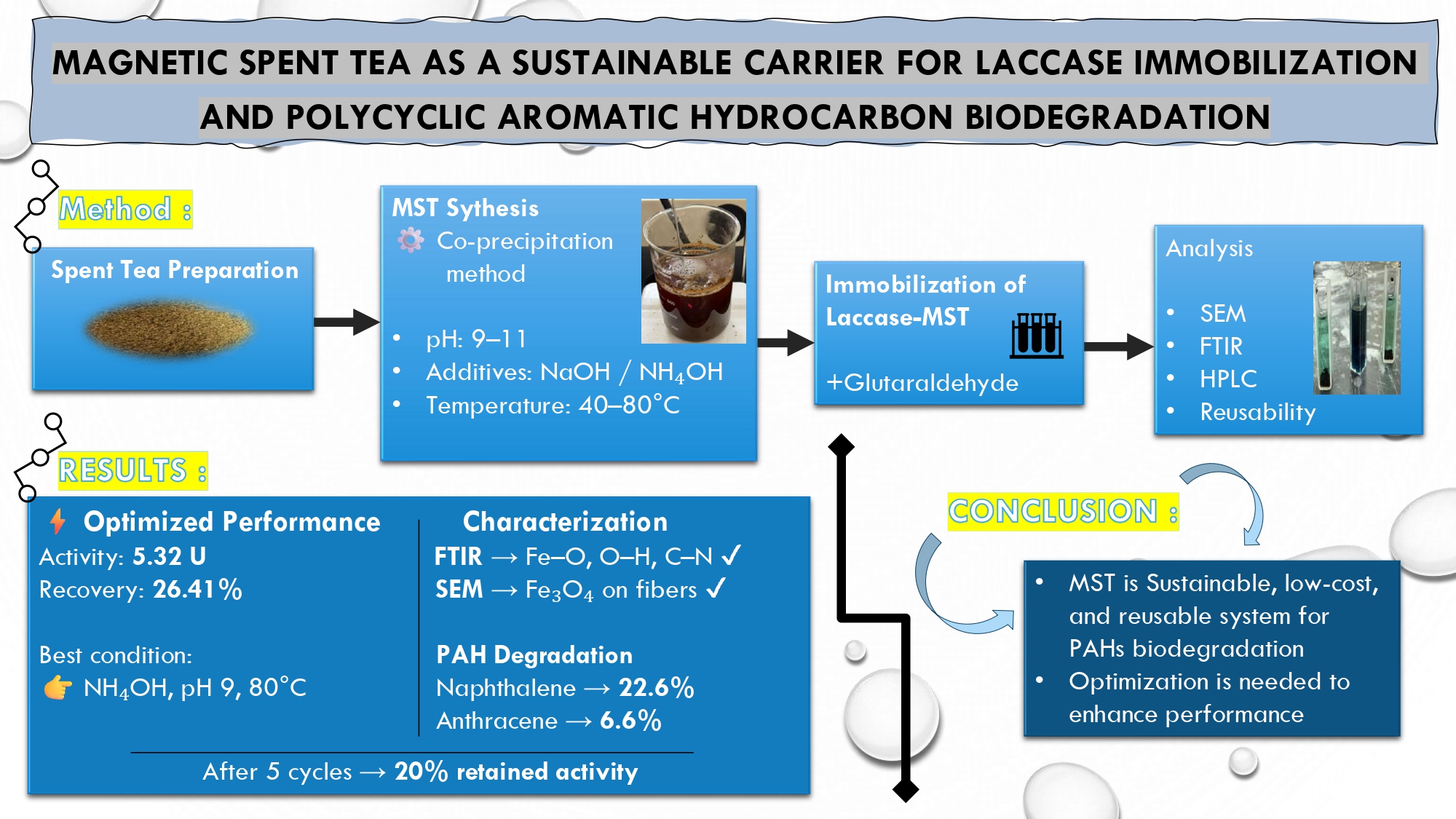
Due to their persistence, hydrophobicity, and carcinogenic nature, polycyclic aromatic hydrocarbons (PAHs) produced from the petroleum-based sector give rise to various threats to the environment and human health. Laccase exhibits significant potential for enzymatic bioremediation; however, its practical application is constrained by its low stability and limited reusability. In this study, three synthesis parameters to develop magnetic spent tea (MST) as a sustainable carrier for laccase immobilization were studied, namely precipitation pH (9 to 11), alkaline additive type (NaOH vs NH₄OH), and temperature (40 to 80°C). To ensure the formation of Fe₃O₄ magnetite, the theoretical stoichiometric ratio Fe²⁺:Fe³⁺ of 1:2 was applied. Immobilization of laccase with MST was performed via a crosslinking method with glutaraldehyde, and thereafter, its catalytic activity, recovery, stability, and PAH degradation ability were evaluated. The highest immobilized laccase activity of 5.32 U and recovery of 26.41% were obtained with NH₄OH at pH 9 and 80°C. FTIR spectra showed characteristic peaks corresponding to Fe–O, O–H, and C–N stretching vibrations, denoting that magnetization and enzyme immobilization were successfully achieved. Meanwhile, SEM images confirmed the deposition of Fe₃O₄ nanoparticles on the fibrous structure of spent tea. HPLC analysis revealed that after 24 hours, 22.6% of naphthalene and 6.6% of anthracene were successfully degraded. After five cycles of reuse, the immobilized system retained approximately 20% of its initial activity, indicating promising recyclability. This study demonstrates that magnetic spent tea (MST) is a promising, affordable, and sustainable carrier for laccase immobilization with potential applications for the biodegradation of PAHs.
References
Kołodziejczak-Radzimska, A., Nghiem, L.D. & Jesionowski, T. Functionalized Materials as a Versatile Platform for Enzyme Immobilization in Wastewater Treatment. Curr Pollution Rep 7, 263–276 (2021). https://doi.org/10.1007/s40726-021-00193-5
Patel, A. B., Shaikh, S., Jain, K. R., Desai, C., & Madamwar, D. (2020). Polycyclic aromatic hydrocarbons: Sources, toxicity, and remediation approaches. Frontiers in Microbiology, 11, 562813. https://doi.org/10.3389/fmicb.2020.562813
Qiu, T. & Chen, G. (2024). Degradation of naphthalene and anthracene using the CdS/ZnO with enhanced photocatalytic activities. Environmental Technology & Innovation, 36, 103741. https://doi.org/10.1016/j.eti.2024.103741
Fernández Fernández, M., Sanromán, M. Á., & Moldes, D. (2013). Recent developments and applications of immobilized laccase. Biotechnology Advances, 31(8), 1808–1825. https://doi.org/10.1016/j.biotechadv.2012.02.013
Ren, D., Wang, Z., Jiang, S., Yu, H., Zhang, S., & Zhang, X. (2020). Immobilized enzyme systems in biotechnology: techniques and recent applications. Biotechnology and Genetic Engineering Reviews, 36(2), 81–131.https://doi.org/10.1080/02648725.2020.1864187
Rostami, A., Abdelrasoul, A., Shokri, Z., & Shirvandi, Z. (2022). Applications and mechanisms of free and immobilized laccase in detoxification of phenolic compounds—A review. Korean Journal of Chemical Engineering, 39, 1–15. https://doi.org/10.1007/s11814-021-0984-0UOK Research System+1SpringerLink+1
Ahsan, Z., Kalsoom, U., Bhatti, H. N., Aftab, K., Khalid, N., & Bilal, M. (2021). Enzyme-assisted bioremediation approach for synthetic dyes and polycyclic aromatic hydrocarbons degradation. Journal of Basic Microbiology, 61(11), 960–981. https://doi.org/10.1002/jobm.202100218
Homaei, A. A., Sariri, R., Vianello, F., & Stevanato, R. (2013). Enzyme immobilization: an update. Journal of Chemical Biology. doi:Available at: https://doi.org/10.1007/s12154-013-0102-9
İlk, S, Demircan, D, Sağlam, S, Sağlam, N, & Rzayev, Z. M (2016). Immobilization of laccase onto a porous nanocomposite: application for textile dye degradation. Turkish Journal of Chemistry 40 (2): 262-276. https://doi.org/10.3906/kim-1504-63
Abdella, M. A. A., & Hassan, M. E. (2024). Covalent immobilization of β-galactosidase using a novel carrier alginate/tea waste: statistical optimization of beads modification and reusability. Bioprocess and Biosystems Engineering, 47(2), 249–261. https://doi.org/10.1007/s00449-023-02959-1
Zainal, D. A. A., & Syukri, M. S. M (2024). Effects of incubation time and laccase concentration on immobilization of laccase on magnetic spent tea. Journal of Bioprocessing and Biomass Technology, 3(2), 123–127. https://doi.org/10.11113/bioprocessing.v3n2.64
Zdarta, J., Meyer, A. S., Jesionowski, T., & Pinelo, M. (2018). A General Overview of Support Materials for Enzyme Immobilization: Characteristics, Properties, Practical Utility. Catalysts, 8(2), 92. https://doi.org/10.3390/catal8020092MDPI
Mozaffari, M., Khodabakhshi, A., & Azizi, A. (2023). Evaluation of Pb(II) removal by tea pulp modified with magnetite nanoparticle. Journal of Chemistry, 2023, Article ID 7011995.https://doi.org/10.1155/2023/7011995
Majidi, S., Zeinali Sehrig, F., Mussa Farkhani, S., Soleymani Goloujeh, M., & Akbarzadeh, A. (2016). Current methods for synthesis of magnetic nanoparticles. Artificial Cells, Nanomedicine, and Biotechnology, 44(2), 722–734. https://doi.org/10.3109/21691401.2014.982802
Johnson, P. A., Park, H. J., & Driscoll, A. J. (2010). Enzyme nanoparticle fabrication: Magnetic nanoparticle synthesis and enzyme immobilization. In Enzyme stabilization and immobilization (Methods in Molecular Biology, Vol. 679, pp. 183–191). Humana Press.
Jolivet J-P, Henry M, Livage J. 2000. Metal oxide chemistry and synthesis: from solution to solid state. New York: Wiley-Blackwell.
Tartaj, P., Morales, M. D., Veintemillas-Verdaguer, S., González-Carreño, T., & Serna, C. J. (2003). The preparation of magnetic nanoparticles for applications in biomedicine. Journal of Physics D: Applied Physics, 36(13), R182–R197. https://doi.org/10.1088/0022-3727/36/13/202.
Costa, B., Pereira, E., Ferreira-Filho, V. C., Pires, A. S., Pereira, L. C. J., Soares, P. I. P., Botelho, M. F., Mendes, F., Graça, M. P. F., & Teixeira, S. S. (2025). Influence of the pH synthesis of Fe₃O₄ magnetic nanoparticles on their applicability for magnetic hyperthermia: An in vitro analysis. Pharmaceutics, 17(7), 844. https://doi.org/10.3390/pharmaceutics17070844
Tajabadi, M., & Khosroshahi, M. E. (2012). Effect of alkaline media concentration and modification of temperature on magnetite synthesis method using FeSO₄/NH₄OH. International Journal of Chemical Engineering and Applications, 3(3), 206–210.https://doi.org/10.7763/IJCEA.2012.V3.187
Ali, A., Shah, T., Ullah, R., Zhou, P., Guo, M., Ovais, M., Tan, Z., & Rui, Y. (2021). Review on recent progress in magnetic nanoparticles: Synthesis, characterization, and diverse applications. Frontiers in Chemistry, 9, 629054. https://doi.org/10.3389/fchem.2021.629054
Sikder, B. H., Rashid, S. S., Rahim, M. H. B. A., Ramli, A. N. M. B., & Roslan, R. B. (2022). Synthesis of magnetic nanoparticles under ambient temperature from single iron salts and characterization. Science & Technology Asia, 27(3), 19–26. https://tci-thaijo.org/index.php/SciTechAsia
Li, W., Chen, S., Lu, Y., Yu, J., & Zhao, S. (2024). Co-immobilization of laccase-mediator system to catalyze the synthesis of theaflavins from tea polyphenols. Results in Engineering, 22, 102062. https://doi.org/10.1016/j.rineng.2024.102062
Cai, J.-X., Wang, Y.-F., Xi, X.-G., Li, H., & Wei, X.-L. (2015). Using FTIR spectra and pattern recognition for discrimination of tea varieties. International Journal of Biological Macromolecules, 78, 439–446. https://doi.org/10.1016/j.ijbiomac.2015.03.025
Almulaiky, Y. Q., Alkabli, J., & El-Shishtawy, R. M. (2024). Improving enzyme immobilization: A new carrier-based magnetic polymer for enhanced covalent binding of laccase enzyme. International Journal of Biological Macromolecules, 282(Part 6), 137362. https://doi.org/10.1016/j.ijbiomac.2024.137362
Sadighbayan, K., Mazaheri Assadi, M., Farazmand, A., Monadi, A. R., & Aliasgharzad, N. (2016). Biodegradation of naphthalene, phenanthrene and anthracene (PAHs) with bacteria in the oily soil of Tabriz. Bioscience Biotechnology Research Communications, 9(3). https://doi.org/10.21786/bbrc/9.3/9
Okoro, H. K., Tella, A. C., Ajibola, O. A., Zvinowanda, C., & Ngila, J. C. (2019). Adsorptive removal of naphthalene and anthracene from aqueous solution with zinc and copper-terephthalate metal-organic frameworks. Bulletin of the Chemical Society of Ethiopia, 33(2), 229–241. https://dx.doi.org/10.4314/bcse.v33i2.4
Ramsay, J. A., Li, H., Brown, R. S., & Ramsay, B. A. (2003). Naphthalene and anthracene mineralization linked to oxygen, nitrate, Fe(III) and sulphate reduction in a mixed microbial population. Biodegradation, 14, 321–329. https://doi.org/10.1023/A:1025742603734
Al Angari, Y. M., Almulaiky, Y. Q., Alotaibi, M. M., Hussein, M. A., & El-Shishtawy, R. M. (2023). Synthesis and Characterization of Aminoamidine-Based Polyacrylonitrile Fibers for Lipase Immobilization with Effective Reusability and Storage Stability. International Journal of Molecular Sciences, 24(3),1970.https://doi.org/10.3390/ijms24031970
Alshawafi, W. M., Aldhahri, M., Almulaiky, Y. Q., Salah, N., Moselhy, S. S., & Ibrahim, I. H. (2018). Immobilization of horseradish peroxidase on PMMA nanofibers incorporated with nanodiamond. Artificial Cells, Nanomedicine, and Biotechnology, 46(sup3), 973–981. https://doi.org/10.1080/21691401.2018.1522321
Kyomuhimbo, H. D., & Brink, H. G. (2023). Applications and immobilization strategies of the copper-centred laccase enzyme: A review. Heliyon, 9(2), e13156. https://doi.org/10.1016/j.heliyon.2023.e13156
Liu, D., Yang, X., Zhang, L., Tang, Y., He, H., Liang, M., Tu, Z., & Zhu, H. (2022). Immobilization of biomass materials for removal of refractory organic pollutants from wastewater. International Journal of Environmental Research and Public Health, 19(21), 13830. https://doi.org/10.3390/ijerph192113830
Downloads
Published
Issue
Section
License
Copyright (c) 2026 Dylan Nathaneal Jeory, Dr. Mohd Syahlan Bin Mohd Syukri , Mohd Afit Rustan, Mohamad Firdaus Hamid, Cayo Budiman, Ismail Ware

This work is licensed under a Creative Commons Attribution-NonCommercial 4.0 International License.