
Activated Biopolymers from Trigona Honeycomb Waste: Structural Characterization and Potential for Sustainable Agricultural Materials
DOI:
https://doi.org/10.11113/mjfas.v22n4.5503Keywords:
Trigona honeycomb waste, Natural biopolymer, Chemical activation, Physicochemical characterization, Biomass valorizationAbstract
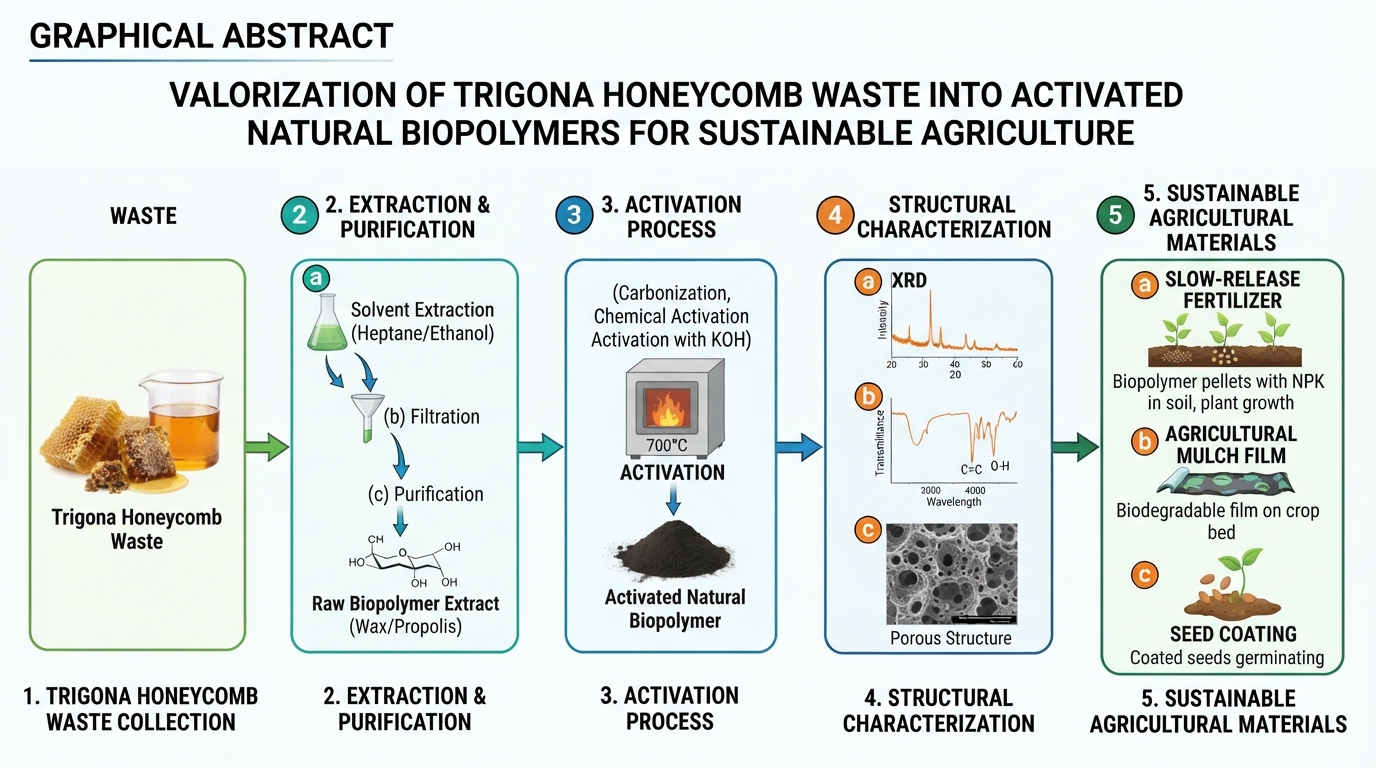
Abstract This study investigates the isolation, activation, and physicochemical characterization of natural biopolymers derived from Trigona honeycomb waste, an underutilized biomass resource with potential value-added applications. The biopolymer was extracted through sequential processes including acid hydrolysis, chlorination, alkaline treatment, and bleaching, followed by chemical activation using a mixed solution of sulfuric acid (H₂SO₄) and acetic acid (CH₃COOH). Structural and compositional analyses were conducted using XRF, XRD, FTIR, and SEM.
XRF results revealed that calcium (Ca) is the dominant component, increasing from 46.6% before activation to 54.8% after activation, indicating enhanced mineral exposure due to structural modification. XRD patterns showed characteristic diffraction peaks at 2θ ≈ 11.65°, 14.81°, 15.99°, 20.81°, and 23.23°, confirming a semi-crystalline Type I biopolymer structure. FTIR spectra identified functional groups typical of natural biopolymers, including hydroxyl (-OH), aliphatic C–H, and C–O–C bonds, suggesting the presence of polysaccharide-based structures. SEM images demonstrated significant morphological changes after activation, with increased surface roughness and the formation of microcavities, which are associated with higher surface area.
These findings indicate that chemical activation significantly alters both the structural and surface properties of the biopolymer, enhancing its potential as a functional biomass precursor. The improved physicochemical characteristics suggest its prospective application in controlled nutrient delivery systems, particularly for sustainable agricultural materials.
References
L. Abdulsalam et al., “Advanced biocompatible and biodegradable polymers: A review of functionalization, smart systems, and sustainable applications,” Polymers (Basel)., vol. 17, no. 21, p. 2901, 2025.
M. Z. Al Mahmud, M. D. Islam, and M. H. Mobarak, “The Development of Eco‐Friendly Biopolymers for Use in Tissue Engineering and Drug Delivery,” J. Nanomater., vol. 2023, no. 1, p. 9270064, 2023.
T. Fazal et al., “Recent developments in natural biopolymer based drug delivery systems,” RSC Adv., vol. 13, no. 33, pp. 23087–23121, 2023.
S. Gulati et al., “Nanobiopolymers in cancer therapeutics: advancing targeted drug delivery through sustainable and controlled release mechanisms,” J. Mater. Chem. B, vol. 12, no. 46, pp. 11887–11915, 2024.
A. C. Q. Silva, A. J. D. Silvestre, C. Vilela, and C. S. R. Freire, “Natural polymers-based materials: A contribution to a greener future,” Molecules, vol. 27, no. 1, p. 94, 2021.
R. K. Pavithran, S. G. Reddy, B. S. Kumar, and S. Kugabalasooriar, “Enhancing sustainability in agriculture: natural polymer-based controlled release systems for effective pest management and environmental protection,” ES Food Agrofor., vol. 18, p. 1276, 2024.
B. Zhang, B. K. Biswal, J. Zhang, and R. Balasubramanian, “Hydrothermal treatment of biomass feedstocks for sustainable production of chemicals, fuels, and materials: progress and perspectives,” Chem. Rev., vol. 123, no. 11, pp. 7193–7294, 2023.
H. Alcocer-García, E. Sánchez-Ramírez, E. García-García, C. Ramírez-Márquez, and J. M. Ponce-Ortega, “Unlocking the potential of biomass resources: a review on sustainable process design and intensification,” Resources, vol. 14, no. 9, p. 143, 2025.
F. G. B. Bueno et al., “Stingless bee floral visitation in the global tropics and subtropics,” Glob. Ecol. Conserv., vol. 43, p. e02454, 2023.
S. Ghosh, D. P. Abrol, and C. Jung, “The State of Beekeeping in India: Insights, Gaps, and Emerging Opportunities,” Entomol. Res., vol. 55, no. 10, p. e70069, 2025.
O. Duangphakdee, J. Baroga-Barbecho, P. Rod-Im, K. Attasopa, A. Locsin, and C. Cervancia, “Economic Feasibility and Income Security of Stingless Bee Keeping for Small-Holder Farmers in Southeast Asia,” in Stingless Bee Nest Cerumen and Propolis, Volume 1, Springer, 2024, pp. 3–31.
T. Mkilima, “Harnessing alkaline-treated agricultural residues for dual-function bioadsorbents and biopolymer precursors,” Biotechnol. Sustain. Mater., vol. 2, no. 1, p. 26, 2025.
A. A. Dandash, B. Abu‐Jdayil, and J. H. Tannous, “Lignin extraction from various biomass sources: A comprehensive review of Characteristics, Applications, and future prospects,” Chem. Rec., vol. 25, no. 8, p. e202500045, 2025.
A. Waithaka et al., “Cellulose-Based biopolymers from banana pseudostem waste: innovations for sustainable bioplastics,” in Waste, MDPI, 2025, p. 37.
S. I. Abro et al., “Valorization strategy for biodegradable products of tissues and paper sheets made from banana pseudostem pulp,” Biomass and Bioenergy, vol. 207, p. 108707, 2026.
M. Sengar et al., “Extraction of plant wax from Colocasia esculenta using polar and non-polar solvents: A sustainable approach,” Biomass Convers. Biorefinery, vol. 15, no. 22, pp. 29401–29413, 2025.
H. O. Onovo, A. A. Agbeleye, T. T. Akano, D. B. Oludele, J. O. Olawoyin, and I. S. Kentosu, “Comprehensive Study of Extraction and Applicability of Nanosilicate Particles from Natural Waste for Biopolymer Reinforcement,” Niger. J. Technol., vol. 43, no. 4, pp. 666–675, 2024.
S. Balkissoon, J. Andrew, and B. Sithole, “Dissolving wood pulp production: a review,” Biomass Convers. biorefinery, vol. 13, no. 18, pp. 16607–16642, 2023.
Z. Huang et al., “Unravelling sequence-dependent molecular transformation pathways of dissolved organic matter in chemical cleaning wastewater during combined Fenton oxidation and activated carbon adsorption processes,” Sep. Purif. Technol., p. 134335, 2025.
D. Mboowa, “A review of the traditional pulping methods and the recent improvements in the pulping processes,” Biomass Convers. Biorefinery, vol. 14, no. 1, pp. 1–12, 2024.
J. Jiang, H. Wang, J. Ren, L. Deng, and D. Che, “Effect of inherent alkali and alkaline earth metals in biochar on adsorption of Pb2+ in aqueous solution: different roles of Na/Mg/K/Ca,” Sep. Purif. Technol., vol. 354, p. 128766, 2025.
R. Murugavel, A. A. Rownaghi, and F. Rezaei, “Effect of alkali metal functionalization on hydrogen storage performance of highly porous activated carbons,” Energy & fuels, vol. 37, no. 23, pp. 19292–19303, 2023.
Z. Deng, Z. Jia, and L. Li, “Biomineralized materials as model systems for structural composites: Intracrystalline structural features and their strengthening and toughening mechanisms,” Adv. Sci., vol. 9, no. 14, p. 2103524, 2022.
L. Zhou et al., “Honeycomb-like macroporous crosslinked chitosan assisted EDTA-intercalated Ca-Mg-Al layered hydrotalcite composite foams for efficient U (VI) biosorption,” Int. J. Biol. Macromol., vol. 279, p. 135011, 2024.
Y. Zhang et al., “Photocatalytic oxidation for volatile organic compounds elimination: from fundamental research to practical applications,” Environ. Sci. Technol., vol. 56, no. 23, pp. 16582–16601, 2022.
P. Tuo, Z. Zhang, P. Du, L. Hu, R. Li, and J. Ren, “Changes in coal waste DOM chemodiversity and Fe/Al oxides during weathering drive the fraction conversion of heavy metals,” Sci. Total Environ., vol. 926, p. 172063, 2024.
A. Cinosi, G. Siviero, and Z. McCaffrey, “Elemental analysis of valuable byproducts by TXRF spectrometry: coal fly ash and activated carbon,” Spectrochim. Acta Part B At. Spectrosc., vol. 220, p. 107017, 2024.
T. R. Tavares, E. de Almeida, C. R. P. Junior, A. Guerrero, P. R. Fiorio, and H. W. P. de Carvalho, “Analysis of total soil nutrient content with X-ray Fluorescence Spectroscopy (XRF): Assessing different predictive modeling strategies and auxiliary variables,” AgriEngineering, vol. 5, no. 2, pp. 680–697, 2023.
N. S. Syazwani, M. N. E. Efzan, C. K. Kok, and M. J. Nurhidayatullaili, “Analysis on extracted jute cellulose nanofibers by Fourier transform infrared and X-Ray diffraction,” J. Build. Eng., vol. 48, p. 103744, 2022.
M.-C. Stanciu, F. Tanasă, and C.-A. Teacă, “Crystallinity changes in modified cellulose substrates evidenced by spectral and X-ray diffraction data,” Polysaccharides, vol. 6, no. 2, p. 30, 2025.
F. CHERIFI, “Extraction, physico-chemicaland morphological analysis of bioproducts from date palm by-products in southern Algeria, and applications.,” université Kasdi Merbah ouargla.
H. Tesfaye, T. Gabriel, N. M. Joseph, and T. Gebre-Mariam, “Comparative Analysis of Cellulose Characteristics from Three Agricultural Waste Biomasses,” J. Nat. Fibers, vol. 22, no. 1, p. 2578610, 2025.
Y. Huang, G. Huang, Z. Han, F. Zhang, M. Liu, and J. Hao, “Evolution of Mechanical Properties, Mineral Crystallization, and Micro-Gel Formation in Alkali-Activated Carbide Slag Cementitious Materials,” Crystals, vol. 15, no. 8, p. 731, 2025.
N. Böhme, K. Hauke, M. Dohrn, M. Neuroth, and T. Geisler, “High-temperature phase transformations of hydroxylapatite and the formation of silicocarnotite in the hydroxylapatite–quartz–lime system studied in situ and in operando by Raman spectroscopy,” J. Mater. Sci., vol. 57, no. 32, pp. 15239–15266, 2022.
J. Li and M. Hitch, “Characterization of the microstructure of mechanically-activated olivine using X-ray diffraction pattern analysis,” Miner. Eng., vol. 86, pp. 24–33, 2016.
P. Pourghahramani and E. Forssberg, “Microstructure characterization of mechanically activated hematite using XRD line broadening,” Int. J. Miner. Process., vol. 79, no. 2, pp. 106–119, 2006.
M. H. Mulla et al., “Low velocity impact performance of natural fibre reinforced polymer composites: a review,” Funct. Compos. Struct., vol. 5, no. 3, p. 35004, 2023.
M. H. Mulla, M. N. Norizan, N. F. M. Rawi, M. H. M. Kassim, N. Abdullah, and M. N. F. Norrrahim, “Surface and interfaces effects of concentrations and alkaline treatment durations on sugar palm fiber as structural reinforcement in polymer composites,” J. Nat. Fibers, vol. 22, no. 1, p. 2527277, 2025.
S. V. María et al., “Biopolymer production by bacteria isolated from native stingless bee honey, Scaptotrigona jujuyensis,” Food Biosci., vol. 42, p. 101077, 2021.
S. Azeez and R. Shenbagaraman, “Fourier transform infrared spectroscopy in characterization of bionanocomposites,” in Characterization Techniques in Bionanocomposites, Elsevier, 2025, pp. 209–227.
M. O. Yusuf, “Bond characterization in cementitious material binders using Fourier-transform infrared spectroscopy,” Appl. Sci., vol. 13, no. 5, p. 3353, 2023.
R. Md Salim, J. Asik, and M. S. Sarjadi, “Chemical functional groups of extractives, cellulose and lignin extracted from native Leucaena leucocephala bark,” Wood Sci. Technol., vol. 55, no. 2, pp. 295–313, 2021.
H. G. Higgins, C. M. Stewart, and K. J. Harrington, “Infrared spectra of cellulose and related polysaccharides,” J. Polym. Sci., vol. 51, no. 155, pp. 59–84, 1961.
N. Ikhtiarini, M. Masruri, and S. M. Ulfa, “Synthesis and Characterization of Cellulose Acetate and Nanocellulose Acetate from Sengon Agroindustrial Waste (Paraserianthes falcataria).,” J. Pure Appl. Chem. Res., vol. 11, no. 3, 2022.
O. El Samrout, “Molecules at surfaces: formation, reactivity, assembly of (bio) molecules on external and internal surfaces of nanosized/nanostructured materials,” 2023.
Z. Tang, “Fabrication of Surfaces With Controlled Wetting Properties on Porous Substrates Using Nonfluorinated Chemicals,” 2016, Georgia Institute of Technology.
S. Li, G. Ni, H. Wang, M. Xun, and Y. Xu, “Effects of acid solution of different components on the pore structure and mechanical properties of coal,” Adv. Powder Technol., vol. 31, no. 4, pp. 1736–1747, 2020.
J. Kang, X. Yang, Q. Hu, Z. Cai, L.-M. Liu, and L. Guo, “Recent progress of amorphous nanomaterials,” Chem. Rev., vol. 123, no. 13, pp. 8859–8941, 2023.
A. Mazzoli and O. Favoni, “Particle size, size distribution and morphological evaluation of airborne dust particles of diverse woods by Scanning Electron Microscopy and image processing program,” Powder Technol., vol. 225, pp. 65–71, 2012.
S. F. Islam, S. M. Hawkins, J. L. L. Meyer, and A. R. C. Sharman, “Evaluation of different particle size distribution and morphology characterization techniques,” Addit. Manuf. Lett., vol. 3, p. 100077, 2022.
S. P. Yeap, “Permanent agglomerates in powdered nanoparticles: Formation and future prospects,” Powder Technol., vol. 323, pp. 51–59, 2018.
Downloads
Published
Issue
Section
License
Copyright (c) 2026 irwan ramli, Hilda Rahmawati, Siti Nurmiati, Fitrah Al Anshori, Yanuar Sigit Pramana, Sukarti, Rapiah, Silfa Azzahraa

This work is licensed under a Creative Commons Attribution-NonCommercial 4.0 International License.