
Hydrothermally Synthesized Carbon Quantum Dots from Amomum compactum for Fluorescence-Based Fe³⁺ Sensing
DOI:
https://doi.org/10.11113/mjfas.v22n3.5417Keywords:
carbon quantum dots; Amomum compactum; fluorescence sensing; Fe³⁺ detection; environmental monitoringAbstract
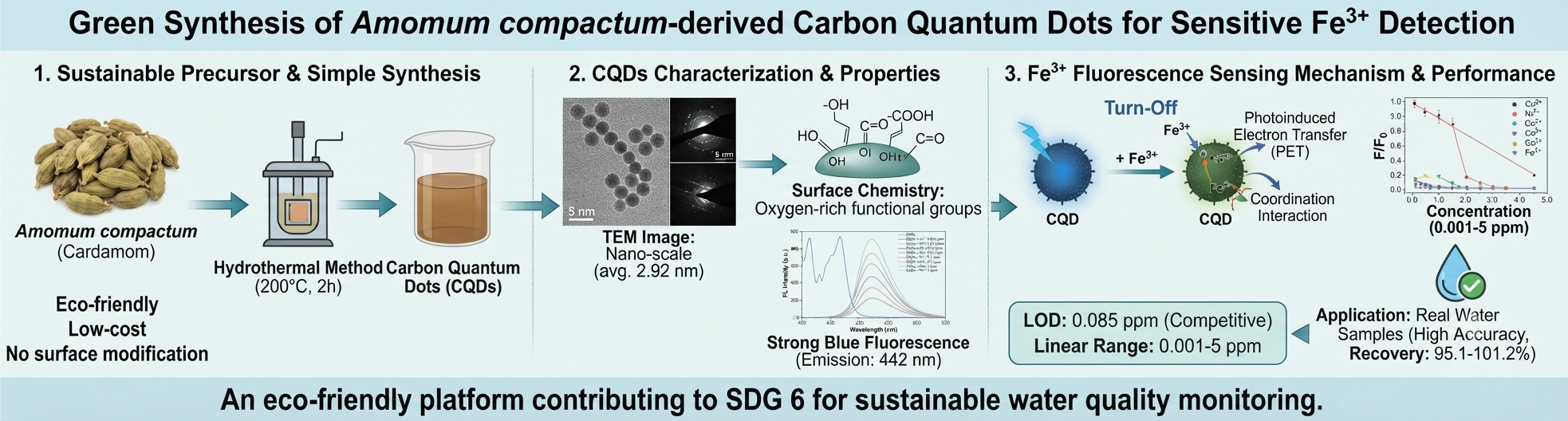
This study reports the green synthesis of carbon quantum dots (CQDs) derived from Amomum compactum via a simple hydrothermal method for the sensitive and selective fluorescence-based detection of Fe³⁺ ions. Compared with previously reported biomass-derived CQD sensors, the developed system offers a simple synthesis route without additional surface modification, high selectivity toward Fe³⁺, and reliable sensing performance in real water samples. The obtained CQDs exhibit nanoscale dimensions (2.92 nm), strong blue emission, and excitation-dependent optical behavior attributed to quantum confinement effects and abundant oxygen-containing functional groups. These surface characteristics facilitate strong interactions with metal ions, where Fe³⁺ induces a pronounced fluorescence quenching response through coordination interactions and electron transfer with oxygen-containing surface groups, compared to other tested ions, demonstrating high selectivity. The sensing system shows a linear response over a concentration range of 0.001–5 ppm with a low detection limit of 0.085 ppm, which is competitive with several previously reported CQD-based Fe³⁺ fluorescent sensors, meeting requirements for environmental monitoring. Application in real water samples confirms high accuracy and precision, with recovery values ranging from 95.1% to 101.2%. Overall, this work highlights an eco-friendly, cost-effective sensing platform that supports sustainable water quality monitoring, contributing to Sustainable Development Goals (SDGs), particularly SDG 6.
References
Han, Y., Li, M., Zheng, J., Wei, L., & Zhu, L. (2022). Green conversion of excess sludge to N-Ca self-doping sustainable carbon quantum dots with remarkable fluorescence enhancement and residual heavy metal reduction. Journal of Environmental Chemical Engineering, 10, 108934. https://doi.org/10.1016/j.jece.2022.108934
You, X.-Y., Yin, W.-M., Wang, Y., Wang, C., Zheng, W.-X., & Guo, Y.-R. (2024). Enrichment and immobilization of heavy metal ions from wastewater by nanocellulose/carbon dots-derived composite. International Journal of Biological Macromolecules, 255, 128274. https://doi.org/10.1016/j.ijbiomac.2023.128274
Zhang, J., Wang, Q., Wan, H., Shi, Y., & Huang, L. (2023). Enhanced etching terminal wastewater treatment and H₂ production by in-situ deposited heavy metals on carbon dots/g-C₃N₄ photocathode microbial electrolysis cells. Journal of Hazardous Materials, 459, 132178. https://doi.org/10.1016/j.jhazmat.2023.132178
Obayes, H. K., Meteab, M. H., & Al-Kareem, B. A. (2024). Modified dosimetric features of new type of lithium borate glass system: Role of magnesium and gold Co-doping. Transactions on Electrical and Electronic Materials, 25(6), 708-721. https://doi.org/10.1007/s42341-024-00551-2
Sami, N. A., Nattah, A. M., Jawad, R. A., Meteab, M. H., & Mohammed, M. K. (2025). Modification and Enhancement of The Structural, Morphological and Optical Characteristics of PMMA/In2O3/SiO2 Promising Ternary Nanostructures for Optical Nanodevices and Gamma Ray Attenuation. Trends in Sciences, 22(7), 9959-9959. https://doi.org/10.48048/tis.2025.9959
Ananda, B., Krushna, B. R. R., Sharma, S. C., Salwe, K. J., Sharma, R., & Akkara, P. J. (2025). Microwave enhanced carbon dots synthesis from eggshell membrane: Versatile applications in heavy metal ion sensing, strain free detection of fingerprints, UV shielding, food packing and anti-counterfeiting. Colloids and Surfaces A: Physicochemical and Engineering Aspects, 705, 135740. https://doi.org/10.1016/j.colsurfa.2024.135740
Bhattacharjee, T., Konwar, A., Boruah, J. S., Chowdhury, D., & Majumdar, G. (2023). A sustainable approach for heavy metal remediation from water using carbon dot based composites: A review. Journal of Hazardous Materials Advances, 10, 100295. https://doi.org/10.1016/j.hazadv.2023.100295
Hadi, A. N., Meteab, M. H., & Mohammed, M. K. (2025). Influence of Inclusion Sb2O3/NiO Nanostructures on the Morphological, Microstructural, and Optical Characteristics of PVA Polymeric for Gamma-Ray Shielding Applications. Revue des Composites et des Materiaux Avances, 35(3), 581. https://doi.org/10.18280/rcma.350319
Koparde, S. V., Nille, O. S., Kolekar, A. G., Bote, P. P., Gaikwad, K. V., & Anbhule, P. V. (2024). Okra peel-derived nitrogen-doped carbon dots: Eco-friendly synthesis and multi-functional applications in heavy metal ion sensing, nitro compound detection and environmental remediation. Spectrochimica Acta Part A: Molecular and Biomolecular Spectroscopy, 321, 124659. https://doi.org/10.1016/j.saa.2024.124659
Aygun, A., Cobas, I., Tiri, R. N. E., & Sen, F. (2024). Hydrothermal synthesis of B, S, and N-doped carbon quantum dots for colorimetric sensing of heavy metal ions. RSC Advances, 14, 10814–10825. https://doi.org/10.1039/d4ra00397g
Algethami, F. K., & Abdelhamid, H. N. (2024). Heteroatoms-doped carbon dots as dual probes for heavy metal detection. Talanta, 273, 125893. https://doi.org/10.1016/j.talanta.2024.125893
Baruah, S., Hazarika, P., Konwar, A., Hazarika, K. K., & Hazarika, S. (2025). Corrigendum to “Synergistic optical sensing of heavy metal ions using Mesua ferrea-derived carbon dot embedded alginate based biopolymeric film as a sensor platform”. International Journal of Biological Macromolecules. https://doi.org/10.1016/j.ijbiomac.2025.147572
Wang, F., Zhang, Y., Li, H., Gong, W., Han, J., & Jiang, S. (2025). Application of carbon quantum dots as fluorescent probes in the detection of antibiotics and heavy metals. Food Chemistry, 463, 141122. https://doi.org/10.1016/j.foodchem.2024.141122
Akbar, S. A., Hasan, M., Nazar, M., Zulfahmi, I., Miswar, E., & Iqhrammullah, M. (2025). Fluorescent carbon quantum dots from Syzygium aromaticum as a selective sensor for Fe³⁺ and Cd²⁺ detection in aqueous solution. Case Studies in Chemical and Environmental Engineering, 11, 101166. https://doi.org/10.1016/j.cscee.2025.101166
Venkatesan, G., & Sathiyan, G. (2025). Recent trends in use of plant-derived carbon dot-based fluorescent probes for heavy metal ion detection and their biological applications. Trends in Environmental Analytical Chemistry, 46, e00259. https://doi.org/10.1016/j.teac.2025.e00259
Yan, F., Liu, S., Huo, X., Liang, G., Yang, F., Zhang, B., & others. (2025). Engineering a carbon dot-decorated fluorescent nanoplatform to promote heavy metal reutilization and photothermal evaporation with antibacterial activity. Chemical Engineering Journal, 504, 158890. https://doi.org/10.1016/j.cej.2024.158890
Zhong, W., & Yang, J. (2024). Fluorescent carbon quantum dots for heavy metal sensing. Science of the Total Environment, 957, 177473. https://doi.org/10.1016/j.scitotenv.2024.177473
Chobpattana, V., Sangtawesin, T., Khaopueak, P., & Wechakorn, K. (2025). Sugar derived fluorescent carbon quantum dots conjugated glutathione for sensing heavy metal ions and antioxidant activity. Materials Science and Engineering: B, 313, 117956. https://doi.org/10.1016/j.mseb.2024.117956
Baruah, S., Hazarika, P., Konwar, A., Hazarika, K. K., & Hazarika, S. (2025). Synergistic optical sensing of heavy metal ions using Mesua ferrea derived carbon dot embedded alginate based biopolymeric film as a sensor platform. International Journal of Biological Macromolecules, 286, 138227. https://doi.org/10.1016/j.ijbiomac.2024.138227
Kadhim, K. K., Azeez, H. M., Yousif, R. T., Mohammed, M. K., & Meteab, M. H. (2025). Boosting the structural, optical and AC electrical characteristics of PVA/CdTe nanocomposites for flexible smart optoelectronic devices. International Journal of Nanoelectronics and Materials (IJNeaM), 18(4), 527-536. https://doi.org/10.58915/ijneam.v18i4.2617
Nurcholis, W., Sya’bani Putri, D. N., Husnawati, H., Aisyah, S. I., & Priosoeryanto, B. P. (2021). Total flavonoid content and antioxidant activity of ethanol and ethyl acetate extracts from accessions of Amomum compactum fruits. Annals of Agricultural Sciences, 66, 58–62. https://doi.org/10.1016/j.aoas.2021.04.001
Anum, J., Akhtar, M. A., Khan, A. M., Ahmed, K., Sayes, C. M., & Almajwal, A. M. (2025). Green-synthesized amino-rich carbon quantum dots: A dual-function platform for fluorescent detection of heavy metals and degradation of malachite green dye. Journal of Water Process Engineering, 77, 108472. https://doi.org/10.1016/j.jwpe.2025.108472
Singh, P., & Singh, L. K. (2025). Carbon quantum dots as a promising tool for heavy metal sensing and removal in wastewater. Desalination and Water Treatment, 324, 101435. https://doi.org/10.1016/j.dwt.2025.101435
Srivastava, S. K., Pratap, R., Yadav, M., Mishra, M., Chaudhary, S., & Chawla, R. (2025). Biogenic synthesis of highly stable multifluorescent carbon quantum dots as dual probe sensor for detection of heavy toxic metal ions. Colloids and Surfaces A: Physicochemical and Engineering Aspects, 723, 137336. https://doi.org/10.1016/j.colsurfa.2025.137336
Enriquez, B. U. M., Rangel-Ayala, M., Kumar, Y., Garcia, J. E., Gomez-Aguilar, J. F., & Khandual, S. (2025). Multifunctional Arthrospira platensis biomass derived carbon dots: Sensing/removal of heavy metal ions and optoelectronic applications. Journal of Environmental Chemical Engineering, 13, 117827. https://doi.org/10.1016/j.jece.2025.117827
Maity, S., Kumar, S., Singh, G., Patra, S., Pareek, D., & Paik, P. (2025). Selective sensing of heavy metal ions using carbon dots synthesized from Azadirachta indica seeds. Sensors and Diagnostics, 4, 407–415. https://doi.org/10.1039/d4sd00350k
Wu, H., & Gao, H. (2025). Preparation of Auricularia auricula doped carbon-nitrogen quantum dots and their application in detecting heavy metal ions. Chinese Journal of Analytical Chemistry, 53, 100596. https://doi.org/10.1016/j.cjac.2025.100596
Javeria, H., Abbas, M. Q., Chen, S.-H., Keshat, B. E., & Du, Z. (2025). Scalability of sulfur-functionalized carbon quantum dots from peanut shells: A sustainable sensor for heavy metal detection. Journal of Environmental Chemical Engineering, 13, 115821. https://doi.org/10.1016/j.jece.2025.115821
Akbar, S. A., Zulfahmi, I., Setiawan, I., Jalil, Z., Rahman, M. M., & Lahori, A. H. (2026). Green synthesis of biomass-derived carbon quantum dots from Syzygium Aromaticum via carbonization-assisted ultrasonication for a selective colorimetric sensor of Ag⁺ in environmental waters. Applied Science And Engineering Progress, 19(2), 7925. https://doi.org/10.14416/j.asep.2025.09.011
Akbar, S. A., Irham, M., Hasan, H. A., Zulfahmi, I., Iqbal, T., Ahsan, A., Rahman, M. M., & Jalil, Z. (2026). Fluorescent optical sensor for Fe³⁺ detection using Syzygium Aromaticum-derived carbon quantum dots embedded in corn starch biopolymeric film. International Journal Of Biological Macromolecules, 359, 151873. https://doi.org/10.1016/j.ijbiomac.2026.151873
Akbar, S. A., Rochliadi, A., Suendo, V., Saidi, N., Lelifajri, L., & Mardhiah, A. A. (2018). Raman spectroscopy study of the polyaniline electrode on Zn polyaniline rechargeable batteries. Rasayan J. Chem, 11, 1525-1531. http://dx.doi.org/10.31788/RJC.2018.1144064
Akbar, S. A., Hasan, M., Jalil, Z., Zulfahmi, I., Iqhrammullah, M., & Safina, N. (2025). Enhanced ammonia nitrogen filtration using NaOH-activated Manihot utilissima peel carbon: Application in recirculating aquaculture systems for Nile tilapia. Chemosphere, 385, 144537. https://doi.org/10.1016/j.chemosphere.2025.144537
Nagaraj, M., Ramalingam, S., Murugan, C., Aldawood, S., Jin, J. O., Choi, I., & Kim, M. (2022). Detection of Fe³⁺ ions in aqueous environment using fluorescent carbon quantum dots synthesized from endosperm of Borassus Flabellifer. Environmental Research, 212, 113273. https://doi.org/10.1016/j.envres.2022.113273
Zhang, J., Zheng, G., Tian, Y., Zhang, C., Wang, Y., Liu, M., Ren, D., Sun, H., & Yu, W. (2022). Green synthesis of carbon dots from elm seeds via hydrothermal method for Fe³⁺ detection and cell imaging. Inorganic Chemistry Communications, 144, 109837. https://doi.org/10.1016/j.inoche.2022.109837
Quang, N. K., & Son, L. V. T. (2022). Sensitive detection of Fe³⁺ ions and cell imaging of carbon nanodots derived from canistel (Pouteria Campechiana). MRS Advances, 7, 278–283. https://doi.org/10.1557/s43580-022-00267-6
Jiao, X. Y., Li, L. S., Qin, S., Zhang, Y., Huang, K., & Xu, L. (2019). The synthesis of fluorescent carbon dots from mango peel and their multiple applications. Colloids And Surfaces A: Physicochemical And Engineering Aspects, 577, 306–314. https://doi.org/10.1016/j.colsurfa.2019.05.073
Zulfajri, M., Gedda, G., Chang, C. J., Chang, Y. P., & Huang, G. G. (2019). Cranberry beans derived carbon dots as a potential fluorescence sensor for selective detection of Fe³⁺ ions in aqueous solution. ACS Omega, 4, 15382–15392. https://doi.org/10.1021/acsomega.9b01333
Wang, N., Wang, Y., Guo, T., Yang, T., Chen, M., & Wang, J. (2016). Green preparation of carbon dots with papaya as carbon source for effective fluorescent sensing of iron (III) and Escherichia Coli. Biosensors And Bioelectronics, 85, 68–75. https://doi.org/10.1016/j.bios.2016.04.089
Atchudan, R., Edison, T. N. J. I., Aseer, K. R., Perumal, S., & Lee, Y. R. (2018). Hydrothermal conversion of Magnolia Liliiflora into nitrogen-doped carbon dots as an effective turn-off fluorescence sensing, multi-colour cell imaging and fluorescent ink. Colloids And Surfaces B: Biointerfaces, 169, 321–328. https://doi.org/10.1016/j.colsurfb.2018.05.032
Zhao, W. B., Liu, K. K., Song, S. Y., Zhou, R., & Shan, C. X. (2019). Fluorescent nano-biomass dots: Ultrasonic-assisted extraction and their application as nanoprobe for Fe³⁺ detection. Nanoscale Research Letters, 14, 130. https://doi.org/10.1186/s11671-019-2950-x
Huang, G., Chen, X., Wang, C., Zheng, H., Huang, Z., Chen, D., & Xie, H. (2017). Photoluminescent carbon dots derived from sugarcane molasses: Synthesis, properties, and applications. RSC AdvanceS, 7, 47840–47847. https://doi.org/10.1039/c7ra09002a
Bi, J., Wang, H., Kamal, T., Zhu, B. W., & Tan, M. (2017). A fluorescence turn-off-on chemosensor based on carbon nanocages for detection of ascorbic acid. RSC Advances, 7, 30481–30487. https://doi.org/10.1039/c7ra04394e
Downloads
Published
Issue
Section
License
Copyright (c) 2026 Said Ali Akbar, Cut Nuzlia, Muhammad Hasan

This work is licensed under a Creative Commons Attribution-NonCommercial 4.0 International License.