
Stingless Bee Honey-Based Hydrogel Incorporating Plant Extracts for Wound Healing Applications
DOI:
https://doi.org/10.11113/mjfas.v22n4.5375Keywords:
hydrogel; plant extract; honey; wound healing; biocompatibility; natural polymer; phytochemical; extract loadingAbstract
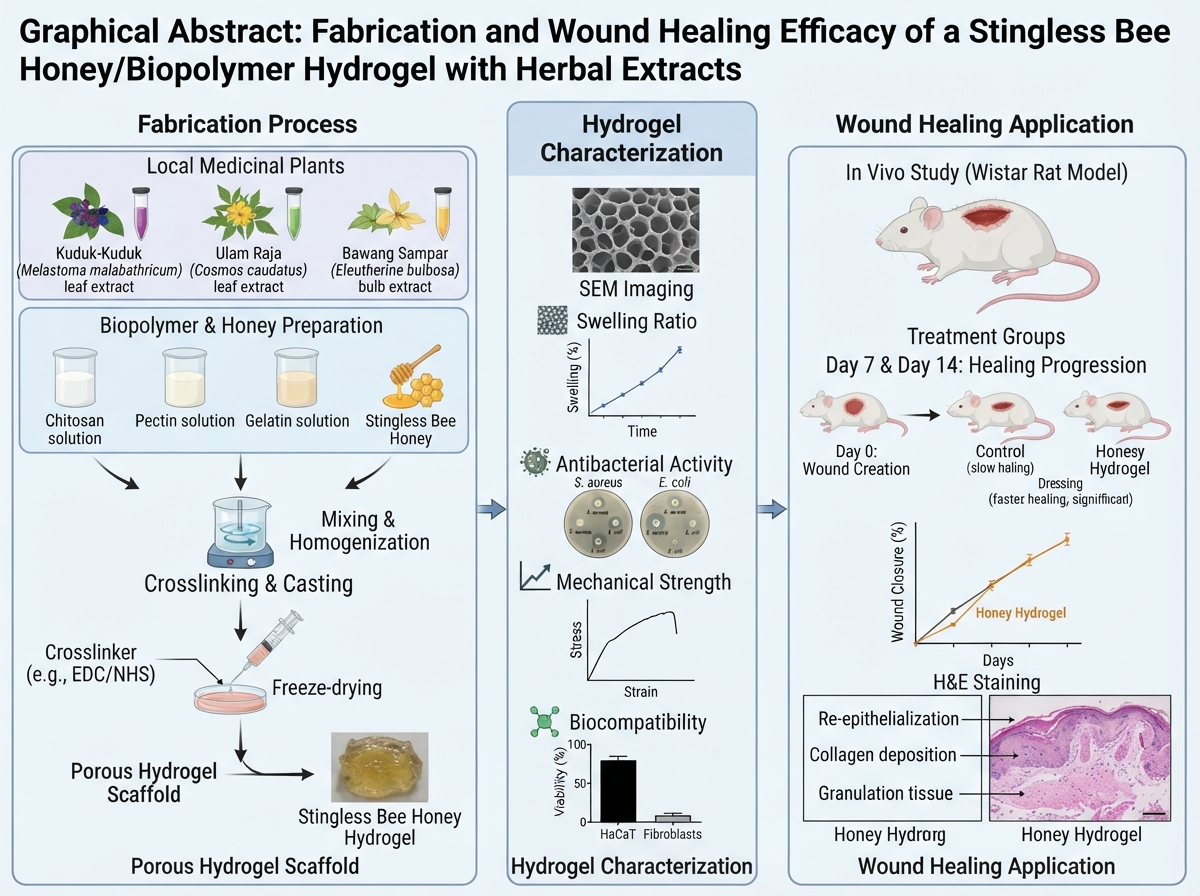
Hydrogels are solid-like materials that are widely used in medicine, particularly as wound dressings, due to their ability to retain moisture, protect wounds from external contaminants, and remain permeable to oxygen. In this research, hydrogels were fabricated using chitosan, pectin, gelatin, stingless bee honey, and the incorporation of medicinal plant extracts to enhance their therapeutic properties. The aim of this study was to fabricate hydrogels incorporating three different medicinal plants and to evaluate their physical, chemical, mechanical, and biological characteristics, as well as to identify the most suitable medicinal plant for wound-dressing applications. FTIR analysis of hydrogel with and without plant extracts confirmed the presence of functional groups associated with the polymers, honey, and plant extracts. Swelling testing revealed a high water absorption capability and this demonstrated their ability to maintain a moist healing environment. XRD analysis exhibited amorphous structures for all samples, indicating that the addition of plant extracts did not alter their crystallinity. Mechanical testing showed that extract-loaded hydrogels exhibited Young’s modulus values of 0.10-0.19 MPa compared to 0.20 MPa for the control, suggesting reduced stiffness upon extract incorporation, with Ulam Raja formulations showing the greatest reduction from 0.18 MPa to 0.10 MPa as extract loading increased. Biocompatibility assessment using human osteoblast cells showed no cytotoxic effects in all hydrogel formulations, with cell densities increasing from 6.09 ´ 106 cells/mL at Day 0 to 1.10 ´ 107-4.70 ´ 107 cells/mL at Day 5, under the current experimental conditions.
References
H. Suhaimi, N. Murdini, N. Shamsuddin, A. Ma’amor, and P. E. Abas, “Synthesis and Characterization of Honey-Pectin Hydrogel: Exploring Potential Applications in Wound Healing,” Malaysian Journal of Fundamental and Applied Sciences, vol. 21, no. 2, pp. 1907–1927, Apr. 2025, doi: 10.11113/mjfas.v21n2.3907.
L. Qiao et al., “Antibacterial conductive self-healing hydrogel wound dressing with dual dynamic bonds promotes infected wound healing,” Bioact. Mater., vol. 30, pp. 129–141, Dec. 2023, doi: 10.1016/j.bioactmat.2023.07.015.
A. Mallick Choudhury, S. S. Mandal, N. K. Singh, M. Sahu, and P. Maiti, “Plant-extract hydrogel for effective wound healing: Animal model studies,” Chemical Engineering Journal, vol. 514, Jun. 2025, doi: 10.1016/j.cej.2025.163131.
Y. Liu, J. Liu, A. Zhang, G. Zhao, B. Jiang, and X. Zhao, “Application prospect of Marine polysaccharide hydrogels in promoting wound healing: A review,” Carbohydr. Res., vol. 558, Dec. 2025, doi: 10.1016/j.carres.2025.109673.
S. Dhivya, V. V. Padma, and E. Santhini, “Wound dressings – a review,” Biomedicine (Taipei)., vol. 5, no. 4, Nov. 2024, doi: 10.37796/2211-8039.1526.
A. Alberts, E. T. Moldoveanu, A. G. Niculescu, and A. M. Grumezescu, “Hydrogels for Wound Dressings: Applications in Burn Treatment and Chronic Wound Care,” Journal of Composites Science, vol. 9, no. 3, p. 133, Mar. 2025, doi: 10.3390/jcs9030133.
L. Wang, M. Zhou, T. Xu, and X. Zhang, “Multifunctional hydrogel as wound dressing for intelligent wound monitoring,” Chemical Engineering Journal, vol. 433, Apr. 2022, doi: 10.1016/j.cej.2022.134625.
M. H. Norahan, S. C. Pedroza-González, M. G. Sánchez-Salazar, M. M. Álvarez, and G. Trujillo de Santiago, “Structural and biological engineering of 3D hydrogels for wound healing,” Bioact. Mater., vol. 24, pp. 197–235, Jun. 2023, doi: 10.1016/j.bioactmat.2022.11.019.
V. Gounden and M. Singh, “Hydrogels and Wound Healing: Current and Future Prospects,” Gels, vol. 10, no. 1, Jan. 2024, doi: 10.3390/gels10010043.
M. Krishani, W. Y. Shin, H. Suhaimi, and N. S. Sambudi, “Development of Scaffolds from Bio-Based Natural Materials for Tissue Regeneration Applications: A Review,” Gels, vol. 9, no. 2, Feb. 2023, doi: 10.3390/gels9020100.
M. Krishani, N. S. Sambudi, and H. Suhaimi, “Green Catalysts in the Synthesis of Biomaterials for Biomedical Applications,” in Sustainable Green Biomaterials As Drug Delivery Systems, vol. 1, Springer, Cham, 2025, pp. 217–252. doi: https://doi.org/10.1007/978-3-031-79062-1_9.
S. W. Chin, A. S. Azman, and J. W. Tan, “Incorporation of natural and synthetic polymers into honey hydrogel for wound healing: A review,” Health Sci. Rep., vol. 7, no. 7, Jul. 2024, doi: 10.1002/hsr2.2251.
O. Phonrachom, P. Charoensuk, K. Kiti, N. Saichana, P. Kakumyan, and O. Suwantong, “Potential use of propolis-loaded quaternized chitosan/pectin hydrogel films as wound dressings: Preparation, characterization, antibacterial evaluation, and in vitro healing assay,” Int. J. Biol. Macromol., vol. 241, Jun. 2023, doi: 10.1016/j.ijbiomac.2023.124633.
J. Feng et al., “Preparation and evaluation of chitosan/salicylaldehyde/collagen peptide Schiff base hydrogels for wound healing,” J. Mol. Struct., vol. 1352, Feb. 2025, doi: 10.1016/j.molstruc.2025.144554.
A. Chetouani et al., “Multifunctional hydrogels based on oxidized pectin and gelatin for wound healing improvement,” Int. J. Biol. Macromol., vol. 212, pp. 248–256, Jul. 2022, doi: 10.1016/j.ijbiomac.2022.05.082.
S. S. Mujawar et al., “3D printed Aloe barbadensis loaded alginate-gelatin hydrogel for wound healing and scar reduction: In vitro and in vivo study,” Int. J. Biol. Macromol., vol. 296, Mar. 2025, doi: 10.1016/j.ijbiomac.2025.139745.
X. F. Zheng, Q. Lian, and S. T. LianSong, “Chitosan-gelatin-pectin composite films from polyion-complex hydrogels,” Asian Journal of Chemistry, vol. 25, no. 10, pp. 5363–5366, Aug. 2013, doi: 10.14233/ajchem.2013.14193.
Q. Zhang, M. Zhang, T. Wang, X. Chen, Q. Li, and X. Zhao, “Preparation of aloe polysaccharide/honey/PVA composite hydrogel: Antibacterial activity and promoting wound healing,” Int. J. Biol. Macromol., vol. 211, pp. 249–258, Jun. 2022, doi: 10.1016/j.ijbiomac.2022.05.072.
M. A. Abd Jalil, M. L. Md Isa, U. Azhan, K. A. Khalid, M. A. Barkat, and H. Hadi, “Evaluating the Wound Healing Activity of Fabricated Stingless Bee Honey Hydrogels in an Animal Model,” Journal of Pharmacy, vol. 5, no. 2, pp. 286–304, Jul. 2025, doi: 10.31436/jop.v5i2.399.
P. Nezhad-Mokhtari et al., “Recent advances in honey-based hydrogels for wound healing applications: Towards natural therapeutics,” J. Drug Deliv. Sci. Technol., vol. 66, Dec. 2021, doi: 10.1016/j.jddst.2021.102789.
A. M. B. Ratnayake et al., “Machine Learning-Based Acoustic Analysis of Stingless Bee (Heterotrigona itama) Alarm Signals During Intruder Events,” Agriculture (Switzerland), vol. 15, no. 6, Mar. 2025, doi: 10.3390/agriculture15060591.
A. M. B. Ratnayake, H. M. Yasin, A. G. Naim, and P. E. Abas, “Buzzing through Data: Advancing Bee Species Identification with Machine Learning,” Applied System Innovation, vol. 7, no. 4, Aug. 2024, doi: 10.3390/asi7040062.
A. Ratnayake, H. M. Yasin, A. G. Naim, and P. E. Abas, “Classification of Subspecies of Honey Bees using Convolutional Neural Network,” IEEE Xplore, pp. 1–6, Dec. 2023, doi: 10.1109/ACIIS59385.2023.10367282.
I. C. Călina, A. Scărișoreanu, M. Demeter, E. Mănăilă, and G. Crăciun, “Strategies for Incorporating Natural Therapeutic Agents into Hydrogel Dressings: Innovations in Wound Healing,” Polymers (Basel)., vol. 17, no. 23, Dec. 2025, doi: 10.3390/polym17233105.
U. Jain and N. Gupta, “Prominent wound healing properties of indigenous medicines,” Journal of Natural Pharmaceuticals, vol. 1, no. 1, p. 2, Jan. 2010, doi: 10.4103/2229-5119.73579.
Y. Iqbal et al., “Chitosan-based functional materials combined with plant extract: A promising strategy in the stimulation of wound healing process,” J. Drug Deliv. Sci. Technol., vol. 101, Nov. 2024, doi: 10.1016/j.jddst.2024.106314.
T. H. Lee et al., “Comparison of extraction methods of phytochemical compounds from white flower variety of Melastoma malabathricum,” South African Journal of Botany, vol. 148, pp. 170–179, Aug. 2022, doi: 10.1016/j.sajb.2022.04.026.
D. T. Mareta, U. Santoso, Supriyadi, and W. Setyaningsih, “Optimized ultrasound-assisted extraction for phenolic and antioxidant analysis in purple senggani (Melastoma malabathricum) flowers: Influence of developmental stages,” Food Chemistry Advances, vol. 7, Jun. 2025, doi: 10.1016/j.focha.2025.100949.
D. P. Ferreira et al., “Toxicity and Anti-inflammatory Effects of Eleutherine bulbosa (Miller) Urb, Ethanolic Extract, in Zebrafish (Danio rerio),” Antiinflamm. Antiallergy Agents Med. Chem., vol. 24, no. 3, pp. 199–214, 2025, doi: 10.2174/0118715230352701241130053455.
A. A. Kamarudin, N. H. Sayuti, N. Saad, N. A. A. Razak, and N. M. Esa, “Induction of apoptosis by Eleutherine bulbosa (Mill.) Urb. bulb extracted under optimised extraction condition on human retinoblastoma cancer cells (WERI-Rb-1),” J. Ethnopharmacol., vol. 284, Feb. 2022, doi: 10.1016/j.jep.2021.114770.
M. Ahda, I. Jaswir, A. Khatib, Q. U. Ahmed, and S. N. A. Syed Mohamad, “A review on Cosmos caudatus as A potential medicinal plant based on pharmacognosy, phytochemistry, and pharmacological activities,” Int. J. Food Prop., vol. 26, no. 1, pp. 344–358, Jan. 2023, doi: 10.1080/10942912.2022.2158862.
S. H. Cheng, M. Y. Barakatun-Nisak, J. Anthony, and A. Ismail, “Potential medicinal benefits of Cosmos caudatus (Ulam Raja): A scoping review,” Journal of Research in Medical Sciences, vol. 20, no. 10, pp. 1000–1006, Oct. 2015, doi: 10.4103/1735-1995.172796.
M. Krishani, J. N. Chong, W. R. Lim, N. Jusoh, N. S. Sambudi, and H. Suhaimi, “Synthesis and Characterization of Keratin-Based Scaffold for Potential Tissue Engineering Applications,” Fibers, vol. 13, no. 7, Jul. 2025, doi: 10.3390/fib13070097.
D. K. Hassan, H. Suhaimi, M. R. Bilad, and P. E. Abas, “Automated Cell Counting using Image Processing,” International Journal of Computing, vol. 22, no. 3, pp. 302–310, Oct. 2023, doi: 10.47839/ijc.22.3.3224.
L. Zamora-Mendoza, S. N. Vispo, L. De Lima, J. R. Mora, A. Machado, and F. Alexis, “Hydrogel for the Controlled Delivery of Bioactive Components from Extracts of Eupatorium glutinosum Lam. Leaves,” Molecules, vol. 28, no. 4, Feb. 2023, doi: 10.3390/molecules28041591.
I. L. Lixandru Matei et al., “RETINOL DISPERSION IN THE FORM OF HYDROGEL FOR DERMAL DELIVERY,” Studia Universitatis Babes-Bolyai Chemia, vol. 2025, no. 2, pp. 37–51, 2025, doi: 10.24193/subbchem.2025.2.03.
A. Kawee-ai, “Advancing Gel Systems with Natural Extracts: Antioxidant, Antimicrobial Applications, and Sustainable Innovations,” Gels, vol. 11, no. 2, Feb. 2025, doi: 10.3390/gels11020125.
Downloads
Published
Issue
Section
License
Copyright (c) 2026 Elene Xie Yin Aw, Siti Nurhazimah Mahmud, Pg Emeroylariffion Abas, Hazwani Suhaimi

This work is licensed under a Creative Commons Attribution-NonCommercial 4.0 International License.