
Generative AI and Computer Vision-based Hybrid Approach for Plant Diseases Classification
DOI:
https://doi.org/10.11113/mjfas.v22n4.5321Keywords:
Cotton leaf disease classification, StyleGAN3-ADA, ConvNeXt, synthetic image augmentation, precision agriculture, retrieval-augmented generation.Abstract
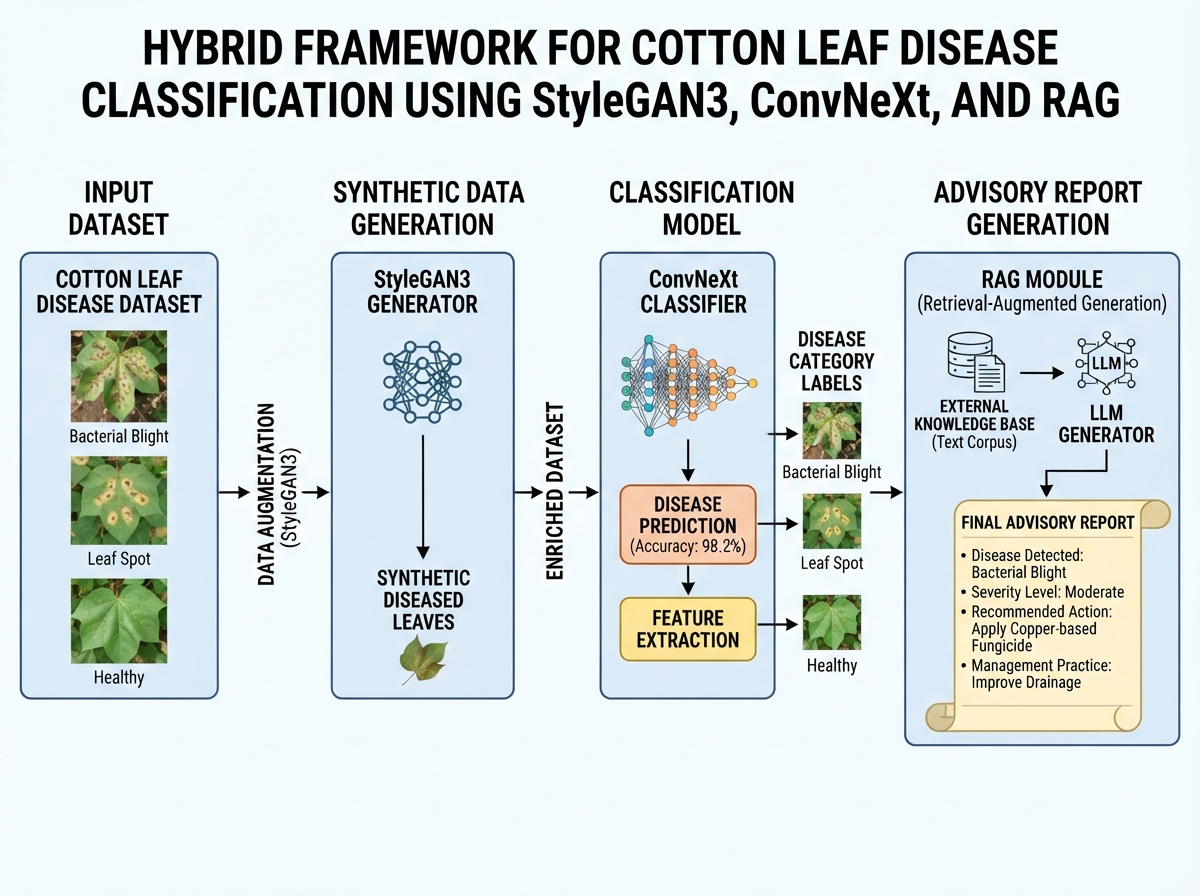
Plant Cotton leaf diseases pose a serious hazard to crop productivity. These diseases contribute to increased use of pesticide resulting in environmental degradation and unsustainable agricultural practices. The problem is particularly serious in precision agriculture, where timely and accurate analysis is crucial for effective interference. Deep learning (DL) models for image classification have shown strong potential for automated disease detection. However, its performance is often affected by inadequate and diversified training data sets, which have reduced generalization under practical field conditions. To address this challenge, this study proposes a generative Artificial Intelligence (AI) and computer vision based hybrid framework for cotton leaf disease classification with implications for sustainable precision agriculture. The proposed framework integrates StyleGAN3-ADA for synthetic image augmentation, ConvNeXt for disease classification, and a retrieval-augmented generation (RAG) module for contextual agricultural decision support. StyleGAN3-ADA was trained on class-specific training subsets, and the generated synthetic images were added only to the training set to increase visual diversity. Validation and testing were performed exclusively on real cotton leaf images to ensure realistic performance assessment. Experimental results demonstrate that the StyleGAN3-based augmentation process produced visually realistic samples with a Fréchet Inception Distance (FID) score of 26.47. The ConvNeXt classifier achieved a training accuracy of 99% and a testing accuracy of 96%, indicating strong convergence and robust classification performance across the six cotton leaf categories. Furthermore, the integration of the RAG module enables the system to provide context-aware, knowledge-driven recommendations for disease management. The proposed framework establishes practical potential for intelligent decision support in precision agriculture. By enabling early and accurate disease identification, the proposed framework can reduce unnecessary pesticide application, thereby minimizing environmental impact and promoting more sustainable agricultural practices
References
- Dr. Nadeem Qazi
Associate Professor, University of East London, UK, England
n.qazi@uel.ac.uk
- Dr. Muhammad Saleem
Associate Professor, Jubail Industrial College, Royal Commission in Jubail and Yanbu, Saudi Arabia
saleemm@rcjy.edu.sa
- Dr. Abdul Wahid Memon
Assistant Professor, Computer Systems Engineering Department, Q.U.E.S.T, Nawabshah, Pakistan
awam@quest.edu.pk
- Muhammad I. Masud
Department of Electrical Engineering, College of Engineering, University of Business and Technology, Jeddah, Saudi Arabia
m.masud@ubt.edu.sa
- Touqeer Ahmed Jumani
Department of Electrical Engineering and Computer Science, College of Engineering, A’Sharqiyah Uni-versity, Ibra, Oman
touqeer.ahmed@asu.edu.om
Downloads
Published
Issue
Section
License
Copyright (c) 2026 Huma Jamshed, Shahbaz Qammar, Syeda Tehreem Naqvi, Yusra Mansoor, Ahmad Hussain

This work is licensed under a Creative Commons Attribution-NonCommercial 4.0 International License.