
Synthesis and Characterization of Polyaniline for the Removal of 4-Vinylcyclohexene in the Nitrile Glove Manufacturing Industry
DOI:
https://doi.org/10.11113/mjfas.v22n3.5179Keywords:
Polyaniline, Volatile organic compounds, 4-vinylcyclohexeneAbstract
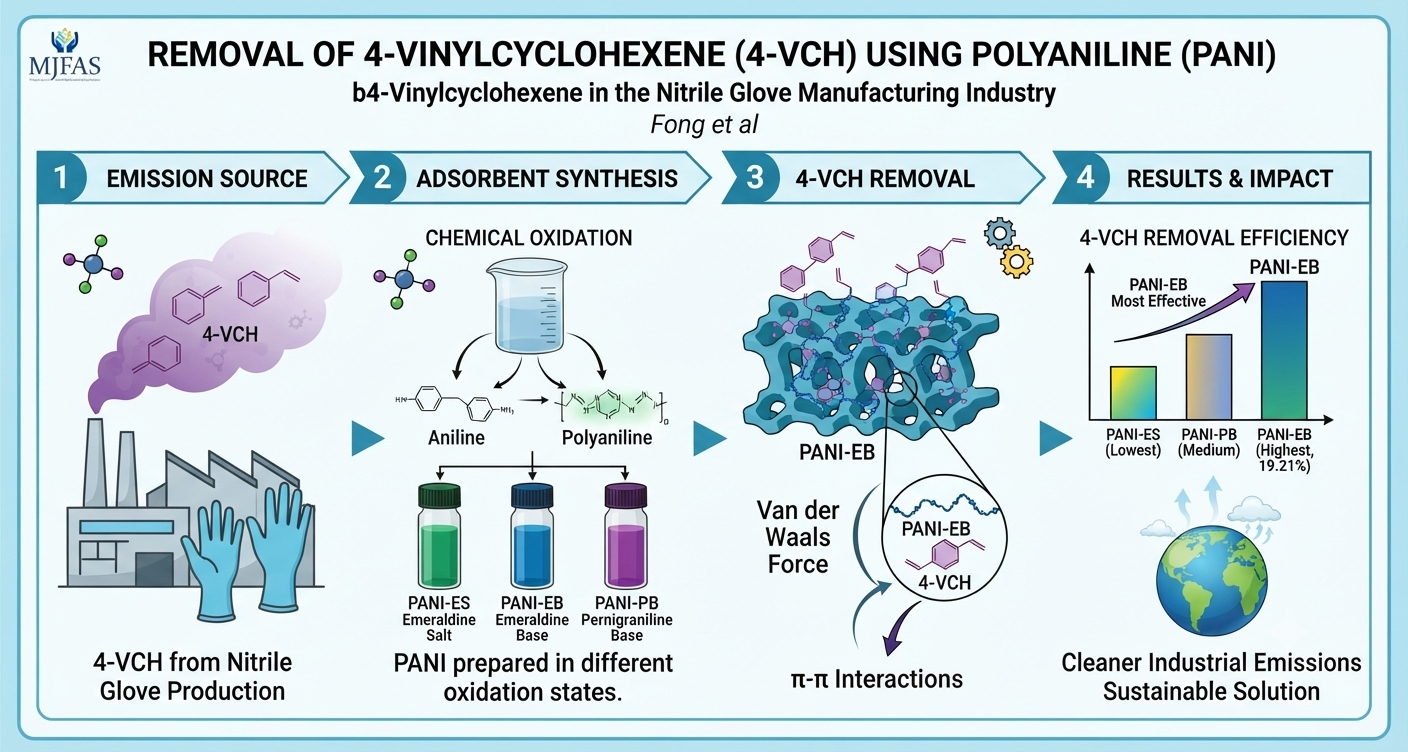
Volatile organic compounds (VOCs) are common by-products released during nitrile glove manufacturing, which can cause unpleasant odours and pose risks to human health and the environment. Among these VOCs, 4-vinylcyclohexene (4-VCH) is found to be emitted during production through cyclization of 1,3-butadiene. Polyaniline (PANI), which has been widely studied for the removal of pollutants, such as heavy metals and organic dyes, shows potential as an adsorbent for 4-VCH due to its tunable oxidation states. In this study, emeraldine salt (PANI-ES) was synthesized via chemical oxidation, while emeraldine base (PANI-EB) and pernigraniline base (PANI-PB) were obtained through deprotonation and further chemical oxidation. All synthesized PANI samples were examined using FTIR, UV-Vis, TGA and electrical conductivity measurements to confirm their chemical structures, oxidation states, thermal stability, and electrical properties. The adsorption performance of the different PANI oxidation states toward 4-VCH was determined using gas chromatography- flame ionization detector (GC-FID). Among the PANI samples, PANI-EB exhibited the highest 4-VCH removal efficiency of 19.21% at 60 mins in 100ppm 4-VCH solution, followed by PANI-PB with the removal efficiency of 17.75% at 90 mins, whereas PANI-ES showed the lowest removal efficiency of 13.53% at 60 mins. Post-adsorption UV-Vis and FTIR analyses revealed no significant changes in spectral features of PANI-EB, indicating that the adsorption mechanism is mainly by physical interactions. This study shows the potential of PANI, particularly in its emeraldine base form, as a potential adsorbent for the removal of non-polar VOCs, such as 4-VCH, from industrial emissions.
References
Nucera, E., Aruanno, A., Rizzi, A., & Centrone, M. (2020). Latex Allergy: Current Status and Future Perspectives. Journal of Asthma and Allergy, Volume 13, 385–398.
Gunasegaran, J., Teh, Y.-Y., Lim, C.-K., & Ng, S.-F. (2024). Review on Prevalence, Risk Factors, and Research Advancements on the Use of Medical Gloves Concerning Hand Dermatitis Among Health Care Workers. Safety and Health at Work, 15(2), 129–138.
Huang, Y., Shen, L., Ma, C., Jiang, Y., & Yu, B. (2024). Functionalization of 1,3-Butadiene Derivatives under Photo/Electrocatalysis. European Journal of Organic Chemistry, 27(28).
Schulze, W. T., Schwalbe, S., Trepte, K., Croy, A., Kortus, J., & Gräfe, S. (2023). Bond formation insights into the Diels–Alder reaction: A bond perception and self-interaction perspective. The Journal of Chemical Physics, 158(16).
Zhou, X., Zhou, X., Wang, C., & Zhou, H. (2023). Environmental and human health impacts of volatile organic compounds: A perspective review. Chemosphere, 313, 137489.
David, E., & Niculescu, V.-C. (2021). Volatile Organic Compounds (VOCs) as Environmental Pollutants: Occurrence and Mitigation Using Nanomaterials. International Journal of Environmental Research and Public Health, 18(24), 13147.
Zhu, L., Shen, D., & Luo, K. H. (2020). A critical review on VOCs adsorption by different porous materials: Species, mechanisms and modification methods. Journal of Hazardous Materials, 389, 122102.
Ding, Z., Li, Y., Fu, Q., Tian, M., Wang, F., Wang, Y., & Huang, K. (2025). Volatile organic compounds in a typical petrochemical production area in Shanghai, China: Source profiles, human health and environmental impacts. Environmental Pollution, 372, 126074.
Huang, H., Wang, Z., Dai, C., Guo, J., & Zhang, X. (2022). Volatile organic compounds emission in the rubber products manufacturing processes. Environmental Research, 212, 113485.
Mo, Z., Lu, S., & Shao, M. (2021). Volatile organic compound (VOC) emissions and health risk assessment in paint and coatings industry in the Yangtze River Delta, China. Environmental Pollution, 269, 115740.
Meng, J., Wang, J., Ning, X., Li, W., Wang, G., Li, W., Ma, B., Wang, J., Wang, H., Xiao, X., Cui, H., & Jing, B. (2024). Olfactory-chemical establishment using odour wheels and fingerprints to manage odor pollution for the petrochemical industry. Microchemical Journal, 205, 111253.
Beygisangchin, M., Abdul Rashid, S., Shafie, S., Sadrolhosseini, A. R., & Lim, H. N. (2021). Preparations, Properties, and Applications of Polyaniline and Polyaniline Thin Films—A Review. Polymers, 13(12), 2003.
Sowa, I., Wójciak, M., Tyszczuk-Rotko, K., Klepka, T., & Dresler, S. (2022). Polyaniline and Polyaniline-Based Materials as Sorbents in Solid-Phase Extraction Techniques. Materials, 15(24), 8881.
Samadi, A., Xie, M., Li, J., Shon, H., Zheng, C., & Zhao, S. (2021). Polyaniline-based adsorbents for aqueous pollutants removal: A review. Chemical Engineering Journal, 418, 129425.
Arsalan, M., Siddique, I., Awais, A., Baoji, M., Khan, I., Badran, M., & Mousa, A. A. A. (2022). Highly Efficient PANI-WH Novel Composite for Remediation of Ni(II), Pb(II), and Cu(II) From Wastewater. Frontiers in Environmental Science, 10.
Jamadade, V. S., Dhawale, D. S., & Lokhande, C. D. (2010). Studies on electrosynthesized leucoemeraldine, emeraldine and pernigraniline forms of polyaniline films and their supercapacitive behavior. Synthetic Metals, 160(9–10), 955–960.
Xie, M., Kim, J. W., Yang, Z., Uemura, S., Anderson, M., Katsuyama, Y., Kroes, B. C., Chang, X., Lin, C.-W., & Kaner, R. B. (2025). Heterophase Reduction of the Fully Oxidized Aniline Tetramer. ACS Materials Letters, 7(2), 675–681.
Ajeel, K. I., & Kareem, Q. S. (2019). Synthesis and Characteristics of Polyaniline (PANI) Filled by Graphene (PANI/GR) nano-Films. Journal of Physics: Conference Series, 1234, 012020.
Yoon, S.-B., Yoon, E.-H., & Kim, K.-B. (2011). Electrochemical properties of leucoemeraldine, emeraldine, and pernigraniline forms of polyaniline/multi-wall carbon nanotube nanocomposites for supercapacitor applications. Journal of Power Sources, 196(24), 10791–10797.
Udum, Y. A., Killard, A. J., & Wagner, M. (2024). Determination of the relative sensitivity of polyaniline inks and films to deprotonation by ammonia using UV–Vis spectroscopy. European Polymer Journal, 205, 112709.
Goswami, S., Nandy, S., Calmeiro, T. R., Igreja, R., Martins, R., & Fortunato, E. (2016). Stress Induced Mechano-electrical Writing-Reading of Polymer Film Powered by Contact Electrification Mechanism. Scientific Reports, 6(1), 19514.
Passador, F. R., de Faria, P. v., Backes, E. H., Montanheiro, T. L. A., Montagna, L. S., de Souza Pinto, S., Pessan, L. A., & Rezende, M. C. (2017). Thermal, mechanical and electromagnetic properties of LLDPE/PANI composites. Polymer Bulletin, 74(7), 2701–2717.
Lenin, R., Singh, A., & Bera, C. (2021). Effect of dopants and morphology on the electrical properties of polyaniline for various applications. Journal of Materials Science: Materials in Electronics, 32(20), 24710–24725.
Sayah, A., Boumaza, N., Habelhames, F., Bahloul, A., Tounsi, A., Lamiri, L., & Nessark, B. (2024). Effect of dopant on electrochemical performance of polyaniline on FTO substrate. Polymer Bulletin, 81(6), 5179–5192.
Yalcin, D., Bamford, S., Espiritu, M., Rigopoulos, N., Martinez-Botella, I., Alexander, D., Gozukara, Y., Greaves, M., Bruton, E. A., Kinlen, P. J., Howard, S., Pigram, P. J., Muir, B. W., & Kohl, T. M. (2023). New insight into degradation mechanisms of conductive and thermally resistant polyaniline films. Polymer Degradation and Stability, 215, 110427.
Toroń, B., Das, T. K., Kozioł, M., Szperlich, P., & Kępińska, M. (2025). Impact of hydrochloric acid doping on polyaniline conductivity and piezoelectric performance in polyaniline/bismuth oxyiodide nanocomposites. Composites Part B: Engineering, 289, 111960.
Banjar, M. F., Joynal Abedin, F. N., Fizal, A. N. S., Muhamad Sarih, N., Hossain, Md. S., Osman, H., Khalil, N. A., Ahmad Yahaya, A. N., & Zulkifli, M. (2023). Synthesis and Characterization of a Novel Nanosized Polyaniline. Polymers, 15(23), 4565.
Michelle, L.-Y. L., Ahmad, I., & Phang, S.-W. (2024). Preparation and Optimization of Polyaniline/ Titanium Dioxide/ Carboxymethyl Cellulose Powder for Effective Nickel Adsorption. Sains Malaysiana, 53(7), 1661–1676.
Nath, B. K., Chaliha, C., Kalita, E., & Kalita, M. C. (2016). Synthesis and characterization of ZnO:CeO2:nanocellulose:PANI bionanocomposite. A bimodal agent for arsenic adsorption and antibacterial action. Carbohydrate Polymers, 148, 397–405.
Li, X., Zhang, L., Yang, Z., Wang, P., Yan, Y., & Ran, J. (2020). Adsorption materials for volatile organic compounds (VOCs) and the key factors for VOCs adsorption process: A review. Separation and Purification Technology, 235, 116213.
Khan, M. I., Almesfer, M. K., Elkhaleefa, A., Shigidi, I., Shamim, M. Z., Ali, I. H., & Rehan, M. (2021). Conductive Polymers and Their Nanocomposites as Adsorbents in Environmental Applications. Polymers, 13(21), 3810.
Liao, G., Li, Q., & Xu, Z. (2019). The chemical modification of polyaniline with enhanced properties: A review. Progress in Organic Coatings, 126, 35–43.
Benabdesselam, S., Sellami, M. H., Ghomri, R., Mezouar, M., & Amor, A. A. (2024). Removal of benzene and toluene from aqueous solutions using Phoenix dactylifera leaves treated with HNO3 as adsorbent: Kinetic, isotherm studies and modeling. Desalination and Water Treatment, 320, 100668.
Wobowiec, M., Muir, B., Bajda, T., Zięba, K., Kijak, B., & Franus, W. (2017). Removal of BTEX and hexane by organo-zeolites: The influence of surfactant carbon chain length on the sorption process. Desalination and Water Treatment, 94, 120–128.
Ojaghloo, L., Assadi, A., Mohammadian Fazli, M., & Peyda, M. (2025). Removal of n-hexane extractable material from synthetic oil produced water using Desmopan®5377A thermoplastic polyurethane packed bed reactor. Environmental Health Engineering and Management, 12, 1416.
Mohamad Ahad, I. Z., Wadi Harun, S., Gan, S. N., & Phang, S. W. (2018). Polyaniline (PAni) optical sensor in chloroform detection. Sensors and Actuators B: Chemical, 261, 97–105.
Albuquerque, J. E., Mattoso, L. H. C., Balogh, D. T., Faria, R. M., Masters, J. G., & MacDiarmid, A. G. (2000). A simple method to estimate the oxidation state of polyanilines. Synthetic Metals, 113(1–2), 19–22.
Hussin, H., Gan, S.-N., & Phang, S.-W. (2021). Development of water-based polyaniline sensor for hydrazine detection. Sensors and Actuators A: Physical, 317, 112460.
Abdelraheem, A., H. El-Shazly, A., & Elkady, M. (2019). Comparable investigation of polyaniline behavior towards gaseous ammonia and toluene adsorption. Environmental Science and Pollution Research, 26(4), 3991–3999.
Choi, J.-S., Lim, S.-H., Lingamdinne, L. P., Park, S.-Y., Koduru, J. R., Yang, J.-K., & Chang, Y.-Y. (2023). Development of ultra-high surface area polyaniline-based activated carbon for the removal of volatile organic compounds from industrial effluents. Environmental Pollution, 337, 122594.
Downloads
Published
Issue
Section
License
Copyright (c) 2026 Kar Yan Fong, Rusli Daik, Wai Leon Low, Sook Wai Phang

This work is licensed under a Creative Commons Attribution-NonCommercial 4.0 International License.