
Mathematical Modelling of Sea Turtle Nesting Behaviour Incorporating Predation and Carrying Capacity
DOI:
https://doi.org/10.11113/mjfas.v22n3.5107Keywords:
Sea turtle ecology, predator-prey interactions, mathematical modelling, carrying capacity, conservation strategy.Abstract
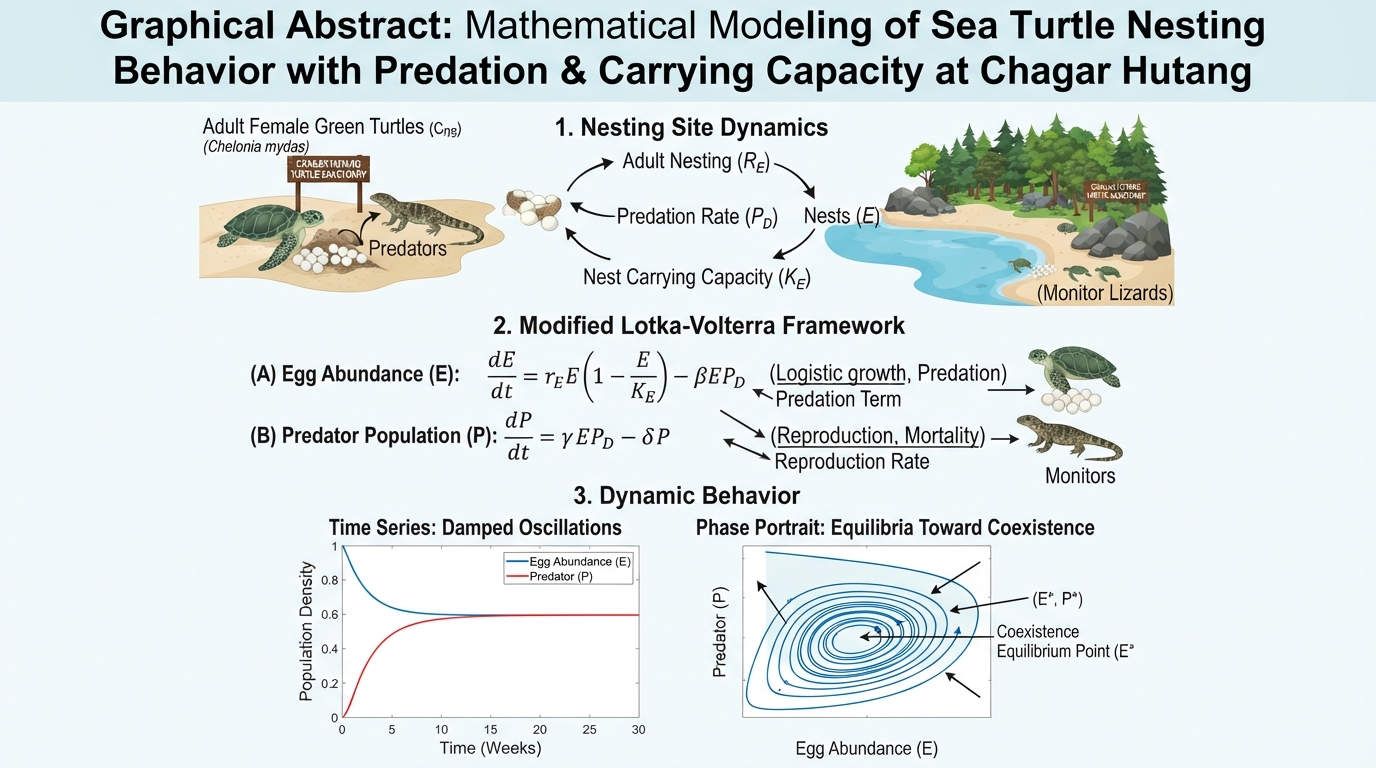
Understanding the ecological balance on sea turtle nesting beaches is essential for developing effective conservation strategies. These environments are shaped by interacting ecological pressures, particularly carrying capacity and predation. In this study, we adapt a Lotka-Volterra predator-prey framework with logistic growth to evaluate the long-term interaction between sea turtle egg abundance and predation pressure at Chagar Hutang Turtle Sanctuary (CHTS), Redang Island, Malaysia. The contribution of this study lies in the site-specific parameterisation of the model using eleven years of field monitoring data (2013-2023), which are used to identify and analyse possible equilibrium states of egg abundance and predation pressure under carrying capacity constraints. Stability analysis indicates that the extinction equilibrium is unstable, whereas the coexistence equilibrium is locally stable under the estimated parameter values. Numerical simulations further show damped oscillations converging towards coexistence, suggesting that long-term nesting outcomes at CHTS are influenced by both the habitat carrying capacity and the persistent predation pressure. These findings suggest that sustainable sea turtle nesting management should focus on maintaining or enhancing habitat carrying capacity while reducing excessive predation pressure, rather than relying solely on predator eradication.
References
Mortimer, J. A. (1995). Factors influencing beach selection by nesting sea turtles. In K. A. Bjorndal (Ed.), Biology and Conservation of Sea Turtles (pp. 45–51). Smithsonian Institution Press.
Bouchard, S. S., & Bjorndal, K. A. (2000). Sea turtles as biological transporters of nutrients and energy from marine to terrestrial ecosystems. Ecology, 81(8), 2305–2313.
Tomillo, P. S., Vélez, E., Reina, R. D., Piedra, R., Paladino, F. V., & Spotila, J. R. (2010). Reassessment of the leatherback turtle (Dermochelys coriacea) nesting population at Parque Nacional Marino Las Baulas, Costa Rica: effects of conservation efforts. Chelonian Conservation and Biology, 9(2), 173–181.
Stancyk, S. E. (1982). Non-human predators of sea turtles and their control. In K. A. Bjorndal (Ed.), Biology and Conservation of Sea Turtles (pp. 139–152). Smithsonian Institution Press.
Burke, R. L., Schneider, C. M., & Dolinger, M. T. (2005). Cues used by raccoons to find turtle nests: effects of flags, human scent, and diamondback terrapin sign. Journal of Wildlife Management, 69(1), 306–313.
Leighton, P. A., Horrocks, J. A., & Kramer, D. L. (2008). Predicting nest survival in sea turtles: when and where are eggs most vulnerable to predation? Animal Conservation, 11(3), 186–195.
Patankar, V., Rangnekar, P., & Alcoverro, T. (2018). Predation on eggs and hatchlings of green turtles (Chelonia mydas) at a nesting beach in the Andaman and Nicobar Islands, India. Chelonian Conservation and Biology, 17(2), 157–164.
Erickson, K. A., Forys, E. A., & Quammen, M. (2004). Predation on artificial nests along a suburban–wildland gradient. Urban Ecosystems, 7, 53–62.
Brock, K. A., Reece, J. S., & Ehrhart, L. M. (2009). The effects of ghost crab predation on sea turtle nests in Florida. Chelonian Conservation and Biology, 8(1), 98–101.
Kot, M. (2001). Elements of Mathematical Ecology. Cambridge University Press.
Turchin, P. (2003). Complex Population Dynamics: A Theoretical/Empirical Synthesis. Princeton University Press.
Bowen, B. W., & Karl, S. A. (2007). Population genetics and phylogeography of sea turtles. Molecular Ecology, 16(23), 4886–4907.
Heppell, S. S., Crowder, L. B., Crouse, D. T., Epperly, S. P., & Frazer, N. B. (2003). Population models for Atlantic loggerheads: Past, present, and future. In A. B. Bolten & B. E. Witherington (Eds.), Loggerhead Sea Turtles (pp. 255–273). Smithsonian Books.
Ackerman, R. A. (1997). The nest environment and the embryonic development of sea turtles. In P. L. Lutz & J. A. Musick (Eds.), The Biology of Sea Turtles (pp. 83–106). CRC Press.
Rosenzweig, M. L., & MacArthur, R. H. (1963). Graphical representation and stability conditions of predator-prey interactions. American Naturalist, 97(895), 209–223.
Khairuddin, N. A., Rusli, M. U., & Chan, E. H. (2021). A mathematical model of predator–prey interactions in sea turtle nesting populations at Chagar Hutang Turtle Sanctuary, Malaysia. Journal of Sustainability Science and Management, 16(3), 45–58.
Mohd Roslan, M. A., Rusli, M. U., & Chan, E. H. (2019). Mathematical modelling of human disturbance and conservation impact on sea turtle nesting dynamics. Sains Malaysiana, 48(12), 2657–2666. https://doi.org/10.17576/jsm-2019-4812-11
Chan, E. H. (2010). Sea Turtles in Malaysia: Past, Present and Future. SEATRU.
Matsuzawa, Y., Sato, K., Sakamoto, W., & Bjorndal, K. A. (2002). Seasonal fluctuations in sand temperature: effects on the incubation period and mortality of loggerhead sea turtle (Caretta caretta) pre-emergent hatchlings in Minabe, Japan. Marine Biology, 140(3), 639–646.
Chew, W. Y., Hii, N., Tan, S. A., & Sulong, S. (2015). The green turtle nesting population and internesting intervals at Chagar Hutang Turtle Sanctuary, Redang Island, Malaysia. Herpetological Conservation and Biology, 10(Supplement 1), 120–127.
Frederick, P. C., & Collopy, M. W. (1989). Nesting success of five ciconiiform species in relation to water conditions in the Florida Everglades. Auk, 106(4), 625–634.
Oro, D., Pradel, R., & Lebreton, J. D. (1999). Food availability and nest predation influence life history traits in Audouin's gull, Larus audouinii. Oecologia, 118(4), 438–445.
Sogard, S. M., & Olla, B. L. (1993). The influence of predator presence on utilization of artificial seagrass habitats by juvenile walleye pollock, Theragra chalcogramma. Environmental Biology of Fishes, 36, 393–400.
Verhulst, P. F. (1838). Notice sur la loi que la population suit dans son accroissement. Correspondance Mathématique et Physique, 10, 113–121.
Pearl, R., & Reed, L. J. (1920). On the rate of growth of the population of the United States since 1790 and its mathematical representation. Proceedings of the National Academy of Sciences, 6(6), 275–288.
Volterra, V. (1926). Fluctuations in the abundance of a species considered mathematically. Nature, 118, 558–560.
Bennett, D., & Lim, K. K. P. (1995). A note on the distribution, diet and population size of water monitors (Varanus salvator) in Singapore. Malayan Nature Journal, 49, 1–6.
Strogatz, S. H. (2015). Nonlinear Dynamics and Chaos: With Applications to Physics, Biology, Chemistry, and Engineering (2nd ed.). Westview Press.
Edelstein-Keshet, L. (2005). Mathematical Models in Biology. SIAM.
Murray, J. D. (2002). Mathematical Biology I: An Introduction (3rd ed.). Springer.
Wiggins, S. (2003). Introduction to Applied Nonlinear Dynamical Systems and Chaos (2nd ed.). Springer.
Lotka, A. J. (1925). Elements of Physical Biology. Williams and Wilkins.
Caughley, G. (1976). The elephant problem – an alternative hypothesis. East African Wildlife Journal, 14(4), 265–283.
Bjorndal, K. A., Wetherall, J. A., Bolten, A. B., & Mortimer, J. A. (1999). Twenty-six years of green turtle nesting at Tortuguero, Costa Rica: An encouraging trend. Conservation Biology, 13(1), 126–134.
Kamel, S. J., & Mrosovsky, N. (2005). Repeatability of nesting preferences in the hawksbill sea turtle, Eretmochelys imbricata, and their fitness consequences. Animal Behaviour, 70(4), 819–828.
Engeman, R. M., Martin, R. E., Smith, H. T., Woolard, J., Crady, C. K., & Constantine, B. (2006). Dramatic reduction in predation on marine turtle nests through improved predator monitoring and management. Oryx, 40(3), 318–326.
Fryxell, J. M., Packer, C., McCann, K., Solberg, E. J., & Sæther, B. E. (2007). Resource management cycles and the sustainability of harvested wildlife populations. Science, 328(5980), 903–906.
Sinclair, A. R. E., Pech, R. P., Dickman, C. R., Hik, D., Mahon, P., & Newsome, A. E. (1998). Predicting effects of predation on conservation of endangered prey. Conservation Biology, 12(3), 564–575.
Chan, E. H. (2006). Marine turtles in Malaysia: On the verge of extinction? Aquatic Ecosystem Health & Management, 9(2), 175–184.
Hawkes, L. A., Broderick, A. C., Godfrey, M. H., & Godley, B. J. (2009). Climate change and marine turtles. Endangered Species Research, 7(2), 137–154.
Limpus, C. J., Couper, P. J., & Read, M. A. (2005). The green turtle, Chelonia mydas, in Queensland: Population structure in a warm temperate feeding area. Memoirs of the Queensland Museum, 49(1), 139–154.
Chaloupka, M., & Limpus, C. (2005). Estimates of sex- and age-class-specific survival probabilities for a southern Great Barrier Reef green sea turtle population. Marine Biology, 146(6), 1251–1261.
Mazaris, A. D., Schofield, G., Gkazinou, C., Almpanidou, V., & Hays, G. C. (2017). Global sea turtle conservation successes. Science Advances, 3(9), e1600730.
Peterson, C. H., & Bishop, M. J. (2005). Assessing the environmental impacts of beach nourishment. BioScience, 55(10), 887–896.
Patino-Martinez, J., Marco, A., Quiñones, L., & Hawkes, L. (2012). A potential tool to mitigate the impacts of climate change to the Caribbean leatherback sea turtle. Global Change Biology, 18(2), 401–411.
Witherington, B. E., & Martin, R. E. (2000). Understanding, Assessing, and Resolving Light Pollution Problems on Sea Turtle Nesting Beaches (2nd ed.). Florida Marine Research Institute Technical Report TR-2.
Doak, D. F., Gross, K., & Morris, W. F. (2005). Understanding and predicting the effects of sparse data on demographic analyses. Ecology, 86(5), 1154–1163.
Smith, C. E., Sykora-Bodie, S. T., Bloodworth, B., Pack, S. M., Spradlin, T. R., & LeBoeuf, N. R. (2014). Assessment of known impacts of unmanned aerial systems (UAS) on marine mammals: Data gaps and recommendations for researchers in the United States. Journal of Unmanned Vehicle Systems, 4(1), 1–13.
Hawkes, L. A., Broderick, A. C., Godfrey, M. H., & Godley, B. J. (2007). Investigating the potential impacts of climate change on a marine turtle population. Global Change Biology, 13(5), 923–932.
Schlacher, T. A., Dugan, J., Schoeman, D. S., Lastra, M., Jones, A., Scapini, F., ... & Defeo, O. (2007). Sandy beaches at the brink. Diversity and Distributions, 13(5), 556–560.
Wanger, T. C., Darras, K., Bumrungsri, S., Tscharntke, T., & Klein, A. M. (2009). Bat pest control contributes to food security in Thailand. Biological Conservation, 171, 220–223.
Christiansen, F., Rojano-Doñate, L., Madsen, P. T., & Bejder, L. (2014). Noise levels of multi-rotor unmanned aerial vehicles with implications for potential underwater impacts on marine mammals. Frontiers in Marine Science, 3, 277.
Burger, J., & Gochfeld, M. (2014). Habitat, Population Dynamics, and Metal Levels in Colonial Waterbirds: A Food Chain Approach. CRC Press.
Okubo, A., & Levin, S. A. (2001). Diffusion and Ecological Problems: Modern Perspectives (2nd ed.). Springer.
Crouse, D. T., Crowder, L. B., & Caswell, H. (1987). A stage-based population model for loggerhead sea turtles and implications for conservation. Ecology, 68(5), 1412–1423.
Crowder, L. B., Crouse, D. T., Heppell, S. S., & Martin, T. H. (1994). Predicting the impact of turtle excluder devices on loggerhead sea turtle populations. Ecological Applications, 4(3), 437–445.
Chaloupka, M. (2004). Exploring the metapopulation dynamics of the southern Great Barrier Reef green sea turtle stock. In M. Coyne & R. Clark (Eds.), Proceedings of the 21st Annual Symposium on Sea Turtle Biology and Conservation (pp. 85–86). NOAA Technical Memorandum.
Downloads
Published
Issue
Section
License
Copyright (c) 2026 Ummu Atiqah Mohd Roslan, MOHD UZAIR RUSLI, Adriana Dania Hemizan

This work is licensed under a Creative Commons Attribution-NonCommercial 4.0 International License.