
Effect of Electrodeposition Conditions and Sn:Co Ratio on SnCo-Modified Carbon Electrodes for Cathodic Reactions and Microbial Fuel Cell Performance
DOI:
https://doi.org/10.11113/mjfas.v22n3.5074Keywords:
SnCo electrocatalyst, microbial fuel cell (MFC), oxygen reduction reaction, carbon dioxide reduction reaction, energy recoveryAbstract
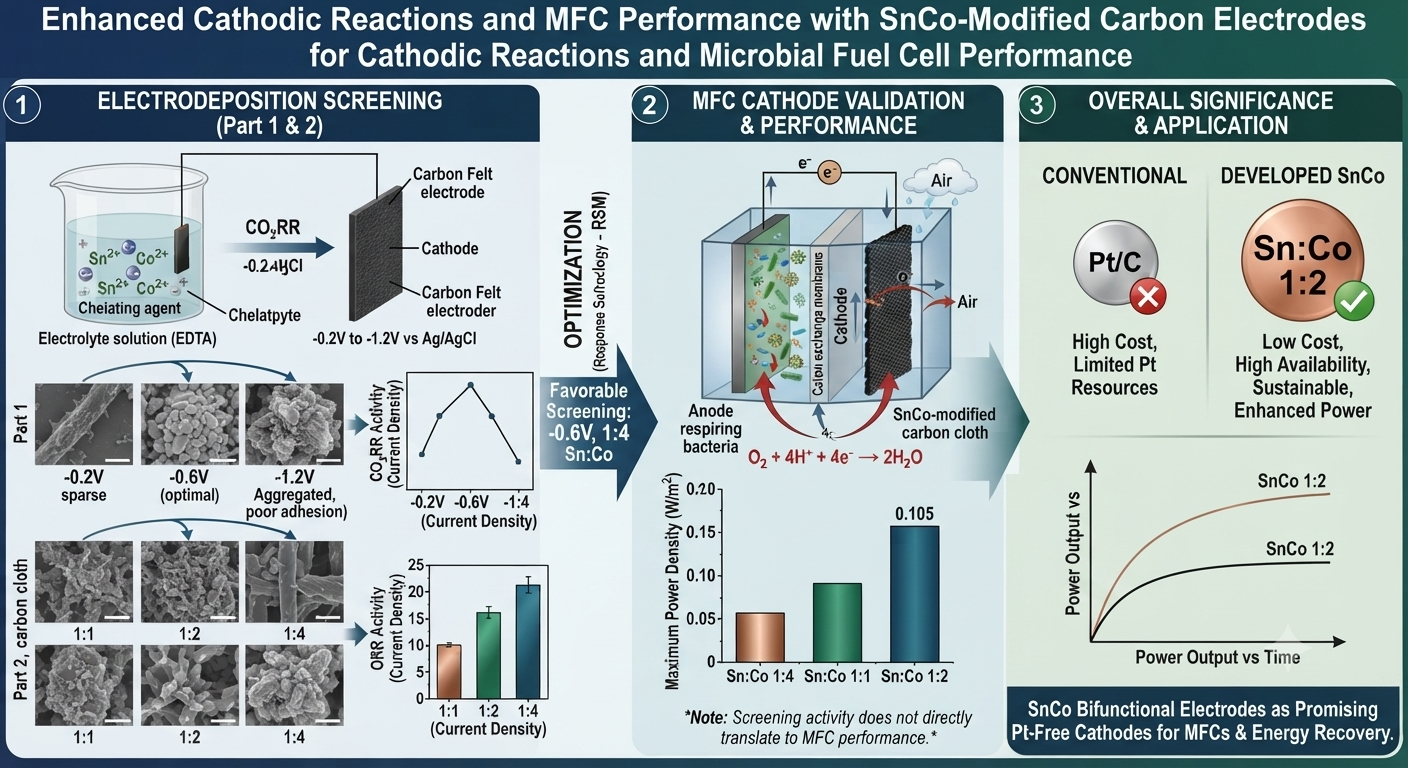
The performance of microbial fuel cells (MFCs) is commonly limited by the sluggish oxygen reduction reaction (O₂RR) at the cathode, which reduces electron acceptance and overall power generation. Therefore, the development of low-cost and stable cathode catalysts is important to improve MFC performance. In this study, SnCo-based electrocatalysts were developed as alternative cathode materials to enhance cathodic reduction reactions in bioelectrochemical systems. Tin (Sn) was introduced into cobalt (Co)-based catalysts to improve catalytic behaviour, active-site availability and structural stability. The study was conducted in two screening parts. First, SnCo was electrodeposited onto carbon felt at different deposition potentials from −0.2 to −1.2 V to evaluate carbon dioxide reduction reaction (CO₂RR) activity and surface morphology. Carbon felt deposited at −0.6 V showed the highest CO₂RR current density, although surface analysis showed that the deposits did not fully cover the carbon felt. Secondly, SnCo was deposited onto carbon cloth at Sn:Co ratios of 1:1, 1:2 and 1:4 to evaluate O₂RR activity, stability and MFC cathode performance. Response surface methodology (RSM) identified −0.6 V and SnCo 1:4 as the most favourable electrochemical screening condition based on the selected CO₂RR and O₂RR responses. However, MFC validation showed that SnCo 1:2 achieved the highest maximum power density of 0.105 W m⁻², followed by SnCo 1:1 at 0.089 W m⁻² and SnCo 1:4 at 0.069 W m⁻². This indicates that electrochemical screening does not directly translate to whole-cell MFC performance. Overall, SnCo-modified carbon electrodes show potential as low-cost cathode catalysts for bioelectrochemical systems.
References
L. J. R. Nunes, “The Rising Threat of Atmospheric CO2: A Review on the Causes, Impacts, and Mitigation Strategies,” Environments - MDPI, 10(4), 2023. https://doi.org/10.3390/environments10040066
R. M. Venegas, J. Acevedo, and E. A. Treml, “Three decades of ocean warming impacts on marine ecosystems: A review and perspective,” Deep Sea Res 2 Top Stud Oceanogr, 212, p. 105318, 2023. https://doi.org/10.1016/j.dsr2.2023.105318
V. Davtyan, “International Energy Agency,” Elgar Encyclopedia of Energy Economics, pp. 294–296, 2025. https://doi.org/10.4337/9781035310371.00082
X. P. Nguyen, A. T. Hoang, A. I. Ölçer, and T. T. Huynh, “Record decline in global CO2 emissions prompted by COVID-19 pandemic and its implications on future climate change policies,” Energy Sources, Part A: Recovery, Utilization and Environmental Effects, vol. 47( 1), pp. 4699–4702, 2025. https://doi.org/10.1080/15567036.2021.1879969
S. Norasyiqin et al., “The Trend and Status of Energy Resources and Greenhouse Gas Emissions in the Malaysia Power Generation Mix,” Energies (Basel), vol. 14, no. 2200, pp. 1–26, 2021.
E. Ranieri et al., “Evaluation of greenhouse gas emissions from aerobic and anaerobic wastewater treatment plants in Southeast of Italy,” J Environ Manage, vol. 337, no. March, p. 117767, 2023. https://doi.org/10.1016/j.jenvman.2023.117767
R. Boiocchi et al., “A study on the carbon footprint contributions from a large wastewater treatment plant,”
Energy Reports, vol. 9, no. February, pp. 274–286, 2023. https://doi.org/10.1016/j.egyr.2023.06.002
Y. Wu et al., “Achieving high power density and excellent durability for high temperature proton exchange membrane fuel cells based on crosslinked branched polybenzimidazole and metal-organic frameworks,” J Memb Sci, vol. 630, no. January, p. 119288, 2021. https://doi.org/10.1016/j.memsci.2021.119288
T. C. Dakal et al., “New horizons in microbial fuel cell technology: applications, challenges, and prospects,”
Biotechnology for Biofuels and Bioproducts, 18(1) 2025. https://doi.org/10.1186/s13068-025-02649-y
D. Ucar, Y. Zhang, and I. Angelidaki, “An overview of electron acceptors in microbial fuel cells,” Front Microbiol, vol. 8, no. APR, pp. 1–14, 2017. https://doi.org/10.3389/fmicb.2017.00643
R. Boukoureshtlieva, T. Stankulov, and A. Momchilov, “Carbon-Based Cathode Catalysts Used in Microbial Fuel Cells for Wastewater Treatment and Energy Recovery,” Ecological Engineering and Environment Protection, vol. 2021, no. 3/2021, pp. 24–33, 2021. https://doi.org/10.32006/eeep.2021.3.2433
K. Elangovan et al., “Outline of microbial fuel cells technology and their significant developments, challenges, and prospects of oxygen reduction electrocatalysts,” Frontiers in Chemical Engineering, 5, pp. 1–27, 2023. https://doi.org/10.3389/fceng.2023.1228510
R. Agrahari, B. Bayar, H. N. Abubackar, B. S. Giri, E. R. Rene, and R. Rani, “Advances in the development of electrode materials for improving the reactor kinetics in microbial fuel cells,” Chemosphere, 290, 2022. https://doi.org/10.1016/j.chemosphere.2021.133184
A. Chaturvedi and P. P. Kundu, “Recent advances and perspectives in platinum-free cathode catalysts in microbial fuel cells,” J Environ Chem Eng, 9(4), p. 105662, 2021. https://doi.org/10.1016/j.jece.2021.105662
N. Helsel and P. Choudhury, “Non-Platinum Group Metal Oxygen Reduction Catalysts for a Hydrogen Fuel Cell Cathode: A Mini-Review,” Catalysts, 15(6), 2025. https://doi.org/10.3390/catal15060588
S. Karthick, A. Sumisha, and K. H. Haribabu, “Performance of tungsten oxide/polypyrrole composite as cathode catalyst in single chamber microbial fuel cell,” J Environ Chem Eng, 8(6), p. 104520, 2020. https://doi.org/10.1016/j.jece.2020.104520
F. Lan, G. Huang, Y. Cao, X. Zhang, R. Wang, and J. Chen, “Enhancing oxygen reduction reaction in microbial fuel cell by Cu-metal organic framework@Fe-metal organic framework (Cu-MOF@Fe-MOF) as cathode catalyst,” J Environ Chem Eng, 13( 2), p. 115448, 2025. https://doi.org/10.1016/j.jece.2025.115448
M. Li, J. Zhou, Y. G. Bi, S. Q. Zhou, and C. H. Mo, “Transition metals (Co, Mn, Cu) based composites as catalyst in microbial fuel cells application: The effect of catalyst composition,” Chemical Engineering Journal, 383, p. 123152, 2020. https://doi.org/10.1016/j.cej.2019.123152
S. Ashmath, H. J. Kwon, S. G. Peera, and T. G. Lee, “Solid-State Synthesis of Cobalt/NCS Electrocatalyst for Oxygen Reduction Reaction in Dual Chamber Microbial Fuel Cells,” Nanomaterials, 12(24), 2022. https://doi.org/10.3390/nano12244369
W. Liu, L. Zheng, S. Cheng, Y. Zhu, and J. Sun, “Cobalt nitrogen carbon nanotube co-implanted activated carbon as efficient cathodic oxygen reduction catalyst in microbial fuel cells,” Journal of Electroanalytical Chemistry, 876, 2020. https://doi.org/10.1016/j.jelechem.2020.114498
M. Li et al., “Cobalt-based Catalysts Modified Cathode for Enhancing Bioelectricity Generation and Wastewater Treatment in Air-breathing Cathode Microbial Fuel Cells,” Electroanalysis, 31(8), pp. 1482–1493, 2019. https://doi.org/10.1002/elan.201900161
X. M. Qu et al., “In-situ growth of carbon nanotubes for improving the performance of Co-N/C catalysts in proton exchange membrane fuel cell,” Chemical Engineering Journal, vol. 461, no. February, 2023. https://doi.org/10.1016/j.cej.2023.142054
S. Zhao et al., “Advances in Sn-Based Catalysts for Electrochemical CO2 Reduction,” Nanomicro Lett, 11(1),
pp. 1–19, 2019. https://doi.org/10.1007/s40820-019-0293-x
X. Tu, X. Liu, Y. Zhang, J. Zhu, and H. Jiang, “Advances in Sn-based oxide catalysts for the electroreduction of CO2 to formate,” Green Carbon, 2(2), pp. 131–148, 2024. https://doi.org/10.1016/j.greenca.2024.03.006
R. K. Dharman, A. Mariappan, H. M. Lo, and T. H. Oh, “Kinetically accelerated bifunctional water splitting performance using tin-induced cobalt molybdate electrocatalyst,” Inorg Chem Commun, 183 (P1), p. 115725, 2026. https://doi.org/10.1016/j.inoche.2025.115725
S. S. Lim, J. M. Fontmorin, M. N. Ikhmal Salehmin, Y. Feng, K. Scott, and E. H. Yu, “Enhancing hydrogen production through anode fed-batch mode and controlled cell voltage in a microbial electrolysis cell fully catalysed by microorganisms,” Chemosphere, 288(P2), p. 132548, 2022. https://doi.org/10.1016/j.chemosphere.2021.132548
G. Pignol, P. Bassil, J. M. Fontmorin, D. Floner, F. Geneste, and P. Hapiot, “Electrochemical Properties of Carbon Fibers from Felts” Molecules, 27(19), 2022.
https://doi.org/10.3390/molecules27196584
D. Emmel, J. D. Hofmann, T. Arlt, I. Manke, G. D. Wehinger, and D. Schröder, “Understanding the Impact of Compression on the Active Area of Carbon Felt Electrodes for Redox Flow Batteries,” ACS Appl Energy Mater, 3(5), pp. 4384–4393, 2020.
https://doi.org/10.1021/acsaem.0c00075
Y. Du, R. Kang, B. Zhang, H. Wang, G. Chen, and J. Zhang, “Retarding Deposition and Hydrogen Evolution Reaction Enables Stable and Reversible Zn Metal Anode,” ACS Energy Lett, 9(3), pp. 967–975, 2024. https://doi.org/10.1021/acsenergylett.4c00347
J. Huang et al., “Effect of deposition potential on electrodeposition of Sn-Ag-Cu ternary alloy solderable coating in deep eutectic solvent,” Journal of Electroanalytical Chemistry, 943, no. April, p. 117613, 2023. https://doi.org/10.1016/j.jelechem.2023.117613
A. Boukhouiete, S. Boumendjel, and N. E. H. Sobhi, “Effect of current density on the microstructure and morphology of the electrodeposited nickel coatings,” Turk J Chem, 45(5), pp. 1599–1608, 2021. https://doi.org/10.3906/kim-2102-46
S. Saini, S. C. Wright, S. Parvin, J. Baltrusaitis, and M. T. McDowell, “Investigating the Effects of Copper Impurity Deposition on the Structure and Electrochemical Behavior of Hydrogen Evolution Electrocatalyst Materials,” ACS Appl Energy Mater, 8(2), pp. 1143–1153, 2025. https://doi.org/10.1021/acsaem.4c02697
A. Raveendran, M. Chandran, and R. Dhanusuraman, “A comprehensive review on the electrochemical parameters and recent material development of electrochemical water splitting electrocatalysts,” RSC Adv, 13(6), pp. 3843–3876, 2023
https://doi.org/10.1039/d2ra07642j
W. Yu, H. Jiang, and Z. Hou, “Nanocurved electric-field-induced optimal catalyst loading for carbon dioxide electroreduction,” Phys Rev Res, 5(4) 2023.
https://doi.org/10.1103/PhysRevResearch.5.043235
M. Tribbia, J. Glenneberg, F. La Mantia, and G. Zampardi, “Effect of the Current Density on the Electrodeposition Efficiency of Zinc in Aqueous Zinc-Ion Batteries,” ChemElectroChem, 11(1), 2024. https://doi.org/10.1002/celc.202300394
D. Kong et al., “Inhibition of hydrogen evolution reaction during iron electrodeposition from sulfate system by reducing hydrogen bonding activity in water,” Int J Hydrogen Energy, 191, p. 152286, 2025. https://doi.org/10.1016/j.ijhydene.2025.152286
E. P. Barbano, G. M. de Oliveira, M. F. de Carvalho, and I. A. Carlos, “Copper-tin electrodeposition from an acid solution containing EDTA added,” Surf Coat Technol, 240, pp. 14–22, 2014. https://doi.org/10.1016/j.surfcoat.2013.12.005
F. Luo et al., “P-block single-metal-site tin/nitrogen-doped carbon fuel cell cathode catalyst for oxygen reduction reaction,” Nat Mater, 19(11), pp. 1215–1223, 2020. https://doi.org/10.1038/s41563-020-0717-5
K. Ye et al., “Synergy effects on Sn-Cu alloy catalyst for efficient CO2 electroreduction to formate with high mass activity,” Sci Bull (Beijing), 65(9), pp. 711–719, 2020. https://doi.org/10.1016/j.scib.2020.01.020
B. G. Abraham, R. Bhaskaran, and R. Chetty, “Electrodeposited Bimetallic (PtPd, PtRu, PtSn) Catalysts on Titanium Support for Methanol Oxidation in Direct Methanol Fuel Cells,” J Electrochem Soc, 167(2), p. 024512, 2020. https://doi.org/10.1149/1945-7111/ab6a7d
S. Jiang, L. Zhu, Z. Yang, and Y. Wang, “Self-supported hierarchical porous FeNiCo-based amorphous alloys as high-efficiency bifunctional electrocatalysts toward overall water splitting,” Int J Hydrogen Energy, 46(74),
pp. 36731–36741, 2021. https://doi.org/10.1016/j.ijhydene.2021.08.223
M. Wang et al., “Colloids and Surfaces A : Physicochemical and Engineering Aspects Enhancing electrochemical CO 2 reduction by utilizing tin-based gas diffusion electrodes with cubic nanostructured Cu 2 O as an interlayer carrier,” Colloids Surf A Physicochem Eng Asp, 726(P1), p. 137740, 2025. https://doi.org/10.1016/j.colsurfa.2025.137740
S. Li et al., “International Journal of Hydrogen Energy Recent advances in the development of single atom catalysts for oxygen evolution reaction, 82, pp. 1081–1100, 2024. https://doi.org/10.1016/j.ijhydene.2024.08.026
L. Eifert, R. Banerjee, Z. Jusys, and R. Zeis, “Characterization of Carbon Felt Electrodes for Vanadium Redox Flow Batteries: Impact of Treatment Methods,” J Electrochem Soc, 165(11), pp. A2577–A2586, 2018. https://doi.org/10.1149/2.0531811jes
Y. Chen, Huina, Jian, Demin, Xie, Hao, Liu, Yuxin, Li, Shishi, Wang, “Cu2O@Co/N-doped carbon as antibacterial catalysts for oxygen reduction in microbial fuel cells,” Environ Sci Nano, 10(1), pp. 158–165, 2023. https://doi.org/10.1039/D2EN00980C
Y. Sun, H. Li, S. Guo, and C. Li, “Metal-based cathode catalysts for electrocatalytic ORR in microbial fuel cells:
A review,” Chinese Chemical Letters, 35(5), p. 109418, 2024. https://doi.org/10.1016/j.cclet.2023.109418
J. Tian et al., “Effects of the Intrinsic Structures of Graphite Felt and Carbon Cloth on the Working Condition of Iron-Chromium Redox Flow Batteries,” 2025.
R. Amdoun et al., “The Desirability Optimization Methodology; a Tool to Predict Two Antagonist Responses in Biotechnological Systems: Case of Biomass Growth and Hyoscyamine Content in Elicited Datura starmonium Hairy Roots,” Iran J Biotechnol, 16(1), pp. 11–19, Feb. 2018. https://doi.org/10.21859/ijb.1339
P. H. He, C. Y. Chiang, J. C. Yu, E. C. Liu, and C. N. Liao, “Effect of hydrogen evolution on morphology and capillary performance of electrodeposited copper wicks,” Mater Chem Phys, 337, 2025. https://doi.org/10.1016/j.matchemphys.2025.130560
F. Nacimiento, R. Alcántara, and J. L. Tirado, “Comparative study of composite electrodes containing tin, polyacrylonitrile and cobalt or iron,” J Power Sources, 196(5), pp. 2893–2898, Mar. 2011. https://doi.org/10.1016/j.jpowsour.2010.11.034
S. Singh, A.K., Gangwar, Agendra, Kumar, “Prospects and limitations of existing biofuels and emerging trends in the utilization of nanoparticles for enhanced biofuel production and microbial fuel cell efficiency,” Biofuels, 16(5), 2025.
https://doi.org/10.1080/17597269.2024.2431766
R. Nurzulaikha et al., “Graphene/SnO2 nanocomposite-modified electrode for electrochemical detection of dopamine,” Sens Biosensing Res, 5, pp. 42–49, 2015. https://doi.org/10.1016/j.sbsr.2015.06.002
S. Gupta, R. Fernandes, R. Patel, M. Spreitzer, and N. Patel, “A review of cobalt-based catalysts for sustainable energy and environmental applications,” Appl Catal A Gen, 661, 2023. https://doi.org/10.1016/j.apcata.2023.119254
K. Ben, W. Ramli, W. Daud, and M. Ghasemi, “ScienceDirect Non-Pt catalyst as oxygen reduction reaction in microbial fuel cells: A review,” Int J Hydrogen Energy, 39(10), pp. 4870–4883, 2014. https://doi.org/10.1016/j.ijhydene.2014.01.062
Downloads
Published
Issue
Section
License
Copyright (c) 2026 Nor Syazwanie Mohd Saidi, Yashawini Phriya Rauichandran, Muhamad Amirul Aiman Bin Mohd Nor, Norhamizah Hazirah Ahmad Junaidi, Irwan Ibrahim, Wai Yin Wong, Swee Su Lim

This work is licensed under a Creative Commons Attribution-NonCommercial 4.0 International License.