
A Copula-Enhanced ARMA-GARCH Framework for Rainfall Analysis
DOI:
https://doi.org/10.11113/mjfas.v22n4.5055Keywords:
ARMA; GARCH; Box-Jenkins; Copula; ForecastAbstract
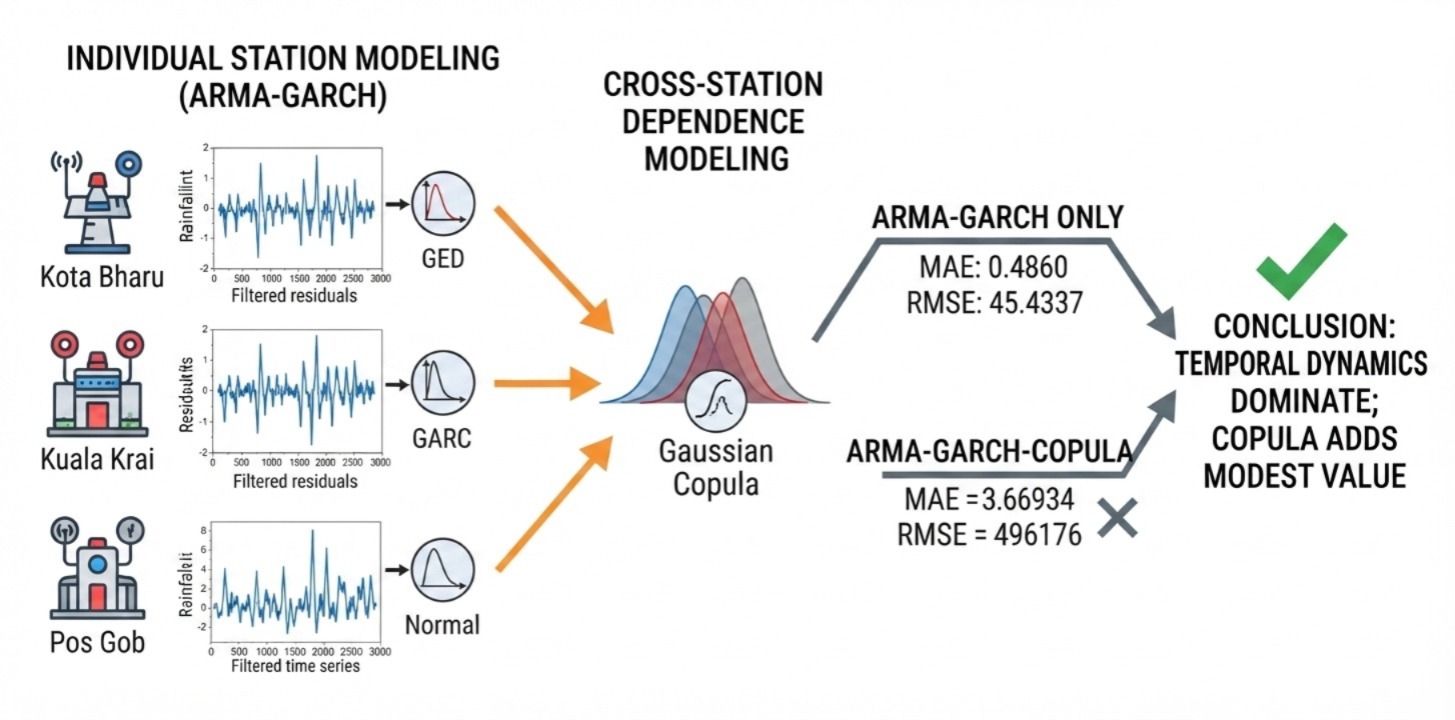
Accurate rainfall simulation is essential for hydrological risk assessment and water resources management. The ARMA-GARCH models effectively capture temporal dependence and volatility in rainfall series and copula models are frequently used to represent the joint dependence among rainfall stations. However, it is generally assumed that modelling cross-station dependence will improve forecasting performance, with limited attention given to whether sufficient residual dependence remains after temporal filtering to justify the additional modelling complexity. Hence, this study investigates whether incorporating copula-based dependence modelling provides additional benefits for rainfall simulation after ARMA-GARCH filtering. Daily rainfall data from three meteorological stations were first modelled using ARMA-GARCH, and the standardized residuals were transformed to uniform margins. Residual dependence was then evaluated using Kendall's tau and empirical upper tail dependence before fitting multivariate copula models. The dependence analysis revealed weak residual association among the stations, with Kendall's tau values ranging from 0.01 to 0.05. Although weak upper tail dependence was observed at the 90th percentile threshold, it decreased to approximately zero at higher thresholds, indicating limited co-occurrence of extreme rainfall events after temporal filtering. The forecasting comparison showed that the ARMA-GARCH model achieved lower MAE, MSE and RMSE values than the ARMA-GARCH-copula framework. These findings suggest that, for the selected rainfall stations, modelling the remaining cross-station dependence after temporal filtering contributed only modestly to forecasting performance. This study highlights the importance of evaluating residual dependence before introducing copula-based dependence structures in multisite rainfall modelling
References
Doocy, S., Daniels, A., Murray, S., & Kirsch, T. D. (2013). The Human Impact of Floods: a Historical Review of Events 1980-2009 and Systematic Literature Review. PLoS Currents. https://doi.org/10.1371/currents.dis.f4deb457904936b07c09daa98ee8171a
Izati, P. P., Prastyo, D. D., & Akbar, M. S. (2024). Modeling the volatility of world energy commodity prices using the GARCH-Fractional Cointegration Model. Procedia Computer Science, 234, 412–419. https://doi.org/10.1016/j.procs.2024.03.022
Ampadu, S., Mensah, E. T., Aidoo, E. N., Boateng, A., & Maposa, D. (2024). A comparative study of error distributions in the GARCH model through a Monte Carlo simulation approach. Scientific African, 23, e01988. https://doi.org/10.1016/j.sciaf.2023.e01988
Lu, L., Lei, Y., Yang, Y., Zheng, H., Wang, W., Meng, Y., Meng, C., & Zha, L. (2023). Assessing nickel sector index volatility based on quantile regression for Garch and Egarch mod-els: Evidence from the Chinese stock market 2018–2022. Resources Policy, 82, 103563. https://doi.org/10.1016/j.resourpol.2023.103563
Gro´dek-Szostak, Z., Malik, G., Kajrunajtys, D., Szela˛g-Sikora, A., Sikora, J., Kubon´, M., Niemiec, M., & Kapusta-Duch, J. (2019). Modeling the Dependency between Extreme Prices of Selected Agricultural Products on the Derivatives Market Using the Linkage Function. Sustainability, 11(15), 4144. https://doi.org/10.3390/su11154144
Bhatti, M. I., & Do, H. Q. (2019). Recent development in copula and its applications to the energy, forestry and environmental sciences. International Journal of Hydrogen Energy, 44(36), 19453–19473. https://doi.org/10.1016/j.ijhydene.2019.06.015
Han, Y., Li, J., Zhao, M., Guo, H., Wang, C., Huang, H., & Cao, R. (2025). Analysis of rainfall abundance and drought occurrence and probability of flood and drought occurrence in Yellow River Basin based on Copula function family. Journal of Hydrology Regional Studies, 58, 102242. https://doi.org/10.1016/j.ejrh.2025.102242
Han, Y., Li, J., Zhao, M., Guo, H., Wang, C., Huang, H., & Cao, R. (2025). Analysis of rainfall abundance and drought occurrence and probability of flood and drought occurrence in Yellow River Basin based on Copula function family. Journal of Hydrology Regional Studies, 58, 102242. https://doi.org/10.1016/j.ejrh.2025.102242
Ismail, W. R., & Haghroosta, T. (2018). Extreme weather and floods in Kelantan state, Malaysia in December 2014. In Research in Marine Sciences (Vols. 3–1, Issue 1, pp. 231–244).
Naji, A. S. M., Yaziz, S. R., Zakaria, R., Mohamad, N. N., & Radi, N. F. A. (2024). Gold price forecasting using ARIMA-GARCH model during COVID-19 pandemic outbreak. AIP Conference Proceedings, 3080, 090018. https://doi.org/10.1063/5.0193381
Molina, J., Zazo, S., Rodr´ıguez-Gonza´lvez, P., & Gonza´lez-Aguilera, D. (2016). Innovative Analysis of Runoff Temporal Behavior through Bayesian Networks. Water, 8(11), 484. https://doi.org/10.3390/w8110484
Vambol, S., Soomro, R., Ghauri, S. P., Marri, A. A., Dung, H. T., Manzoor, N., Bano, S., Shahid, S., Asadullah, N., Farooq, A., & Lutsenko, Y. (2022). Viable forecasting monthly weather data using time series methods. Ecological Questions, 34(1), 1–16. https://doi.org/10.12775/eq.2023.003
Box, G. E. P., Jenkins, G. M., Reinsel, G. C., & Ljung, G. M. (2015). Time Series analysis: Forecasting and Control. John Wiley & Sons.
Alaminos, D., Salas, M. B., &Partal-Uren˜a, A. (2024). Hybrid ARMA-GARCH-Neural Networks for intraday strategy exploration in high-frequency trading. Pattern Recognition, 148, 110139. https://doi.org/10.1016/j.patcog.2023.110139
Yusof, F., Kane, I. L., & Yusop, Z. (2013). Hybrid of ARIMA-GARCH modeling in rainfall Time Series. Jurnal Teknologi/Jurnal Teknologi, 63(2). https://doi.org/10.11113/jt.v63.1908
Nakatsuma, T., Tsurumi, H. (1996). ARMA-GARCH models: Bayes Estimation versus MLE, and Bayes Non-stationarity Test. In Department of Economics, Rutgers University, Department of Eco-nomics, Rutgers University (Working Paper No. 1996-19). Department of Economics, Rutgers University. https://hdl.handle.net/10419/94323
Radzi, N. N., & Yaziz, N. S. (2021). Forecasting Malaysian overnight islamic interbank rate us-ing the Box-Jenkins model. Data Analytics and Applied Mathematics (DAAM), 2(1), 38–51. https://doi.org/10.15282/daam.v2i1.6837
Duarte, G. V., & Ozaki, V. A. (2019). Pricing Crop Revenue Insurance using Parametric Copulas. Revista Brasileira De Economia, 73(3). https://doi.org/10.5935/0034-7140.20190015
Muela, S. B., & Lo´pez-Mart´ın, C. (2023). A comparison of information criterion for choosing copula models. International Business Research, 16(4), 1. https://doi.org/10.5539/ibr.v16n4p1
Burns, P. (2003). Robustness of the Ljung-Box Test and its Rank Equivalent. SSRN Electronic Journal. https://doi.org/10.2139/ssrn.443560
Glinskiy, V., Ismayilova, Y., Khrushchev, S., Logachov, A., Logachova, O., Serga, L., Yambart-sev, A., Zaykov, K. (2024). Modifications to the Jarque–Bera test. Mathematics, 12(16), 2523. https://doi.org/10.3390/math12162523
Laux, P., Vogl, S., Qiu, W., Knoche, H. R., & Kunstmann, H. (2011). Copula-based statistical refinement of precipitation in RCM simulations over complex terrain. Hydrology and Earth System Sciences, 15(7), 2401–2419. https://doi.org/10.5194/hess-15-2401-2011
Sklar, A. (1959). Fonctions de r´epartition a` n dimensions et leurs marges. Publications de l’Institut de Statistique de l’Universit´e de Paris, 8, 229-31.
Alokley, S. A., Araichi, S., & Alomair, G. (2024). Exploring the relationship and predictive accuracy for the Tadawul All share index, oil prices, and Bitcoin using copulas and machine learning. Energies, 17(13), 3241. https://doi.org/10.3390/en17133241
Lian, Y., Yasmin, S., & Haque, M. M. (2024). Influence of road safety policies on the long-term trends in fatal Crashes: A Gaussian Copula-based time series count model with an autoregressive moving average process. Accident Analysis & Prevention, 211, 107795. https://doi.org/10.1016/j.aap.2024.107795
Yusof, F. & Syed Jamaludin, S. S. (2023). Copula Modelling and Its Application. PENERBIT UTM PRESS.
Jaworski, P., Durante, F., Ha¨rdle, W. K., & Rychlik, T. (2010). Copula Theory and its applications: Proceedings of the Workshop Held in Warsaw, 25-26 September 2009. Springer Science & Business Media.
Kollo, T., Pettere, G., & Valge, M. (2015). Tail dependence of skew t-copulas. Communications in Statistics - Simulation and Computation, 46(2), 1024–1034. https://doi.org/10.1080/03610918.2014.988979
Tsay, R. S. (2010). Analysis of financial time series. John Wiley Sons.
Shahriari, S., Sisson, S., Rashidi, T. (2022). Copula ARMA-GARCH modelling of spatially and temporally correlated time series data for transportation planning use. Transportation Research Part C Emerging Technologies, 146, 103969. https://doi.org/10.1016/j.trc.2022.103969
Jiang, Q., Jin, X., Lee, S., & Yao, S. (2017). Protein secondary structure prediction: A sur-vey of the state of the art. Journal of Molecular Graphics and Modelling, 76, 379–402. https://doi.org/10.1016/j.jmgm.2017.07.015
Khojasteh, M., Bahreinian, S., Riasi, A. (2025). Predictive modeling for savonius hy-drokinetic turbine performance: a machine learning investigation. Energy, 340, 139109. https://doi.org/10.1016/j.energy.2025.139109
Ali, F., Sarwar, A., Bakhsh, F. I., Ahmad, S., Shah, A. A., & Ahmed, H. (2022). Param-eter extraction of photovoltaic models using atomic orbital search algorithm on a decent basis for novel accurate RMSE calculation. Energy Conversion and Management, 277, 116613. https://doi.org/10.1016/j.enconman.2022.116613
Ma¨ınassara, Y. B., Kadmiri, O., & Saussereau, B. (2022). Estimation of multivariate asymmetric power GARCH models. Journal of Multivariate Analysis/Journal of Multivariate Analysis, 192, 105073. https://doi.org/10.1016/j.jmva.2022.105073
Deng, X., Zhou, W., Geng, F., & Lu, Y. (2024). A novel ARMA-GARCH-Sent-EVT-Copula Portfolio model with investor sentiment. Soft Computing. https://doi.org/10.1007/s00500-024-10300-5
Downloads
Published
Issue
Section
License
Copyright (c) 2026 Nurfarzana Syakirah Nor Afpidin, Wan Muhammad Haiqal Shah Mohd Sariff, Siti Meriam Zahari, Siti Roslindar Yaziz, Noor Fadhilah Ahmad Radi

This work is licensed under a Creative Commons Attribution-NonCommercial 4.0 International License.