
Biological Parameters of Flowerhorn Cichlid in Panglima Besar Soerdirman Reservoir, Indonesia
DOI:
https://doi.org/10.11113/mjfas.v22n1.4990Keywords:
Cichlids, Gear Selectivity, Introduced Fish, Midas Cichlids, Serayu RiverAbstract
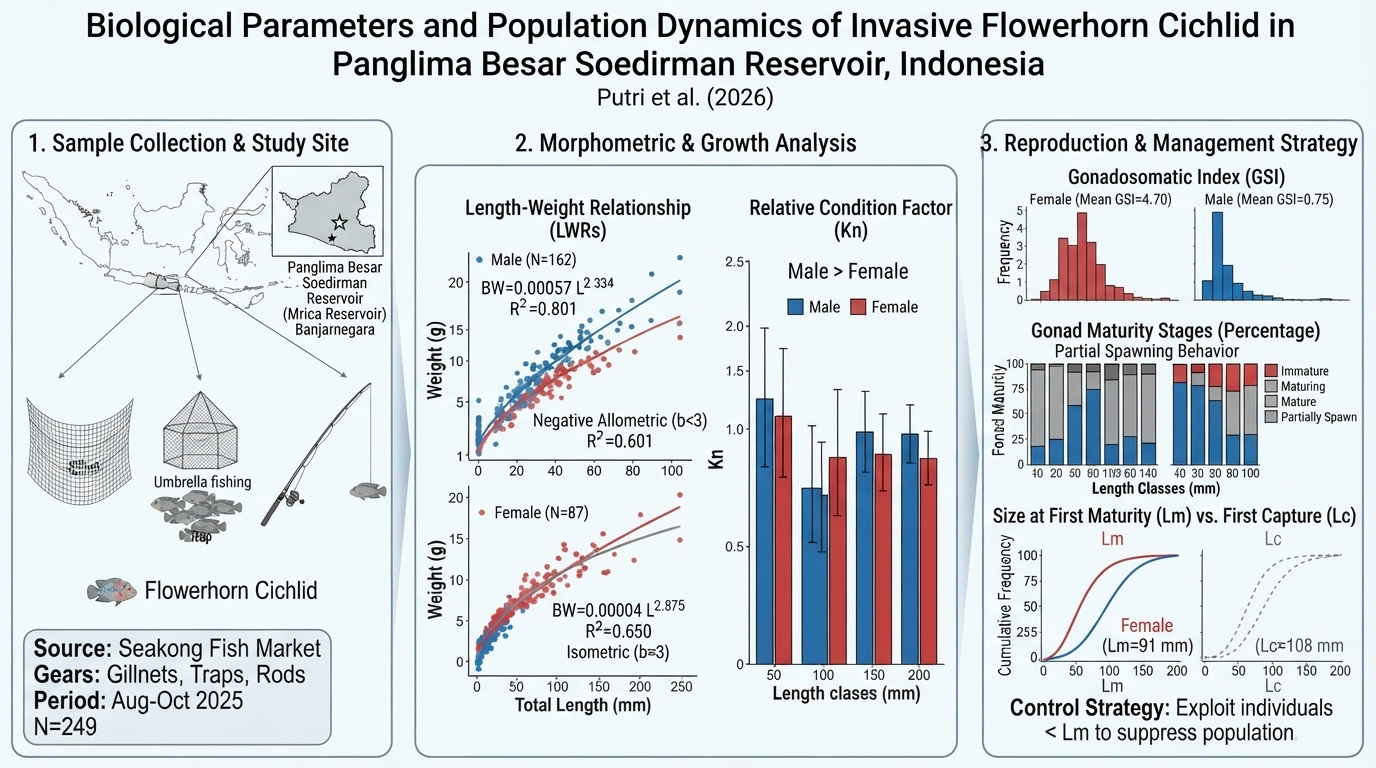
Flowerhorn cichlids are potentially invasive fish species because of their wide ranged in trophic level and reproductive properties. This study aims to analyze several biological parameters of flowerhorn cichlids in Panglima Besar Soedirman Reservoirs that consist of many native fishes from Serayu River. Fish were collected from the fisherman that operated using multiple gears and landed the flowerhorn fish in Seakong Fish Market, Wanadadi, Banjarnegara, Indonesia from August to October 2025. Fish were then analyzed in Pescica Marina Laboratory of Fisheries and Marine Science, Universitas Jenderal Soedirman. Biological aspects that were assessed consist of morphology, length-weight relationship (LWRs), relative condition factor (Kn), gonadosomatic index (GSI), length at the first capture (Lc), and maturity (Lm). The results showed that males have a higher condition factor (1.05), although with a negative allometric growth pattern (b<3). Conversely, the female was heavier (444.34 ± 26.34 g) and longer (117.58 ± 22.84 mm). The mean gonadosomatic index for male (0.75) and female (4.70) are related to the gonad maturity stage in which the male are mostly immature to maturing but females are dominantly mature. The length of maturity of female is 91 mm while male is 219.2 mm, and their length at the first capture is 107.9 mm and 109.5 mm, respectively.
References
Akhdiana, I., Dina, R., Wahyudewantoro, G., Lestari, F. S., Nafisyah, E., Oktaviyani, D., & Waluyo, A. (2023). A biological perspective for the fishery management of a small urban lake in Indonesia: A case study on the reproductive stage of the red devil (Amphilophus citrinellus) in Situ Cilodong, West Java, Indonesia. LIMNOTEK: Perairan Darat Tropis di Indonesia, 29(1). https://doi.org/10.55981/limnotek.2023.2031.
Alfianto, A. (2014). Techno Sabo for overcoming reservoir watershed sedimentation (Case study: Mrica Reservoir) (Indonesian). Jurnal Teknik Hidraulik, 5(1), 83–98.
Anggraini, D., Purnomo, S. A., & Wulandari, D. A. (2019). Economic analysis of sediment control at Mrica Reservoir (Indonesian). Briliant: Jurnal Riset dan Konseptual, 4(4), 567–574.
Araújo, A. S. D., do Nascimento, W. S., Yamamoto, M. E., & Chellappa, S. (2012). Temporal dynamics of reproduction of the Neotropical fish Crenicichla menezesi (Perciformes: Cichlidae). The Scientific World Journal, 2012, Article 579051. https://doi.org/10.1100/2012/579051.
Baldauf, S. A., Bakker, T. C. M., Herder, F., Kullmann, H., & Thünken, T. (2010). Male mate choice scales female ornament allometry in a cichlid fish. BMC Evolutionary Biology, 10(1), 301. https://doi.org/10.1186/1471-2148-10-301.
Detmer, T., Airey, M., Jirka, K., Randall, E., Zarri, L., McIntyre, P., & Kraft, C. (2025). Community-wide transient dynamics of lake fish populations in response to two decades of suppressing an introduced predator. Journal of Applied Ecology, 62(6), 1406–1420. https://doi.org/10.1111/1365-2664.70064.
Dinh, Q. M., Nguyen, T. H. D., Truong, N. T., & Nguyen-Ngoc, L. (2022). Factors regulating growth pattern and condition factor of an amphibious fish Periophthalmus gracilis living in the Mekong Delta. PeerJ, 10, e13060. https://doi.org/10.7717/peerj.13060.
Evangelista, C., Britton, J. R., & Cucherousset, J. (2015). Impacts of invasive fish removal through angling on population characteristics and juvenile growth rate. Ecology and Evolution, 5(11), 2193–2202. https://doi.org/10.1002/ece3.1471.
Fadlovich, R., Landom, K., & Walsworth, T. E. (2025). Selectivity of invasive species suppression efforts influences control efficacy. Journal of Applied Ecology, 62(2), 280–289. https://doi.org/10.1111/1365-2664.14856.
Hedianto, A. D., Purnomo, K., Kartamihardja, E. S., & Warsa, A. (2014). Population parameters of three-spot cichlid (Cichlasoma trimaculatum Günther, 1867) in Sempor Reservoir, Central Java. Jurnal Penelitian Perikanan Indonesia, 20(2), 83–92.
Hedianto, D. A., & Satria, H. (2018). Recruitment pattern and exploitation rate of flowerhorn cichlid for controlling invasive alien species in Lake Matano, South Sulawesi (Indonesian). Jurnal Penelitian Perikanan Indonesia, 23(4), 227–239. https://doi.org/10.15578/jppi.23.4.2017.227-239.
Hedianto, D. A., Sentosa, A. A., & Satria, H. (2018). Reproductive aspects of hybrid flowerhorn cichlid as an invasive alien species in Lake Matano, South Sulawesi (Indonesian). Bawal: Widya Riset Perikanan Tangkap, 10(2), 69–82. https://doi.org/10.15578/bawal.10.2.2018.69-82.
Humanica, A. P., Putri, A. K., Sari, L. K., Junaidi, T., Sanjayasari, D., Samudera, S. R., … Irawan, H. (2024). Several biological aspects of invasive hybrid louhan fish from P.B. Sudirman Reservoir, Banjarnegara Regency, Central Java (Indonesian). In Proceedings of the National Seminar LPPM UNSOED 2023 (pp. 50–58).
Knight, J. D. M. (2010). Invasive ornamental fish: A potential threat to aquatic biodiversity in peninsular India. Journal of Threatened Taxa, 2(2), 700–704. https://doi.org/10.11609/JoTT.o2179.700-4.
Le Cren, E. D. (1951). The length–weight relationship and seasonal cycle in gonad weight and condition in the perch (Perca fluviatilis). Journal of Animal Ecology, 20(2), 201–219. https://doi.org/10.2307/1540.
Magalhães, A. L. B., Orsi, M. L., Pelicice, F. M., Azevedo-Santos, V. M., Vitule, J. R. S., Lima-Junior, D. P., & Brito, M. F. G. (2017). Small size today, aquarium dumping tomorrow: Sales of juvenile non-native large fish as an important threat in Brazil. Neotropical Ichthyology, 15(4), e170033. https://doi.org/10.1590/1982-0224-20170033.
Mlingi, F. T., Burgerhout, E., Mommens, M., Tveiten, H., Tomkiewicz, J., Kjørsvik, E., & Puvanendran, V. (2024). Reproductive performance of lumpfish (Cyclopterus lumpus): Effects of integrated photoperiod and temperature manipulation. PLOS ONE, 19(10), e0311735. https://doi.org/10.1371/journal.pone.0311735.
Nasution, S. H., Akhdiana, I., Muchlis, A. M., & Cinnawara, H. T. (2022). Size distribution and length–weight relationship of invasive flowerhorn (Cichlasoma trimaculatum) in Lake Mahalona, South Sulawesi. IOP Conference Series: Earth and Environmental Science, 1062(1), 012002. https://doi.org/10.1088/1755-1315/1062/1/012002.
Novikova, O. V. (2025). Sexual dimorphism in postembryonic development of saffron cod, walleye pollock, and Pacific cod. Izvestiya TINRO, 205(1), 17–38. https://doi.org/10.26428/1606-9919-2025-205-17-38.
Ohee, H. L., Mote, N., Rice, M. A., & Sujarta, P. (2020). Sex ratio and reproduction of invasive red devil (Amphilophus labiatus) in Lake Sentani, Indonesia. Lakes & Reservoirs, 25(3), 334–345. https://doi.org/10.1111/lre.12332.
Okuda, N. (2001). The costs of reproduction to males and females of a paternal mouthbrooding cardinalfish Apogon notatus. Journal of Fish Biology, 58(3), 776–787. https://doi.org/10.1111/j.1095-8649.2001.tb00530.x.
Oldfield, R. G. (2005). Genetic, abiotic and social influences on sex differentiation in cichlid fishes and the evolution of sequential hermaphroditism. Fish and Fisheries, 6(2), 93–110. https://doi.org/10.1111/j.1467-2979.2005.00184.x
Rogers, W. (1995). Female choice predicts the best father in a biparental fish, the Midas cichlid (Cichlasoma citrinellum). Ethology, 100(3), 230–241. https://doi.org/10.1111/j.1439-0310.1995.tb00327.x.
Rukayah, S., & Lestari, W. (2021). Conservation of native species through reproductive and environmental studies of wader pari fish (Rasbora argyrotaenia). In Proceedings of the National Seminar on Biology Education and Science (pp. 1–12).
Santos, M. E., Lopes, J. F., & Kratochwil, C. F. (2023). East African cichlid fishes. EvoDevo, 14(1), 1. https://doi.org/10.1186/s13227-022-00205-5.
Sari, D. W. K., Achmad, H., Rahman, H., & Bimasuci, H. (2023). Molecular identification of morphologically distinct flowerhorn fish using mitochondrial gene markers. Journal of Tropical Biodiversity and Biotechnology, 8(2), 78459. https://doi.org/10.22146/jtbb.78459.
Sentosa, A. A., & Hedianto, D. A. (2020). Gillnet selectivity and effectiveness for controlling invasive fish species in Lake Matano, South Sulawesi. IOP Conference Series: Earth and Environmental Science, 535(1), 012039. https://doi.org/10.1088/1755-1315/535/1/012039.
Sentosa, A., & Hedianto, D. (2019). Distribution of invasive flowerhorn fish in Lake Matano, South Sulawesi (Indonesian). Bawal: Widya Riset Perikanan Tangkap, 11(1), 1–9.
Samudra, S., Islami, S., Sanjayasari, D., Firdaus, A., Putri, A., Fikriyya, N., & Attaqi, A. (2024). Phytoplankton community structure in P.B. Soedirman Reservoir, Central Java, Indonesia. Biodiversitas: Journal of Biological Diversity, 25(5), 2161–2169. https://doi.org/10.13057/biodiv/d250534.
Silva, T., Lima, D., Prado-Valladares, A., Ferreira, M., Rocha, R., & Queiroz, H. (2015). Reproductive aspects of the flag cichlid Mesonauta insignis in várzea lakes of the Central Brazilian Amazon. Aquatic Biology, 24(1), 35–40. https://doi.org/10.3354/ab00631.
Sparre, P., & Venema, S. C. (1992). Introduction to tropical fish stock assessment: Part 1. FAO Fisheries Technical Paper No. 306. FAO.
Thünken, T., Baldauf, S. A., Kullmann, H., Schuld, J., Hesse, S., & Bakker, T. C. M. (2011). Size-related inbreeding preference and competitiveness in male Pelvicachromis taeniatus. Behavioral Ecology, 22(2), 358–362. https://doi.org/10.1093/beheco/arq217.
Tsuboi, M., & Takahashi, T. (2024). Sexually divergent selection, allometric constraints, and the evolution of sexual dimorphism in cichlids from Lake Tanganyika. Journal of Evolutionary Biology, 37(12), 1563–1575. https://doi.org/10.1093/jeb/voae101.
Udupe, K. S. (1986). Statistical method of estimating the size at first maturity in fishes. Fishbyte, 4(2), 8–10.
Warsa, A., & Purnomo, K. (2013). Monofilament gillnet selectivity and biological aspects of Midas cichlid (Amphilophus citrinellus). Jurnal Penelitian Perikanan Indonesia, 19(2), 65–72.
Downloads
Published
Issue
Section
License
Copyright (c) 2026 Adinda Putri, Dinda Agy Cahyaningrum, Novia Nurul Afiyah, Yuriza Eshananda, I Nyoman Yoga Parawangsa

This work is licensed under a Creative Commons Attribution-NonCommercial 4.0 International License.