
Muricins as Potential Natural B-cell Lymphoma-extra-large (Bcl-xL) Inhibitors: A Multiscale in Silico Approach Targeting Apoptosis and Chemoresistance in Cancer
DOI:
https://doi.org/10.11113/mjfas.v22n3.4885Keywords:
Muricin H, Muricin I, Molecular docking, Molecular dynamics, Network pharmacology.Abstract
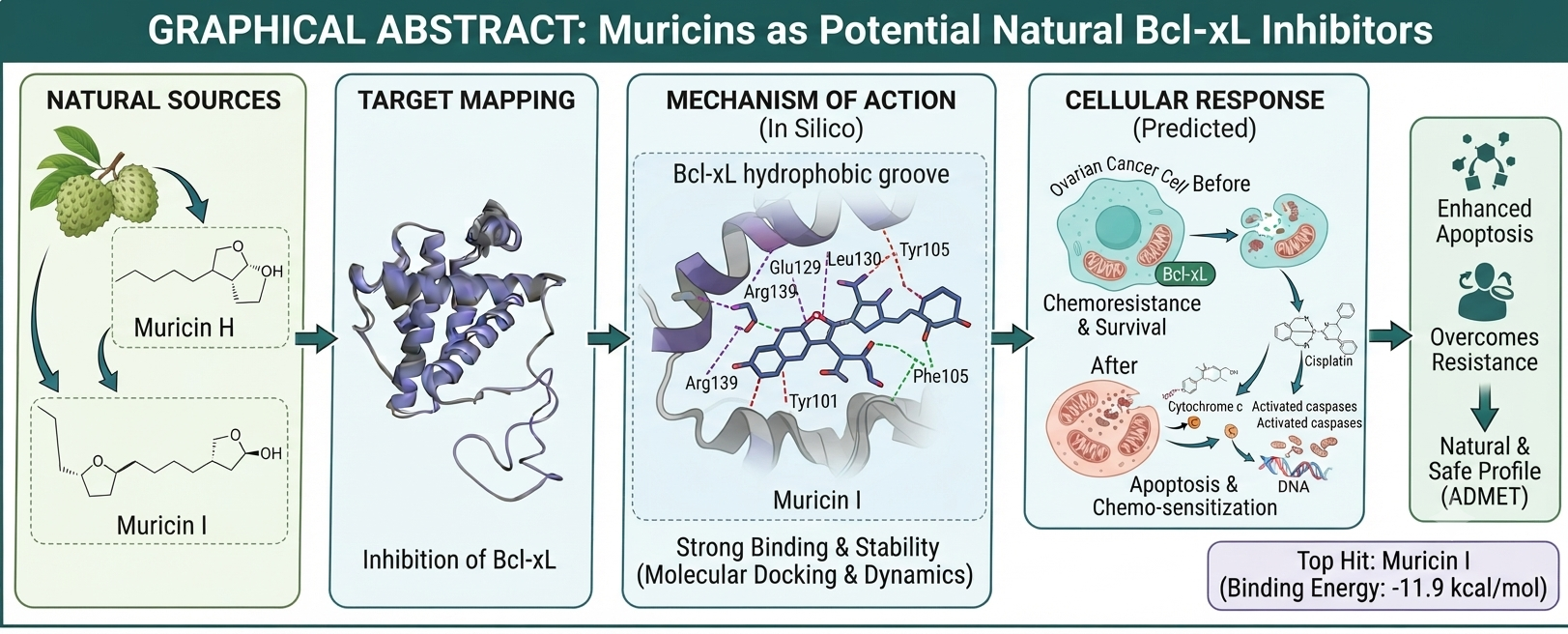
Resistance to apoptosis mediated by overexpression of anti-apoptotic proteins such as B-cell lymphoma-extra-large (Bcl-xL) is notable in most cancers. Natural acetogenins, including muricin I and muricin H from Annona species, are structurally unique compounds with cytotoxic potential, yet their mechanisms of action in ovarian cancer remain unexplored. This study integrates molecular docking, ADMET profiling, network pharmacology, and molecular dynamics (MD) simulations to investigate the potential of muricin I and H as Bcl-xL inhibitors. Molecular docking revealed strong binding affinities of muricin I/Bcl-xL and muricin H/Bcl-xL complexes with binding energies of –11.9 kcal/mol and –11.6 kcal/mol, respectively, suggesting potential inhibitory activity. ADMET analysis showed favourable pharmacokinetic profiles, including good oral bioavailability and low predicted toxicity (class IV). To further contextualize these findings, network pharmacology was employed to identify overlapping targets with ovarian cancer and apoptosis-related genes. Enrichment and protein–protein interaction analyses highlighted Bcl-xL and related apoptosis pathways as central nodes along with chemoresistance signalling, with key hub genes such as BCL2 and CASP3 linking to platinum resistance pathways. These findings reflect the polypharmacological nature of muricin compounds and suggest potential synergistic effects relevant to tumour progression. Finally, 100 ns of MD simulations confirmed the structural stability of muricins/Bcl-xL complexes, with consistent RMSD values of 1.29 ± 0.23 Å (muricin I) and 1.31 ± 0.16 Å (muricin H), supporting strong and stable binding interactions. This is the first study to identify muricin I and muricin H as Bcl-xL inhibitors, highlighting their potential as natural multi-target pro-apoptotic agents.
References
Saddam, M., Paul, S. K., Habib, M. A., Fahim, M. A., Mimi, A., Islam, S., Paul, B., & Helal, M. M. U. (2024). Emerging biomarkers and potential therapeutics of the BCL-2 protein family: The apoptotic and anti-apoptotic context. Egyptian Journal of Medical Human Genetics, 25(1), 12. https://doi.org/10.1186/s43042-024-00485-7
Czabotar, P. E., Lessene, G., Strasser, A., & Adams, J. M. (2014). Control of apoptosis by the BCL-2 protein family: Implications for physiology and therapy. Nature Reviews Molecular Cell Biology, 15(1), 49–63. https://doi.org/10.1038/nrm3722
Man, K. F., Darweesh, O., Hong, J., Thompson, A., O’Connor, C., Bonaldo, C., Melkonyan, M. N., Sun, M., Patel, R., Ellisen, L. W., & Robinson, T. (2025). CREB1–BCL2 drives mitochondrial resilience in RAS GAP-dependent breast cancer chemoresistance. Oncogene, 44(16), 1093–1105. https://doi.org/10.1038/s41388-025-03284-5
Vogler, M., Braun, Y., Smith, V. M., Westhoff, M. A., Pereira, R. S., Pieper, N. M., Anders, M., Callens, M., Vervliet, T., Abbas, M., & Macip, S. (2025). The BCL2 family: From apoptosis mechanisms to new advances in targeted therapy. Signal Transduction and Targeted Therapy, 10(1), 91. https://doi.org/10.1038/s41392-025-02176-0
Souers, A. J., Leverson, J. D., Boghaert, E. R., Ackler, S. L., Catron, N. D., Chen, J., Dayton, B. D., Ding, H., Enschede, S. H., Fairbrother, W. J., & Huang, D. C. (2013). ABT-199, a potent and selective BCL-2 inhibitor, achieves antitumor activity while sparing platelets. Nature Medicine, 19(2), 202–208. https://doi.org/10.1038/nm.3048
Birkinshaw, R. W., Gong, J. N., Luo, C. S., Lio, D., White, C. A., Anderson, M. A., Blombery, P., Lessene, G., Majewski, I. J., Thijssen, R., & Roberts, A. W. (2019). Structures of BCL-2 in complex with venetoclax reveal the molecular basis of resistance mutations. Nature Communications, 10(1), 2385. https://doi.org/10.1038/s41467-019-10363-1
Stevens, M., & Oltean, S. (2019). Modulation of the apoptosis gene Bcl-x function through alternative splicing. Frontiers in Genetics, 10, 804. https://doi.org/10.3389/fgene.2019.00804
Nocquet, L., Roul, J., Lefebvre, C. C., Duarte, L., Campone, M., Juin, P. P., & Souazé, F. (2024). Low BCL-xL expression in triple-negative breast cancer cells favors chemotherapy efficacy, and this effect is limited by cancer-associated fibroblasts. Scientific Reports, 14(1), 14177. https://doi.org/10.1038/s41598-024-64696-z
Antony, P., & Vijayan, R. (2016). Acetogenins from Annona muricata as potential inhibitors of antiapoptotic proteins: A molecular modeling study. Drug Design, Development and Therapy, 10, 1399–1410.
https://doi.org/10.2147/DDDT.S103216
Liaw, C. C., Chang, F. R., Lin, C. Y., Chou, C. J., Chiu, H. F., Wu, M. J., & Wu, Y. C. (2002). New cytotoxic monotetrahydrofuran Annonaceous acetogenins from Annona muricata. Journal of Natural Products, 65(4), 470–475. https://doi.org/10.1021/np0105578
Nordin, N., Khimani, K., & Abd Ghani, M. F. (2021). Acetogenins exhibit potential BCL-XL inhibitor for the induction of apoptosis in the molecular docking study. Current Drug Discovery Technologies, 18(6), 98–
https://doi.org/10.2174/1570163818666210204202426
Daina, A., Michielin, O., & Zoete, V. (2019). SwissTargetPrediction: Updated data and new features for efficient prediction of protein targets of small molecules. Nucleic Acids Research, 47(W1), W357–W364. https://doi.org/10.1093/nar/gkz382
Pires, D. E., Blundell, T. L., & Ascher, D. B. (2015). pkCSM: Predicting small-molecule pharmacokinetic and toxicity properties using graph-based signatures. Journal of Medicinal Chemistry, 58(9), 4066–4072. https://doi.org/10.1021/acs.jmedchem.5b00104
Filimonov, D. A., Lagunin, A. A., Gloriozova, T. A., Rudik, A. V., Druzhilovskii, D. S., Pogodin, P. V., & Poroikov, V. V. (2014). Prediction of the biological activity spectra of organic compounds using the PASS online web resource. Chemistry of Heterocyclic Compounds, 50(3), 444–457. https://doi.org/10.1007/s10593-014-1496-1
Dong, Z., Chang, X., Luo, X., Li, H., Deng, M., Huang, Z., Chen, T., Chen, Y., Sun, B., Wu, Y., & Wu, R. (2025). Integration of network pharmacology, transcriptomics, and experimental verification to investigate the mechanism of action of cepharanthine hydrochloride against prostate cancer. Scientific Reports, 15(1), 18115. https://doi.org/10.1038/s41598-025-03004-9
Daina, A., Michielin, O., & Zoete, V. (2019). SwissTargetPrediction: Updated data and new features for efficient prediction of protein targets of small molecules. Nucleic Acids Research, 47(W1), W357–W364. https://doi.org/10.1093/nar/gkz382
Liu, X., Ouyang, S., Yu, B., Liu, Y., Huang, K., Gong, J., Zheng, S., Li, Z., Li, H., & Jiang, H. (2010). PharmMapper server: A web server for potential drug target identification using pharmacophore mapping approach. Nucleic Acids Research, 38(Suppl_2), W609–W614.
https://doi.org/10.1093/nar/gkq300
Chen, J., Li, L. F., Hu, X. R., Wei, F., & Ma, S. (2021). Network pharmacology-based strategy for elucidating the molecular basis for the pharmacologic effects of licorice (Glycyrrhiza spp.). Frontiers in Pharmacology, 12, 590477. https://doi.org/10.3389/fphar.2021.590477
Wang, J., Wang, Y., Li, L., Cai, S., Mao, D., Lou, H., & Zhao, J. (2023). Network pharmacology-based pharmacological mechanism prediction of Lycii Fructus against postmenopausal osteoporosis. Medicine, 102(48), e36292. https://doi.org/10.1097/MD.0000000000036292
Jain, N. K., Tailang, M., Chandrasekaran, B., Khazaleh, N. T., Thangavel, N., Makeen, H. A., Albratty, M., Najmi, A., Alhazmi, H. A., Zoghebi, K., & Alagusundaram, M. (2024). Integrating network pharmacology with molecular docking to rationalize the ethnomedicinal use of Alchornea laxiflora (Benth.) Pax & K. Hoffm. for efficient treatment of depression. Frontiers in Pharmacology, 15, 1290398. https://doi.org/10.3389/fphar.2024.1290398
Lessene, G., Czabotar, P. E., Sleebs, B. E., Zobel, K., Lowes, K. N., Adams, J. M., Baell, J. B., Colman,
P. M., Deshayes, K., Fairbrother, W. J., & Flygare, J. A. (2013). Structure-guided design of a selective BCL-XL inhibitor. Nature Chemical Biology, 9(6), 390–397. https://doi.org/10.1038/nchembio.1246
Waterhouse, A., Bertoni, M., Bienert, S., Studer, G., Tauriello, G., Gumienny, R., Heer, F. T., de Beer, T.
A. P., Rempfer, C., Bordoli, L., & Lepore, R. (2018). SWISS-MODEL: Homology modelling of protein structures and complexes. Nucleic Acids Research, 46(W1), W296–W303. https://doi.org/10.1093/nar/gky427
Trott, O., & Olson, A. J. (2010). AutoDock Vina: Improving the speed and accuracy of docking with a new scoring function, efficient optimization, and multithreading. Journal of Computational Chemistry, 31(2), 455–461. https://doi.org/10.1002/jcc.21334
Lee, T. S., Cerutti, D. S., Mermelstein, D., Lin, C., LeGrand, S., Giese, T. J., Roitberg, A., Case, D. A., Walker, R. C., & York, D. M. (2018). GPU-accelerated molecular dynamics and free energy methods in Amber18: Performance enhancements and new features. Journal of Chemical Information and Modeling, 58(10), 2043–2050. https://doi.org/10.1021/acs.jcim.8b00462
Hao, X., Li, C., Liu, C., Meng, Q., & Sun, J. (2022). The performance of OPC water model in prediction of the phase equilibria of methane hydrate. Journal of Chemical Physics, 157(1), Article 014101. https://doi.org/10.1063/5.0093659
Humphrey, W., Dalke, A., & Schulten, K. (1996). VMD: Visual molecular dynamics. Journal of Molecular Graphics, 14(1), 33–38. https://doi.org/10.1016/0263-7855(96)00018-5
Roe, D. R., & Cheatham, T. E. III. (2013). PTRAJ and CPPTRAJ: Software for processing and analysis of molecular dynamics trajectory data. Journal of Chemical Theory and Computation, 9(7), 3084–3095. https://doi.org/10.1021/ct400341p
Jeliński, T., Przybyłek, M., & Cysewski, P. (2019). Natural deep eutectic solvents as agents for improving solubility, stability and delivery of curcumin. Pharmaceutical Research, 36(8), 116. https://doi.org/10.1007/s11095-019-2643-2
Gangavarapu, A., Tapia-Lopez, L. V., Sarkar, B., Pena-Zacarias, J., Badruddoza, A. Z. M., & Nurunnabi,
M. (2024). Lipid nanoparticles for enhancing oral bioavailability. Nanoscale, 16(39), 18319–18338. https://doi.org/10.1039/D4NR01487A
Elnady, R. E., Amin, M. M., & Zakaria, M. Y. (2023). A review on lipid-based nanocarriers mimicking chylomicron and their potential in drug delivery and targeting infectious and cancerous diseases. AAPS Open, 9(1), 13. https://doi.org/10.1186/s41120-023-00080-x
Sambhakar, S., Saharan, R., Narwal, S., Malik, R., Gahlot, V., Khalid, A., Najmi, A., Zoghebi, K., Halawi,
M. A., Albratty, M., & Mohan, S. (2023). Exploring lipids for their potential to improve bioavailability of lipophilic drug candidates: A review. Saudi Pharmaceutical Journal, 31(12), 101870. https://doi.org/10.1016/j.jsps.2023.101870
Seo, Y., Lim, H., Park, H., Yu, J., An, J., Yoo, H. Y., & Lee, T. (2023). Recent progress of lipid nanoparticles-based lipophilic drug delivery: Focus on surface modifications. Pharmaceutics, 15(3), 772. https://doi.org/10.3390/pharmaceutics15030772
Uti, D. E., Alum, E. U., Atangwho, I. J., Ugwu, O. P. C., Egbung, G. E., & Aja, P. M. (2025). Lipid-based nano-carriers for the delivery of anti-obesity natural compounds: Advances in targeted delivery and precision therapeutics. Journal of Nanobiotechnology, 23(1), 336.
https://doi.org/10.1186/s12951-025-03412-z
Shao, L. I., & Zhang, B. (2013). Traditional Chinese medicine network pharmacology: Theory, methodology and application. Chinese Journal of Natural Medicines, 11(2), 110–120. https://doi.org/10.1016/S1875-5364(13)60037-0
Li, H., Zhao, L., Zhang, B., Jiang, Y., Wang, X., Guo, Y., Liu, H., Li, S., & Tong, X. (2014). A network pharmacology approach to determine active compounds and action mechanisms of Ge-gen-qin-lian decoction for treatment of type 2 diabetes. Evidence-Based Complementary and Alternative Medicine, 2014, 495840. https://doi.org/10.1155/2014/495840
Lagunin, A., Stepanchikova, A., Filimonov, D., & Poroikov, V. (2000). PASS: Prediction of activity spectra for biologically active substances. Bioinformatics, 16(8), 747–748. https://doi.org/10.1093/bioinformatics/16.8.747
Youle, R. J., & Strasser, A. (2008). The BCL-2 protein family: Opposing activities that mediate cell death.
Nature Reviews Molecular Cell Biology, 9(1), 47–59. https://doi.org/10.1038/nrm2308
Bermejo, A., Figadère, B., Zafra-Polo, M. C., Barrachina, I., Estornell, E., & Cortes, D. (2005). Acetogenins from Annonaceae: Recent progress in isolation, synthesis and mechanisms of action.
Natural Product Reports, 22(2), 269–303. https://doi.org/10.1039/B500186M
Mollinedo, F., & Gajate, C. (2020). Lipid rafts as signaling hubs in cancer cell survival/death and invasion: Implications in tumor progression and therapy. Journal of Lipid Research, 61(5), 611–635. https://doi.org/10.1194/jlr.TR119000439
Gregoraszczuk, E. L., Rak-Mardyła, A., Ryś, J., Jakubowicz, J., & Urbański, K. (2015). Effect of chemotherapeutic drugs on caspase-3 activity as a key biomarker for apoptosis in ovarian tumor cells cultured as monolayer: A pilot study. Iranian Journal of Pharmaceutical Research, 14(4), 1153–1161.
Yuan, J., Lan, H., Jiang, X., Zeng, D., & Xiao, S. (2020). Bcl-2 family: Novel insight into individualized therapy for ovarian cancer. International Journal of Molecular Medicine, 46(4), 1255–1265. https://doi.org/10.3892/ijmm.2020.4689
Boyenle, I. D., Ogunlana, A. T., Oyedele, A. Q. K., Olokodana, B. K., Owolabi, N., Salahudeen, A., Aderenle, O. T., Oloyede, T. O., & Adelusi, T. I. (2023). Reinstating apoptosis using putative Bcl-xL natural product inhibitors: Molecular docking and ADMETox profiling investigations. Journal of Taibah University Medical Sciences, 18(3), 461–469. https://doi.org/10.1016/j.jtumed.2022.10.014
Grinevicius, V. M., Andrade, K. S., Mota, N. S., Bretanha, L. C., Felipe, K. B., Ferreira, S. R., & Pedrosa,
R. C. (2019). CDK2 and Bcl-xL inhibitory mechanisms by docking simulations and anti-tumor activity from piperine-enriched supercritical extract. Food and Chemical Toxicology, 132, 110644. https://doi.org/10.1016/j.fct.2019.110644
Abd Ghani, M. F., Othman, R., & Nordin, N. (2020). Molecular docking study of naturally derived flavonoids with antiapoptotic BCL-2 and BCL-XL proteins toward ovarian cancer treatment. Journal of Pharmacy and Bioallied Sciences, 12(Suppl 2), S676–S680. https://doi.org/10.4103/jpbs.JPBS_272_19
Bekker, G. J., Araki, M., Oshima, K., Okuno, Y., & Kamiya, N. (2023). Mutual induced-fit mechanism drives binding between intrinsically disordered Bim and cryptic binding site of Bcl-xL. Communications Biology, 6(1), 349. https://doi.org/10.1038/s42003-023-04720-6
Fulda, S., & Kroemer, G. (2011). Mitochondria as therapeutic targets for the treatment of malignant disease. Antioxidants & Redox Signaling, 15(12), 2937–2949.
https://doi.org/10.1089/ars.2011.4078
Arsianti, A., Fadilah, L. E., & Paramita, R. I. (2017). Molecular docking of antimycin A. Asian Journal of Pharmaceutical and Clinical Research, 10(8), 317–322. https://doi.org/10.22159/ajpcr.2017.v10i8.18165
Nordin, N., Sulaiman, W. N. W., & Elias, M. H. (2024). Molecular docking of natural alkaloids with Bcl-xL protein in the apoptosis process. Malaysian Journal of Science, Health & Technology, 10(2), 139–146. https://doi.org/10.33102/mjosht.v10i2.406
Umar, A. K., Zothantluanga, J. H., Luckanagul, J. A., Limpikirati, P., & Sriwidodo, S. (2023). Structure-based computational screening of 470 natural quercetin derivatives for identification of SARS-CoV-2 Mpro inhibitor. PeerJ, 11, e14915. https://doi.org/10.7717/peerj.14915
Pandya, V., Rao, P., Prajapati, J., Rawal, R. M., & Goswami, D. (2024). Pinpointing top inhibitors for GSK3β from pool of indirubin derivatives using rigorous computational workflow and their validation using molecular dynamics simulations. Scientific Reports, 14(1), 49.https://doi.org/10.1038/s41598-023-50992-7
Rana, N., Solanki, P., Mehra, R., & Manhas, A. (2025). Identification of natural compound inhibitors for substrate-binding site of MTHFD2 enzyme: Insights from structure-based drug design and biomolecular simulations. Chemical Physics Impact, 10, 100809.
https://doi.org/10.1016/j.chphi.2024.100809
Krishna, S., Kumar, S. B., Murthy, T. K., & Murahari, M. (2021). Structure-based design approach of potential BCL-2 inhibitors for cancer chemotherapy. Computers in Biology and Medicine, 134, 104455. https://doi.org/10.1016/j.compbiomed.2021.104455
Abouzied, A. S., Alqarni, S., Younes, K. M., Alanazi, S. M., Alrsheed, D. M., Alhathal, R. K., Huwaimel, B., & Elkashlan, A. M. (2024). Structural and free energy landscape analysis for the discovery of antiviral compounds targeting the cap-binding domain of influenza polymerase PB2. Scientific Reports, 14(1), 25441. https://doi.org/10.1038/s41598-024-69816-3
Lobanov, M. Y., Bogatyreva, N. S., & Galzitskaya, O. V. (2008). Radius of gyration as an indicator of protein structure compactness. Molecular Biology, 42(4), 623–628. https://doi.org/10.1134/S0026893308040195
Lama, D., Modi, V., & Sankararamakrishnan, R. (2013). Behavior of solvent-exposed hydrophobic groove in the anti-apoptotic Bcl-XL protein: clues for its ability to bind diverse BH3 ligands from MD simulations. PLoS One, 8(2), e54397. https://doi.org/10.1371/journal.pone.0054397
Parikh, N., Koshy, C., Dhayabaran, V., Perumalsamy, L. R., Sowdhamini, R., & Sarin, A. (2007). The N-terminus and alpha-5, alpha-6 helices of the pro-apoptotic protein Bax, modulate functional interactions with the anti-apoptotic protein Bcl-xL. BMC cell biology, 8(1), 16.https://doi.org/10.1186/1471-2121-8-16
Leber, B., Lin, J., & Andrews, D. W. (2010). Still embedded together binding to membranes regulates Bcl-2 protein interactions. Oncogene, 29(38), 5221-5230. https://doi.org/10.1038/onc.2010.283
Wakui, N., Yoshino, R., Yasuo, N., Ohue, M., & Sekijima, M. (2018). Exploring the selectivity of inhibitor complexes with Bcl-2 and Bcl-xL: A molecular dynamics simulation approach. Journal of Molecular Graphics and Modelling, 79, 166–174.
Downloads
Published
Issue
Section
License
Copyright (c) 2026 Kaynat Qurban Khimani, Wan Noraini Wan Sulaiman, Noraziah Nordin

This work is licensed under a Creative Commons Attribution-NonCommercial 4.0 International License.