
Antidiarrheal Activity of Amaranthus spinosus L. Leaf Extract in Castor Oil Induced Diarrhea and Gastrointestinal Motility Models in Mice
DOI:
https://doi.org/10.11113/mjfas.v22n2.4859Keywords:
Antidiarrheal, Amaranthus spinosus L., oleum ricini, defecationAbstract
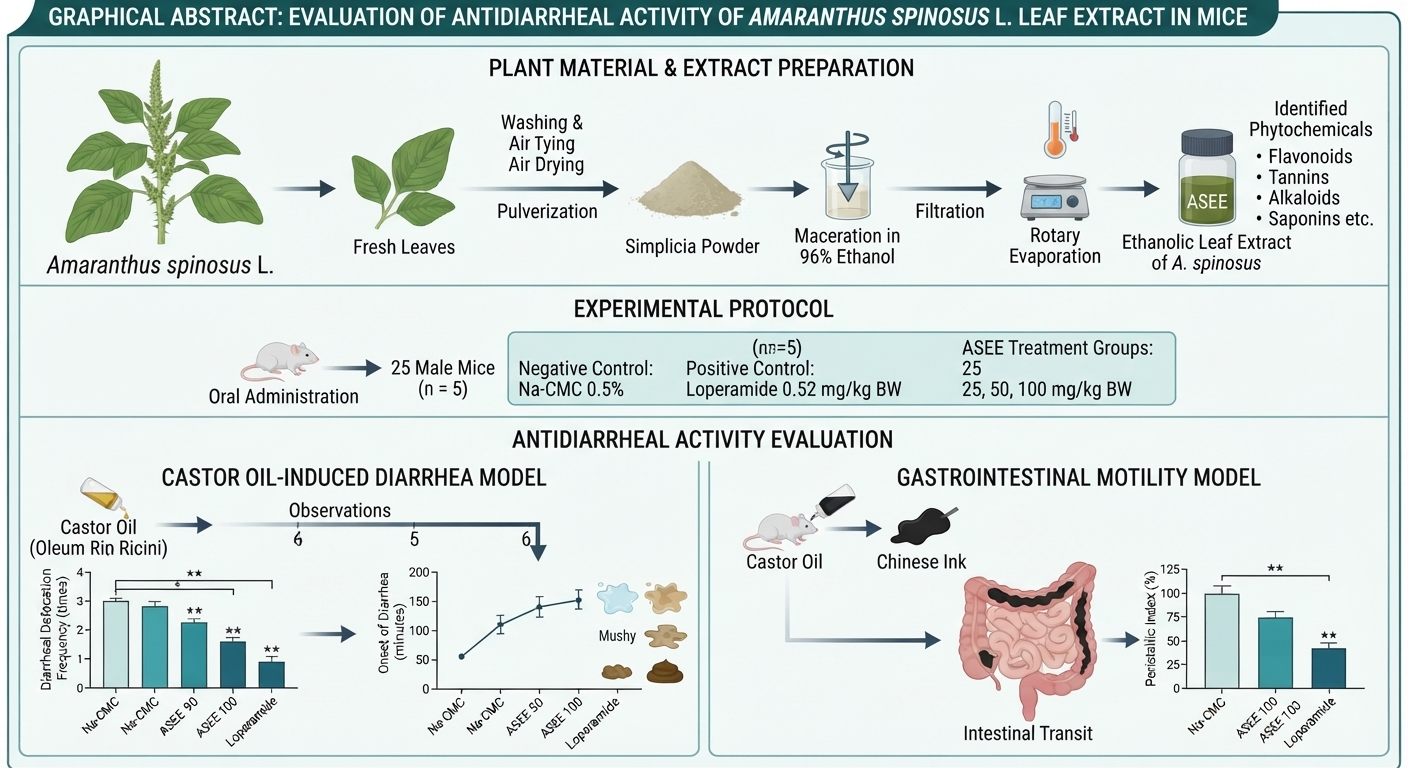
Diarrhea is a common digestive disorder characterized by frequent bowel movements and a shift in stool consistency toward a more liquid form. Amaranthus spinosus L., a plant known to contain tannins and flavonoids, is believed to have antidiarrheal potential due to its astringent properties, which may help reduce intestinal secretions. This study explored the antidiarrheal effect of the ethanolic extract of A.spinosus leaves in male mice. A total of 25 mice were divided into five groups: a negative control group receiving 0.5% CMC-Na suspension, a positive control group treated with Loperamide HCl (0.52 mg/kg BW), and three test groups receiving the A.spinosus extract at doses of 25, 50, and 100 mg/kg BW. Diarrhea was induced using castor oil (oleum ricini), and observations were made every 30 minutes over six hours, focusing on the onset of diarrhea, stool consistency, frequency of defecation, and overall duration of symptoms. The results showed that all doses of the extract had a measurable antidiarrheal effect, with higher doses producing stronger responses. Mice treated with the highest dose (100 mg/kg BW) experienced a delayed onset of diarrhea, fewer episodes, faster normalization of stool consistency, and shorter symptom duration. Statistically, the 100 mg/kg BW dose showed a significant improvement (p < 0.05) compared to the Loperamide HCl treated group in delaying diarrhea onset and reducing defecation frequency. These findings support the potential use of A.spinosus leaf extract as a natural antidiarrheal agent, which may be associated with the presence of tannins and flavonoids identified through phytochemical screening. In conclusion, the ethanolic extract of A.spinosus leaves demonstrated promising antidiarrheal activity in mice, especially at higher doses.
References
Awe, E. O., Kolawole, S. O., Wakeel, K. O., & Abiodun, O. O. (2011). Antidiarrheal activity of Pyrenacantha staudtii Engl. (Iccacinaceae) aqueous leaf extract in rodents. Journal of Ethnopharmacology, 137(1), 327–333. https://doi.org/10.1016/j.jep.2011.04.068.
Sharma, I., Kasture, P., Umrao, A., Rao, J., & Rao, G. (2021). Phytochemical analysis of Amaranthus spinosus Linn.: An in vitro analysis. Journal of Emerging Investigators. https://doi.org/10.59720/20-117.
Sinan, K. I., et al. (2020). Biopotential of Bersama abyssinica Fresen stem bark extracts: UHPLC profiles, antioxidant, enzyme inhibitory, and antiproliferative propensities. Antioxidants, 9(2), 163. https://doi.org/10.3390/antiox9020163.
Sinan, K. I., et al. (2021). A comparative study of the HPLC-MS profiles and biological efficiency of different solvent leaf extracts of two African plants: Bersama abyssinica and Scoparia dulcis. International Journal of Environmental Health Research, 31(3), 306–320. https://doi.org/10.1080/09603123.2019.1652885.
Chaudhary, M. A., Imran, I., Bashir, S., Mehmood, M. H., Rehman, N., & Gilani, A.-H. (2012). Evaluation of gut modulatory and bronchodilator activities of Amaranthus spinosus Linn. BMC Complementary and Alternative Medicine, 12(1), 166. https://doi.org/10.1186/1472-6882-12-166.
Kumkhale, R. S., Nimkar, V. A., & Sumbre, D. B. (n.d.). Investigation of active phytoconstituents of Amaranthus spinosus and Tephrosia purpurea used for ulcerative colitis.
Dos Santos Negreiros, P., et al. (2019). Antidiarrheal activity of α-terpineol in mice. Biomedicine & Pharmacotherapy, 110, 631–640. https://doi.org/10.1016/j.biopha.2018.11.131.
Ghosh, T., et al. (2014). Pharmacological actions and phytoconstituents of Amaranthus spinosus Linn: A review. International Journal of Pharmaceutical Sciences Review and Research, 6(2).
Jhade, D., Ahirwar, D., Jain, R., Kumar, N., & Gupta, S. (n.d.). A pharmacological review: Amaranthus spinosus.
Ganjare, A., & Raut, N. (2019). Nutritional and medicinal potential of Amaranthus spinosus. Journal of Pharmacognosy and Phytochemistry, 8(3), 3149–3156.
Sarker, U., & Oba, S. (2019). Nutraceuticals, antioxidant pigments, and phytochemicals in the leaves of Amaranthus spinosus and Amaranthus viridis weedy species. Scientific Reports, 9(1), 20413. https://doi.org/10.1038/s41598-019-50977-5.
Shivam, A. (2022). Pharmacological evaluation of analgesic, anti-inflammatory and antipyretic activities of Amaranthus spinosus stem. YMER Digital, 21(7). https://doi.org/10.37896/YMER21.07/85.
Olajide, O. A., Ogunleye, B. R., & Erinle, T. O. (2004). Anti-inflammatory properties of Amaranthus spinosus leaf extract. Pharmaceutical Biology, 42(7), 521–525. https://doi.org/10.3109/13880200490893285.
Abir, M. H., & Ahmad, M. (2021). Phytochemical, nutritional and pharmacological potentialities of Amaranthus spinosus Linn.: A review. Archives of Ecotoxicology, 3(2), 49–59. https://doi.org/10.36547/ae.2021.3.2.49-59.
Hussain, Z., Amresh, G., Singh, S., & Rao, C. V. (2009). Antidiarrheal and antiulcer activity of Amaranthus spinosus in experimental animals. Pharmaceutical Biology, 47(10), 932–939. https://doi.org/10.1080/13880200902950769.
Husein, S., Nainggolan, M., Yuandani, Y., & Fanany, I. (2020). Evaluation of antidiarrheal activity of the ethanol extract Leucaena leucocephala (Lam.) de Wit seed. Open Access Macedonian Journal of Medical Sciences, 8, 139–144. https://doi.org/10.3889/oamjms.2020.4060.
Puteri, C. I. A., Simahate, S., Ningtias, A., Fauzi, Z. P. A., Karo-Karo, S. U., & Andry, M. (2024). The analgesic activity study of ethanol extract of Plantago major L. in mice (Mus musculus) using writhing test method. Jurnal Biologi Tropis, 24(3), 945–957.
Fauzi, Z. P. A., Putri, C. I. A., Aska, N., & Utami, D. S. (2024). Formulation of tembelekan leaf hand sanitizer (Lantana camara L.) and antibacterial activity test against Escherichia coli and Staphylococcus aureus. Jurnal Biologi Tropis, 24(3), 747–754.
Asrie, A. B., Abdelwuhab, M., Shewamene, Z., Gelayee, D. A., Adinew, G. M., & Birru, E. (2016). Antidiarrheal activity of methanolic extract of the root bark of Cordia africana. Journal of Experimental Pharmacology, 8, 53–59. https://doi.org/10.2147/JEP.S116155.
Degu, A., Kefale, B., Alemayehu, D., & Tegegne, G. T. (2020). Evaluation of the antidiarrheal activity of hydromethanol crude extracts of Ruta chalepensis and Vernonia amygdalina in mice. Evidence-Based Complementary and Alternative Medicine, 2020, 8318713. https://doi.org/10.1155/2020/8318713.
Alkandahri, M. Y., et al. (2023). Evaluation of antidiarrheal, antispasmodic, and antisecretory activities of extract and fractions of Castanopsis costata leaves in animal models. Pharmacognosy Journal, 15(1).
Birru, E. M., Asrie, A. B., Adinew, G. M., & Tsegaw, A. (2016). Antidiarrheal activity of crude methanolic root extract of Indigofera spicata Forssk. (Fabaceae). BMC Complementary and Alternative Medicine, 16(1), 272. https://doi.org/10.1186/s12906-016-1252-4.
Ramahyani, N., Humaira, V., & Putra, F. A. (2023). Perbandingan efektivitas antidiare ekstrak alkohol 96% daun jambu biji (Psidium guajava L.) dan biji pinang (Areca catechu L.) pada mencit dengan metode defekasi. Jurnal Medisains Kesehatan, 4(2). https://doi.org/10.59963/jmk.v4i2.201.
Okoye, T., Akah, P., Okoli, C., Ezike, A., & Mbaoji, F. (2010). Antimicrobial and antispasmodic activity of leaf extract and fractions of Stachytarpheta cayennensis. Asian Pacific Journal of Tropical Medicine, 3(3), 189–192. https://doi.org/10.1016/S1995-7645(10)60006-5.
Derebe, D., Abdulwuhab, M., Wubetu, M., & Mohammed, F. (2018). Investigation of the antidiarrheal and antimicrobial activities of 80% methanolic leaf extract of Discopodium penninervum (Hochst.). Evidence-Based Complementary and Alternative Medicine, 2018, 1360486. https://doi.org/10.1155/2018/1360486.
Al-Snafi, A. E., Al-Saedy, H. A., Talab, T. A., Majid, W. J., Batiha, G. E.-S., & Abolfazl, J.-S. (2021). The bioactive ingredients and therapeutic effects of Marrubium vulgare: A review. International Journal of Biology, Pharmacy and Sciences Archive, 1(2), 9–21.
Kumar, S., & Pandey, A. K. (2013). Chemistry and biological activities of flavonoids: An overview. The Scientific World Journal, 2013, 162750.
Girard, M., & Bee, G. (2020). Invited review: Tannins as a potential alternative to antibiotics to prevent coliform diarrhea in weaned pigs. Animal, 14(1), 95–107.
da Silva, C. J., et al. (2022). Biological activities associated with tannins and flavonoids present in Hymenaea stigonocarpa and Hymenaea courbaril: A systematic review. Research, Society and Development, 11(12), e174111234196.
Huyen, P. V., Nhung, V. T. T., Phan, N. H. T., Hien, N. T. T., Hanh, T. T. N., & Duyen, N. H. H. (2025). Phytochemistry and pharmacological activities of Tinospora genus: An updated review. Medicinal Chemistry Research.
Sytar, O., & Hajihashemi, S. (2024). Specific secondary metabolites of medicinal plants and their role in stress adaptation. In Plant secondary metabolites and abiotic stress (pp. 425–479).
Tadesse, E., Engidawork, E., Nedi, T., & Mengistu, G. (2017). Evaluation of the anti-diarrheal activity of the aqueous stem extract of Lantana camara Linn (Verbenaceae) in mice. BMC Complementary and Alternative Medicine, 17(1), 190. https://doi.org/10.1186/s12906-017-1696-1.
Rouf, A. S. S., Islam, M. S., & Rahman, M. T. (2003). Evaluation of antidiarrhoeal activity of Rumex maritimus root. Journal of Ethnopharmacology, 84(2–3), 307–310. https://doi.org/10.1016/S0378-8741(02)00326-4.
Emudainohwo, J., Erhirhie, E., & Moke, E. (2015). Anti-diarrheal activity of the aqueous leaf extract of Ageratum conyzoides in Wistar rats. Journal of Applied Sciences and Environmental Management, 19(2), 169–173. https://doi.org/10.4314/jasem.v19i2.1
Mohanta, Y. K., et al. (2020). Anti-biofilm and antibacterial activities of silver nanoparticles synthesized by the reducing activity of phytoconstituents present in the Indian medicinal plants. Frontiers in Microbiology, 11, 1143.
Kanthal, L. K., et al. (2023). In vitro spasmodic and antispasmodic effect of Amaranthus spinosus L. and Amaranthus viridis L. on isolated chicken ileum. International Journal of Pharmacognosy and Life Science, 4(2). https://doi.org/10.33545/27072827.2023.v4.i2b.98.
Goodman, L. S. (2011). Goodman & Gilman’s the pharmacological basis of therapeutics. McGraw-Hill.
Tadesse, W. T., Hailu, A. E., Gurmu, A. E., & Mechesso, A. F. (2014). Experimental assessment of antidiarrheal and antisecretory activity of 80% methanolic leaf extract of Zehneria scabra in mice. BMC Complementary and Alternative Medicine, 14(1), 460. https://doi.org/10.1186/1472-6882-14-460.
Xia, Y., Liang, C., Luo, H., & Zhang, Y. (2025). Therapeutic potential of flavonoids and flavonoid-rich compounds in irritable bowel syndrome. Drug Design, Development and Therapy, 4895–4910.
Bokelmann, J. M. (2021). Medicinal herbs in primary care: An evidence-guided reference for healthcare providers. Elsevier Health Sciences.
Downloads
Published
Issue
Section
License
Copyright (c) 2026 Ziza Putri Aisyia Fauzi, Rabiatul Hadawiyah, Dinda Sari Utami, Cut Intan Annisa Puteri, Nurul Suci, Rani Ardiani, Putri Tri Hartini

This work is licensed under a Creative Commons Attribution-NonCommercial 4.0 International License.