
Bias-Corrected ESM–Driven Rainfall Downscaling via Tweedie Compound Poisson–Gamma and LASSO for Local Climate Projection
DOI:
https://doi.org/10.11113/mjfas.v22n4.4832Keywords:
Bias Correction; Earth System Model; Rainfall Downscaling; Standardized Precipitation Index; Tweedie Compound Poisson–Gamma; West Java.Abstract
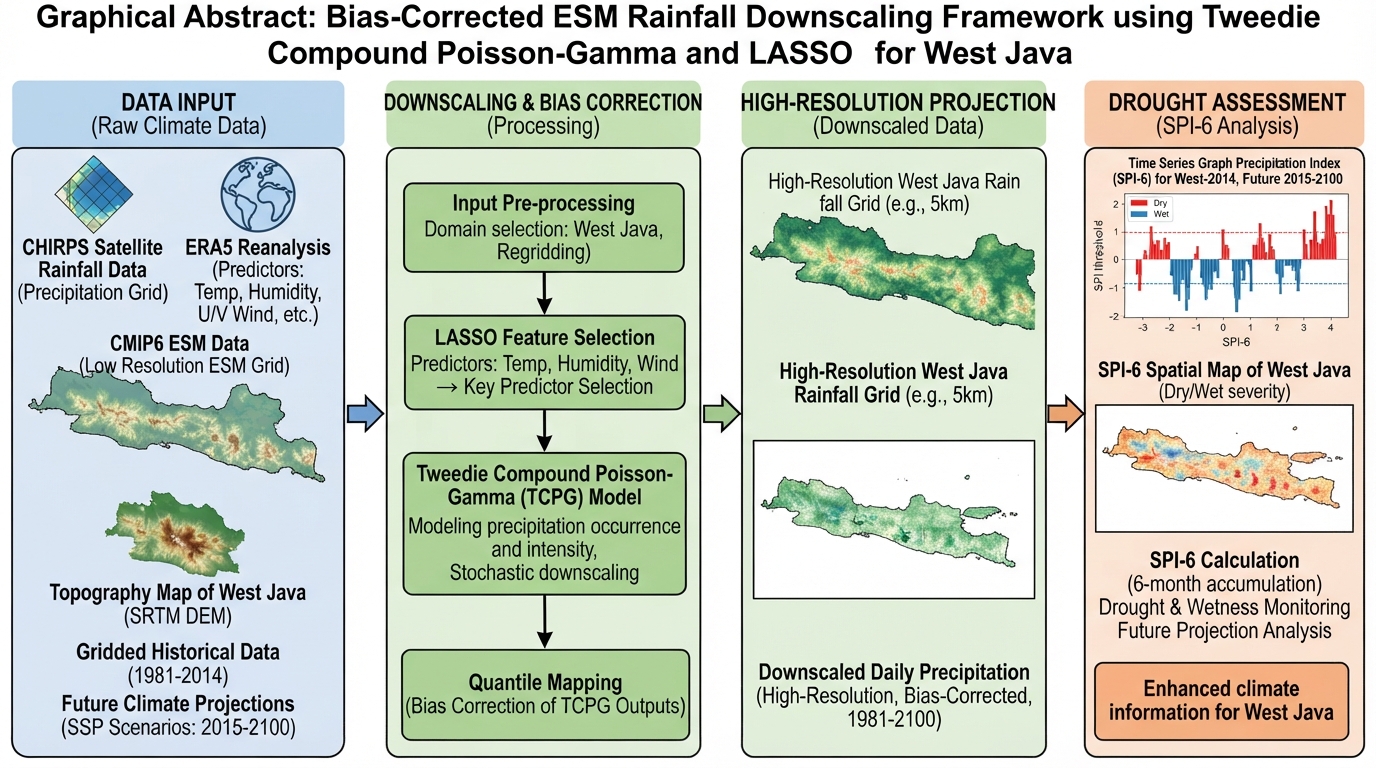
Climate change has increased rainfall variability and intensified the need for reliable local rainfall projections, particularly in agricultural regions such as West Java. Earth System Models (ESMs) provide useful climate change information but remain limited by coarse spatial resolution and systematic bias when applied to local-scale rainfall analysis. This study proposes an ESM-driven rainfall downscaling framework by integrating Tweedie Compound Poisson–Gamma with Least Absolute Shrinkage and Selection Operator (TCPG-LASSO), climate imprint-based resolution enhancement, and ISIMIP bias correction. Three ESMs, namely BNU-ESM, MIROC-ESM, and MIROC-ESM-CHEM, were evaluated using rainfall station data in West Java. Two modelling scenarios were compared: TCPG-LASSO without rescaling and bias correction and TCPG-LASSO with ESM rescaling and Inter-Sectoral Impact Model Intercomparison Project (ISIMIP) bias correction. Model performance was assessed using Taylor diagrams and time series plots. The results show that West Java rainfall follows a unimodal seasonal pattern and has a non-negative, positively skewed distribution, supporting the use of the TCPG framework. LASSO effectively selected a limited number of relevant ESM grids and reduced multicollinearity. The corrected TCPG-LASSO model provided better agreement with observed rainfall than the uncorrected model, with an average correlation of about 0.7. Among the evaluated ESMs, BNU-ESM showed the best performance and was used for six-month Standardized Precipitation Index (SPI-6) projection during 2021–2030. Across the 805 valid station-month SPI-6 values from June 2021 to December 2030, normal conditions dominated, with 583 occurrences. Dry and wet anomalies were also projected, including 85 moderately dry, 15 severely dry, 2 extremely dry, 55 moderately wet, 47 very wet, and 18 extremely wet occurrences. These findings demonstrate that the proposed framework can support drought monitoring, agricultural planning, and hydrometeorological disaster mitigation in West Java.
References
J. A. Marengo, L. M. Alves, T. Ambrizzi, A. Young, N. J. C. Barreto, and A. M. Ramos, “Trends in extreme rainfall and hydrogeometeorological disasters in the Metropolitan Area of São Paulo: a review,” Ann N Y Acad Sci, vol. 1472, no. 1, pp. 5–20, Jul. 2020, doi: https://doi.org/10.1111/nyas.14307.
J. T. Nugroho, D. Nurfitriani, Suwarsono, G. A. Chulafak, R. J. Manalu, and S. Harini, “Rainfall anomalies assessment during drought episodes of 2015 in Indonesia using CHIRPS Data,” in IOP Conference Series: Earth and Environmental Science, IOP Publishing Ltd, Apr. 2021. doi: 10.1088/1755-1315/739/1/012044.
I. Purnamasari, T. Wahyu Saputra, and S. Ristiyana, “Pola Spasial Kekeringan di Jawa Barat Pada Kondisi El Nino Berbasis Metode Palmer Drought Severity Index (PDSI),” Jurnal Teknik Pengairan, vol. 12, no. 1, pp. 16–29, May 2021, doi: 10.21776/ub.pengairan.2021.012.01.02.
M. Auffhammer, V. Ramanathan, and J. R. Vincent, “Climate change, the monsoon, and rice yield in India,” Clim Change, vol. 111, no. 2, pp. 411–424, 2012, doi: 10.1007/s10584-011-0208-4.
W. Kim, T. Iizumi, and M. Nishimori, “Global patterns of crop production losses associated with droughts from 1983 to 2009,” J Appl Meteorol Climatol, vol. 58, no. 6, pp. 1233–1244, 2019, doi: 10.1175/JAMC-D-18-0174.1.
G. M. Flato, “Earth system models: an overview,” WIREs Climate Change, vol. 2, no. 6, pp. 783–800, Nov. 2011, doi: https://doi.org/10.1002/wcc.148.
E. Surmaini and D. A. Faqih, “Kejadian Iklim Ekstrem dan Dampaknya Terhadap Pertanian Tanaman Pangan di Indonesia Extreme Climate Events and their Impacts on Food Crop in Indonesia,” Jurnal SUMBERDAYA LAHAN, vol. 10, no. 2, pp. 115–128, 2016.
F. Fauzi, H. Kuswanto, and R. M. Atok, “Bias correction and statistical downscaling of earth system models using quantile delta mapping (QDM) and bias correction constructed analogues with quantile mapping reordering (BCCAQ),” in Journal of Physics: Conference Series, 2020. doi: 10.1088/1742-6596/1538/1/012050.
B. Miftahurrohmah, H. Kuswanto, D. S. Pambudi, F. Fauzi, and F. Atmaja, “Assessment of the Support Vector Regression and Random Forest Algorithms in the Bias Correction Process on Temperatures,” in Procedia Computer Science, Elsevier B.V., 2024, pp. 637–644. doi: 10.1016/j.procs.2024.03.049.
H. Kuswanto, B. Kravitz, B. Miftahurrohmah, F. Fauzi, A. Sopahaluwaken, and J. Moore, “Impact of solar geoengineering on temperatures over the Indonesian Maritime Continent,” International Journal of Climatology, no. August 2020, pp. 1–20, 2021, doi: 10.1002/joc.7391.
A. Casanueva, S. Kotlarski, S. Herrera, A. M. Fischer, T. Kjellstrom, and C. Schwierz, “Climate projections of a multivariate heat stress index: The role of downscaling and bias correction,” Geosci Model Dev, vol. 12, no. 8, pp. 3419–3438, 2019, doi: 10.5194/gmd-12-3419-2019.
C. Dyn, R. M. A. L. A. Weisheimer, and J. M. Gutiérrez, “Can bias correction and statistical downscaling methods improve the skill of seasonal precipitation forecasts ?,” Clim Dyn, vol. 0, no. 0, p. 0, 2017, doi: 10.1007/s00382-017-3668-z.
Y. Tong, X. Gao, Z. Han, Y. Xu, Y. Xu, and F. Giorgi, “Bias correction of temperature and precipitation over China for RCM simulations using the QM and QDM methods,” Clim Dyn, no. 0123456789, 2020, doi: 10.1007/s00382-020-05447-4.
D. Sandler, H. Saaroni, B. Ziv, A. Hochman, N. Harnik, and D. Rostkier-Edelstein, “A multiscale approach to statistical downscaling of daily precipitation: Israel as a test case,” International Journal of Climatology, vol. 44, no. 1, pp. 59–71, Jan. 2024, doi: 10.1002/joc.8315.
S. S. Sami, A. A. Ali, and A. D. Jalal, “An application of the statistical downscaling model (SDSM) to simulate precipitation data in the Iraqi Western Desert,” AIP Conf Proc, vol. 3009, no. 1, p. 030113, Feb. 2024, doi: 10.1063/5.0197996.
W. H. Bonat and C. C. Kokonendji, “Flexible Tweedie regression models for continuous data,” J Stat Comput Simul, vol. 87, no. 11, pp. 2138–2152, Jul. 2017, doi: 10.1080/00949655.2017.1318876.
N. C. Dzupire, P. Ngare, and L. Odongo, “A Poisson-Gamma Model for Zero Inflated Rainfall Data,” J Probab Stat, vol. 2018, 2018, doi: 10.1155/2018/1012647.
D. Dewanti, A. Djuraidah, B. Sartono, and A. Sopaheluwakan, “Bias correction and ensemble techniques in statistical downscaling model for rainfall prediction using Tweedie-LASSO in West Java, Indonesia,” Journal of Agrometeorology, vol. 26, no. 3, pp. 324–330, Sep. 2024, doi: 10.54386/jam.v26i3.2614.
M. Hayati, A. H. Wigena, A. Djuraidah, and A. Kurnia, “A new approach to statistical downscaling using tweedie compound poisson gamma response and lasso regularization,” Communications in Mathematical Biology and Neuroscience, vol. 2021, 2021, doi: 10.28919/cmbn/5936.
M. Hayati and R. Permatasari, “Comparison of Generalized Linear Model between Gamma and Tweedie Compound Response for Rainfall Prediction in Lampung Province,” Asian Journal of Probability and Statistics, vol. 26, no. 1, pp. 41–49, Jan. 2024, doi: 10.9734/ajpas/2024/v26i1583.
A. Arisandi, A. H. Wigena, and A. Mohamad Soleh, “Continuum Regression Modeling with LASSO to Estimate Rainfall,” International Journal of Scientific and Research Publications (IJSRP), vol. 10, no. 10, pp. 380–385, Oct. 2020, doi: 10.29322/ijsrp.10.10.2020.p10651.
R. N. Rachmawati, I. Sungkawa, and A. Rahayu, “Extreme Rainfall Prediction using Bayesian Quantile Regression in Statistical Downscaling Modeling,” Procedia Comput Sci, vol. 157, pp. 406–413, 2019, doi: https://doi.org/10.1016/j.procs.2019.08.232.
A. M. Soleh, A. H. Wigena, A. Djuraidah, and A. Saefuddin, “Statistical Downscaling to predict monthly rainfall using linear regression with L1 regularization (LASSO),” Applied Mathematical Sciences, vol. 9, no. 105–108, pp. 5361–5369, 2015, doi: 10.12988/ams.2015.56434.
R. R. He, Y. Chen, Q. Huang, and Y. Kang, “LASSO as a tool for downscaling summer rainfall over the Yangtze River Valley,” Hydrological Sciences Journal, vol. 64, no. 1, pp. 92–104, Jan. 2019, doi: 10.1080/02626667.2019.1570210.
C. Piani, J. O. Haerter, and E. Coppola, “Statistical bias correction for daily precipitation in regional climate models over Europe,” pp. 187–192, 2010, doi: 10.1007/s00704-009-0134-9.
D. Maraun, “Bias correction, quantile mapping, and downscaling: Revisiting the inflation issue,” J Clim, vol. 26, no. 6, pp. 2137–2143, 2013, doi: 10.1175/JCLI-D-12-00821.1.
A. J. Cannon, S. R. Sobie, and T. Q. Murdock, “Bias correction of GCM precipitation by quantile mapping: How well do methods preserve changes in quantiles and extremes?,” J Clim, vol. 28, no. 17, pp. 6938–6959, 2015, doi: 10.1175/JCLI-D-14-00754.1.
A. T. Werner and A. J. Cannon, “Hydrologic extremes -- an intercomparison of multiple gridded statistical downscaling methods,” Hydrol Earth Syst Sci, vol. 20, no. 4, pp. 1483–1508, 2016, doi: 10.5194/hess-20-1483-2016.
S. Lange, “Trend-preserving bias adjustment and statistical downscaling with ISIMIP3BASD (v1.0),” Geosci Model Dev, vol. 12, no. 7, pp. 3055–3070, 2019, doi: 10.5194/gmd-12-3055-2019.
F. Fauzi, H. Kuswanto, R. M. Atok, and M. Salamah, “Statistical Downscaling and Bias Correction of the Earth System Models ( ESM ) Outputs for Future Climate Projection under Solar Geoengineering : Case Study Indonesia,” Journal of Mechanical Engineering, vol. 10, no. 1, pp. 33–49, 2021.
G. A. Meehl et al., “Climate System Response to External Forcings and Climate Change Projections in CCSM4,” J Clim, vol. 25, no. 11, pp. 3661–3683, 2012, doi: https://doi.org/10.1175/JCLI-D-11-00240.1.
D. Ji et al., “Description and basic evaluation of Beijing Normal University Earth System Model (BNU-ESM) version 1,” Geosci Model Dev, vol. 7, no. 5, pp. 2039–2064, Sep. 2014, doi: 10.5194/gmd-7-2039-2014.
S. Watanabe et al., “MIROC-ESM 2010: Model description and basic results of CMIP5-20c3m experiments,” Geosci Model Dev, vol. 4, no. 4, pp. 845–872, 2011, doi: 10.5194/gmd-4-845-2011.
R. K. Eentemeyer and R. D. Hunter, “Climatologically Aided Mapping of Daily Precipitation and Temperature,” pp. 1501–1510, 2005.
S. Hempel, K. Frieler, L. Warszawski, J. Schewe, and F. Piontek, “A trend-preserving bias correction – the ISI-MIP approach,” Earth Syst. Dynam., vol. 4, no. 2, pp. 219–236, 2013, doi: 10.5194/esd-4-219-2013.
F. Saeed et al., “Bias correction of multi-ensemble simulations from the HAPPI model intercomparison project,” Jun. 25, 2018. doi: 10.5194/gmd-2018-107.
A. Casanueva, S. Kotlarski, S. Herrera, A. M. Fischer, T. Kjellstrom, and C. Schwierz, “Climate projections of a multivariate heat stress index: The role of downscaling and bias correction,” Geosci Model Dev, vol. 12, no. 8, pp. 3419–3438, Aug. 2019, doi: 10.5194/gmd-12-3419-2019.
Q. Zhou, D. Chen, Z. Hu, and X. Chen, “Decompositions of Taylor diagram and DISO performance criteria,” International Journal of Climatology, vol. 41, no. 12, pp. 5726–5732, Oct. 2021, doi: https://doi.org/10.1002/joc.7149.
Z. Xu and Y. Han, “Short communication comments on ‘DISO: A rethink of Taylor diagram,’” International Journal of Climatology, vol. 40, no. 4, pp. 2506–2510, Mar. 2020, doi: https://doi.org/10.1002/joc.6359.
J. K. Jolliff et al., “Summary diagrams for coupled hydrodynamic-ecosystem model skill assessment,” Journal of Marine Systems, vol. 76, no. 1, pp. 64–82, 2009, doi: https://doi.org/10.1016/j.jmarsys.2008.05.014.
G. M. Guenang and F. Mkankam Kamga, “Computation of the standardized precipitation index (SPI) and its use to assess drought occurrences in Cameroon over recent decades,” J Appl Meteorol Climatol, vol. 53, no. 10, pp. 2310–2324, 2014, doi: 10.1175/JAMC-D-14-0032.1.
H. Wu, M. D. Svoboda, M. J. Hayes, D. A. Wilhite, and F. Wen, “Appropriate application of the standardized precipitation index in arid locations and dry seasons,” International Journal of Climatology, vol. 27, no. 1, pp. 65–79, Jan. 2007, doi: https://doi.org/10.1002/joc.1371.
E. Aldrian and R. Dwi Susanto, “Identification of three dominant rainfall regions within Indonesia and their relationship to sea surface temperature,” International Journal of Climatology, vol. 23, no. 12, pp. 1435–1452, 2003, doi: 10.1002/joc.950.
H. Jun-Ichi, M. D. Yamanaka, J. Matsumoto, P. Agus WINARSO, and T. Sribimawati, “Spatial and Temporal Variations of the Rainy Season over Indonesia and their Link to ENSO,” 2002.
M. Yustiana, M. Zainuri, D. N. Sugianto, M. P. N. Batubara, and A. M. Hidayat, “Dampak Variabilitas Iklim Inter-Annual (El Niño, La Niña) Terhadap Curah Hujan dan Anomali Tinggi Muka Laut di Pantai Utara Jawa Tengah,” Buletin Oseanografi Marina, vol. 12, no. 1, pp. 109–124, Feb. 2023, doi: 10.14710/buloma.v12i1.48377.
P. K. Dunn and G. K. Smyth, Generalized Linear Models With Examples in R. Springer, 2018.
K. E. Taylor, “Summarizing multiple aspects of model performance in a single diagram,” J Geophys Res, vol. 106, no. D7, pp. 7183–7192, 2001.
K. Hussain and M. Shahab, “An Investigation Standardized Precipitation Index Trend in Arid and Semi-arid Region of Pakistan Applying the Innovative Trend Analysis (ITA) Technique,” in Water Resources in Arid Lands: Management and Sustainability, A. Al-Maktoumi, O. Abdalla, A. Kacimov, S. Zekri, M. Chen, T. Al-Hosni, and K. Madani, Eds., Cham: Springer International Publishing, 2021, pp. 111–120.
K. Yildirak and A. S. Selcuk-Kestel, “Adjusting SPI for crop specific agricultural drought,” Environ Ecol Stat, vol. 22, no. 4, pp. 681–691, 2015, doi: 10.1007/s10651-015-0326-7.
V. Potop, M. Možný, and J. Soukup, “Drought evolution at various time scales in the lowland regions and their impact on vegetable crops in the Czech Republic,” Agric For Meteorol, vol. 156, pp. 121–133, 2012, doi: https://doi.org/10.1016/j.agrformet.2012.01.002.
Downloads
Published
Issue
Section
License
Copyright (c) 2026 fatkhurokhman fauzi, Anik Djuraidah, Anang Kurnia, Rochdi Wasono

This work is licensed under a Creative Commons Attribution-NonCommercial 4.0 International License.