
Biofriendly Extraction of Geniotrigona thoracica Propolis Using Plant-based Oils: Phytochemical Composition and Bioactivities
DOI:
https://doi.org/10.11113/mjfas.v22n4.4830Keywords:
Antioxidant activity, cytotoxicity, GC-MS, plant-based extraction, stingless bee propolisAbstract
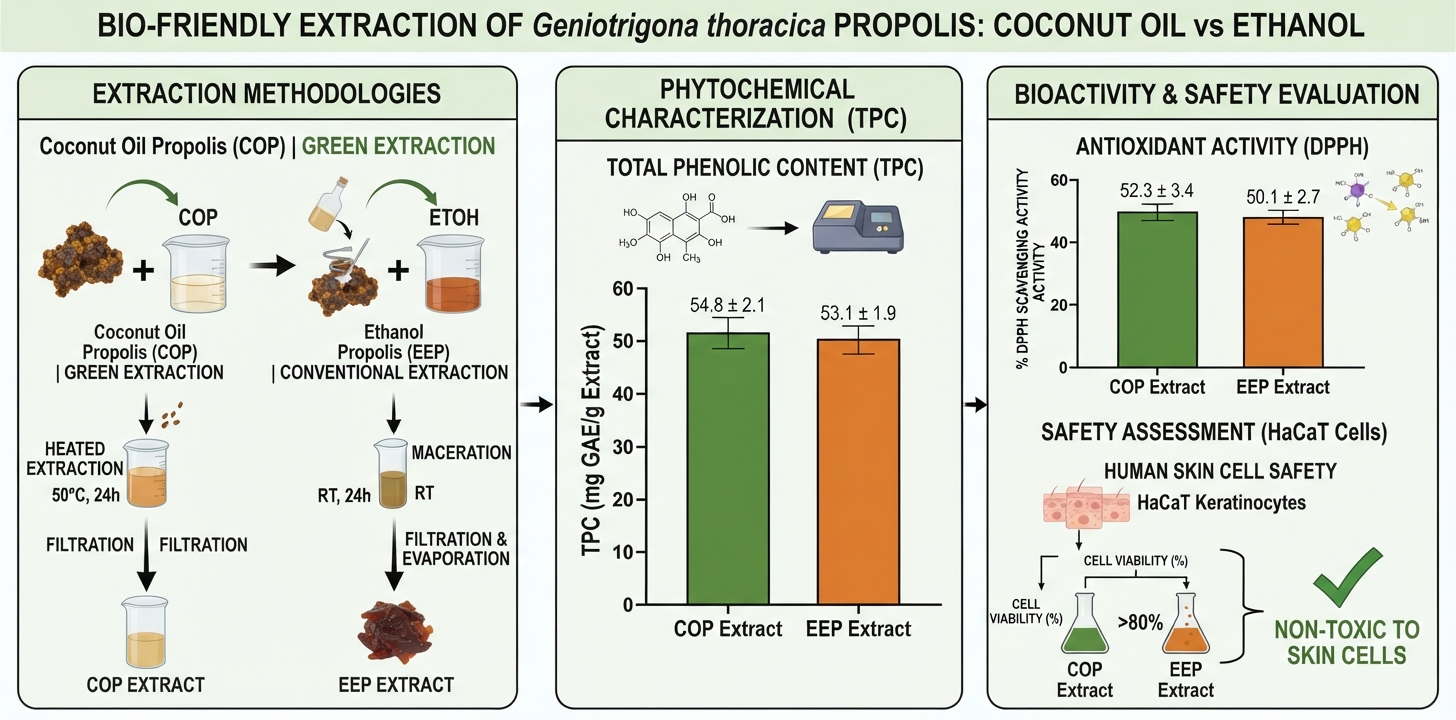
Stingless bees propolis is increasingly recognized as a rich source of bioactive compounds with potential applications in health and skincare. Conventional ethanol-based extraction raises concerns due to skin irritation and regulatory restrictions, underscoring the need for safer alternatives. This study evaluated plant-based oils as bio-friendly plant-based extraction media for Geniotrigona thoracica propolis, using coconut (COP), olive (OOP), and sunflower (SOP) oils, with ethanol (EEP) and water (WEP) as comparators. Recoverable extract yields were determined, while total phenolic content (TPC) and total flavonoid content (TFC) were quantified using Folin–Ciocalteu and aluminium chloride colorimetric assays, respectively. Phytochemical composition was profiled by gas chromatography–mass spectrometry (GC–MS). Antioxidant activities were assessed using 2,2-diphenyl-1-picrylhydrazyl (DPPH) radical scavenging, 2,2′-azino-bis(3-ethylbenzothiazoline-6-sulfonic acid (ABTS), and ferric reducing antioxidant power (FRAP) assays, while cytotoxicity towards human keratinocytes (HaCaT) was determined using 3-(4,5-dimethylthiazol-2-yl)-2,5-diphenyltetrazolium bromide (MTT) assay. COP achieved the highest recoverable extract yield (10.00%) and TPC (54.40 mg GAE/g), statistically comparable to EEP (53.50 mg GAE/g) but significantly higher than other extracts. TFC was greatest in EEP (66.54 mg QE/g), followed by COP (46.55 mg QE/g). GC-MS analysis revealed distinct chemical fingerprints across extracts, encompassing fatty acids, esters, aldehydes, hydrocarbons, and phenolic derivatives. COP exhibited significantly stronger DPPH radical scavenging capacity (50.85 ± 8.70%) than all other extracts, while its ferric reducing capacity (659.00 µM Fe²⁺) was comparable to EEP (597.37 µM Fe²⁺). For ABTS, EEP (33.13 ± 4.48%) and COP (26.60 ± 2.88%) did not differ significantly and were both higher than the other extracts. All extracts were non-toxic to HaCaT cells at the concentrations tested. Overall, coconut oil demonstrated a favorable balance of phytochemical recovery, strong antioxidant activity, and cytocompatibility, supporting its potential as a plant-based extraction medium for bio-friendly propolis-based dermatological formulations.
References
Martinotti, S., Bonsignore, G., & Ranzato, E. (2025). Propolis: A natural substance with multifaceted properties and activities. International Journal of Molecular Sciences, 26(4), 1519.
Tavares, L., Smaoui, S., Lima, P.S., de Oliveira, M.M. and Santos, L., 2022. Propolis: Encapsulation and application in the food and pharmaceutical industries. Trends in food science & technology, 127, pp.169-180.
Radić, B., Radić, S., Mašek, T. and Šuran, J., 2024. Anti‐wrinkle efficacy of standardized phenolic acids polymer extract (PAPE) from propolis: Implications for antiaging and skin health. Journal of cosmetic dermatology, 23(10), pp.3372-3381.
Vit, P., Wang, Z., Massaro, C.F. and Ekundayo, T.C., 2024. Global Trends on the Research of Plant Resin Use by Stingless Bees (1985–2022) and Apis mellifera (1967–2022): A Bibliometric Analysis. In Stingless Bee Nest Cerumen and Propolis, Volume 1 (pp. 45-74). Cham: Springer International Publishing.
Zohdi, R.M., Adli, M.A., Miskan, A.M., Eshak, Z., James, R.J., Bakar, S.I.A. and Payaban, M., 2025. Chemical Profile, Physicochemical Properties, and Antioxidant Activity of Malaysian Propolis: Insights from Honeybee and Stingless Bee. Journal of Science and Mathematics Letters, 13(1), pp.1-9.
Idris, L., Adli, M.A., Yaacop, N.N. and Zohdi, R.M., 2023. Phytochemical screening and antioxidant activities of Geniotrigona thoracica propolis extracts derived from different locations in Malaysia. Malaysian Journal of Fundamental and Applied Sciences, 19(6), pp.1023-1032.
Mohd Badiazaman, A.A., Nazif Aziz, A., Mohamad, H. and Suryati Mohd, K., 2024. Bioassay-guided isolation of cycloartane-type triterpenes, their cytotoxic properties and identification of potential chemical markers from Geniotrigona thoracica propolis. Natural Product Research, pp.1-6.
Ghani, N.A., Ahmat, N., Ismail, N. H. and Zakaria, I. 2011. Flavonoid constituents from the stem bark of Polyalthia cauliflora var. cauliflora. Australian Journal of Basic and Applied Sciences, 5(8), pp. 154-158.
Jusril, N.A., Mohd, K.S., Abd Mutalib, N. and Mohd Badiazaman, A.A., 2024. Chemical composition and pharmacological aspects of Malaysian stingless bee propolis: An up to date systematic review. Biomedical Reports, 22(1), p.9.
Dewi, D.P. and Kustiawan, P.M., 2025. Wound Healing Activity of Ethyl Acetate Extract of Piper crocatum Leaves Combined with Geniotrigona thoracica Propolis. Jurnal Mandala Pharmacon Indonesia, 11(1), pp.181-187.
Bankova, V., Trusheva, B. and Popova, M., 2021. Propolis extraction methods: A review. Journal of apicultural research, 60(5), pp.734-743.
Šuran, J., Cepanec, I., Mašek, T., Radić, B., Radić, S., Tlak Gajger, I. and Vlainić, J., 2021. Propolis extract and its bioactive compounds—From traditional to modern extraction technologies. Molecules, 26(10), p.2930.
El-Sakhawy, M., 2023. Propolis harvesting and extraction. Egyptian Journal of Chemistry, 66(1), pp.313-321.
Yudina, Y.V., Hrubnyk, I.M., Maloshtan, L.M., Velikiy, D.L., Ohanesian, I.G., Bevz, N.Y. and Artushenko, O.V., 2023. Propolis oil extract: qualitative and quantitative aspects. Journal of Chemistry and Technologies, 31(2), pp.309-317.
Pujirahayu, N., Ritonga, H. and Uslinawaty, Z., 2014. Properties and flavonoids content in propolis of some extraction method of raw propolis. Int J Pharm Pharm Sci, 6(6), pp.338-40.
Rahim, M.A., Ayub, H., Sehrish, A., Ambreen, S., Khan, F.A., Itrat, N., Nazir, A., Shoukat, A., Shoukat, A., Ejaz, A. and Özogul, F., 2023. Essential components from plant source oils: a review on extraction, detection, identification, and quantification. Molecules, 28(19), p.6881.
Rabail, R., Shabbir, M.A., Sahar, A., Miecznikowski, A., Kieliszek, M. and Aadil, R.M., 2021. An intricate review on nutritional and analytical profiling of coconut, flaxseed, olive, and sunflower oil blends. Molecules, 26(23), p.7187.
Kubiliene, L., Laugaliene, V., Pavilonis, A., Maruska, A., Majiene, D., Barcauskaite, K., Kubilius, R., Kasparaviciene, G. and Savickas, A., 2015. Alternative preparation of propolis extracts: Comparison of their composition and biological activities. BMC complementary and alternative medicine, 15(1), p.156.
Zohdi, R.M., Yaacob, N.N., Hasif, N.A.M., Adli, M.A., Payaban, M., James, R.J. and Jaapar, F., 2024. Comparative study of different Malaysian Stingless bee propolis: Physicochemical characterization, Phytochemical contents and Antibacterial activity. Research Journal of Pharmacy and Technology, 17(3), pp.1021-1028.
Pratami, D.K., Mun’im, A., Sundowo, A. and Sahlan, M., 2018. Phytochemical profile and antioxidant activity of propolis ethanolic extract from Tetragonula bee. Pharmacognosy Journal, 10(1).
Farasat, M., Khavari-Nejad, R.A., Nabavi, S.M.B. and Namjooyan, F., 2014. Antioxidant activity, total phenolics and flavonoid contents of some edible green seaweeds from northern coasts of the Persian Gulf. Iranian journal of pharmaceutical research: IJPR, 13(1), p.163.
Adams RP. Identification of essential oil components by gas chromatography/mass spectrometry. Carol Stream: Allured Publishing Corporation; 2007.
FFNSC 2 (2012) Flavors and fragrances of natural and synthetic compounds. Mass Spectral Database Japan: Shimadzu Corps.
NIST 08 . Mass spectral library (NIST/EPA/NIH) Gaithersburg: National Institute of Standards and Technology; 2008.
Azman, N.N.A.N.M.A., Salleh, W.M.N.H.W. and Ghani, N.A. 2023. Essential oils composition and bioactivities of most prevalent species of genus Piper in Malaysia: A scope review. Rivista Italiana delle Sostanze Grasse, 100(2), pp 109-116.
Adli, M.A., Idris, L., Mukhtar, S.M., Payaban, M., James, R.J., Halim, H., George, A. and Zohdi, R.M., 2024. Phytochemical assessment, antioxidant activity, and in vitro wound healing potential of Polygonum minus huds. Journal of Current Science and Technology, 14(1), pp.18-18.
Ferreira, L.M.D.M.C., Modesto, Y.Y., Souza, P.D.Q.D., Nascimento, F.C.D.A., Pereira, R.R., Converti, A., Lynch, D.G., Brasil, D.D.S.B., da Silva, E.O., Silva-Júnior, J.O.C. and Ribeiro-Costa, R.M., 2024. Characterization, biocompatibility and antioxidant activity of hydrogels containing propolis extract as an alternative treatment in wound healing. Pharmaceuticals, 17(5), p.575.
Gervajio, G. C. 2000. Fatty acids and derivatives from coconut oil. Kirk‐Othmer Encyclopedia of Chemical Technology, pp.1-38.
Dalawai, D. and Murthy, H.N., 2021. Chemical profile and antioxidant properties of Andrographis producta (CB Clarke) Gamble. Pharmacognosy Journal, 13(2).
Gulcin, İ. and Alwasel, S.H., 2023. DPPH radical scavenging assay. Processes, 11(8), p.2248.
Obidoa, O., Joshua, P.E. and Eze, N.J., 2010. Phytochemical analysis of Cocos nucifera L. Journal of Pharmacy Research, 3(2), pp.280-286.
Cano, A., Maestre, A.B., Hernández-Ruiz, J. and Arnao, M.B., 2023. ABTS/TAC methodology: Main milestones and recent applications. Processes, 11(1), p.185.
Kennas, A. and Amellal-Chibane, H., 2019. Comparison of five solvents in the extraction of phenolic antioxidants from pomegranate (Punica granatum L.) peel. North African Journal of Food and Nutrition Research, 3(5), pp.140-147.
Lim, S., Choi, A.H., Kwon, M., Joung, E.J., Shin, T., Lee, S.G., Kim, N.G. and Kim, H.R., 2019. Evaluation of antioxidant activities of various solvent extract from Sargassum serratifolium and its major antioxidant components. Food chemistry, 278, pp.178-184.
Benzie, I.F. and Devaki, M., 2018. The ferric reducing/antioxidant power (FRAP) assay for non‐enzymatic antioxidant capacity: concepts, procedures, limitations and applications. Measurement of antioxidant activity & capacity: Recent trends and applications, pp.77-106.
Ferreira, A.R., da Costa Machado, M.T. and Chagas, A.G.C.M., 2023. Propolis oil extract as an alternative means to the alcoholic extract. Observatório De La Economía Latinoamericana, 21(10), pp.15657-15676.
Sungpud, C., Panpipat, W., Sae Yoon, A. and Chaijan, M., 2020. Ultrasonic-assisted virgin coconut oil based extraction for maximizing polyphenol recovery and bioactivities of mangosteen peels. Journal of food science and technology, 57(11), pp.4032-4043.
Anywar, G.U., Kakudidi, E., Oryem-Origa, H., Schubert, A. and Jassoy, C., 2022. Cytotoxicity of medicinal plant species used by traditional healers in treating people suffering from HIV/AIDS in Uganda. Frontiers in Toxicology, 4, p.832780.
Prasedya, E.S., Ardiana, N., Padmi, H., Ilhami, B.T.K., Martyasari, N.W.R., Sunarwidhi, A.L., Nikmatullah, A., Widyastuti, S., Sunarpi, H. and Frediansyah, A., 2021. The antiproliferative and apoptosis-inducing effects of the red macroalgae Gelidium latifolium extract against melanoma cells. Molecules, 26(21), p.6568.
Matsuo, M., Sasaki, N., Saga, K. and Kaneko, T., 2005. Cytotoxicity of flavonoids toward cultured normal human cells. Biological and pharmaceutical bulletin, 28(2), pp.253-259.
Sak, K., 2014. Cytotoxicity of dietary flavonoids on different human cancer types. Pharmacognosy reviews, 8(16), p.122.
Downloads
Published
Issue
Section
License
Copyright (c) 2026 Rozaini Mohd Zohdi, Shahida Muhamad Mukhtar, Nurunajah Ab Ghani, Clarissa Jasmin C. Liong, Adriani Susanty, Nor Fadzilah Muhammad Zaidi

This work is licensed under a Creative Commons Attribution-NonCommercial 4.0 International License.