
Sustainable Low-Cost Agro-Waste media as Alternatives for the Cultivation of Lactic Acid Bacteria
DOI:
https://doi.org/10.11113/mjfas.v22n2.4748Keywords:
Lactic acid bacteria, agricultural waste, corn cob, banana peel, mature coconut waterAbstract
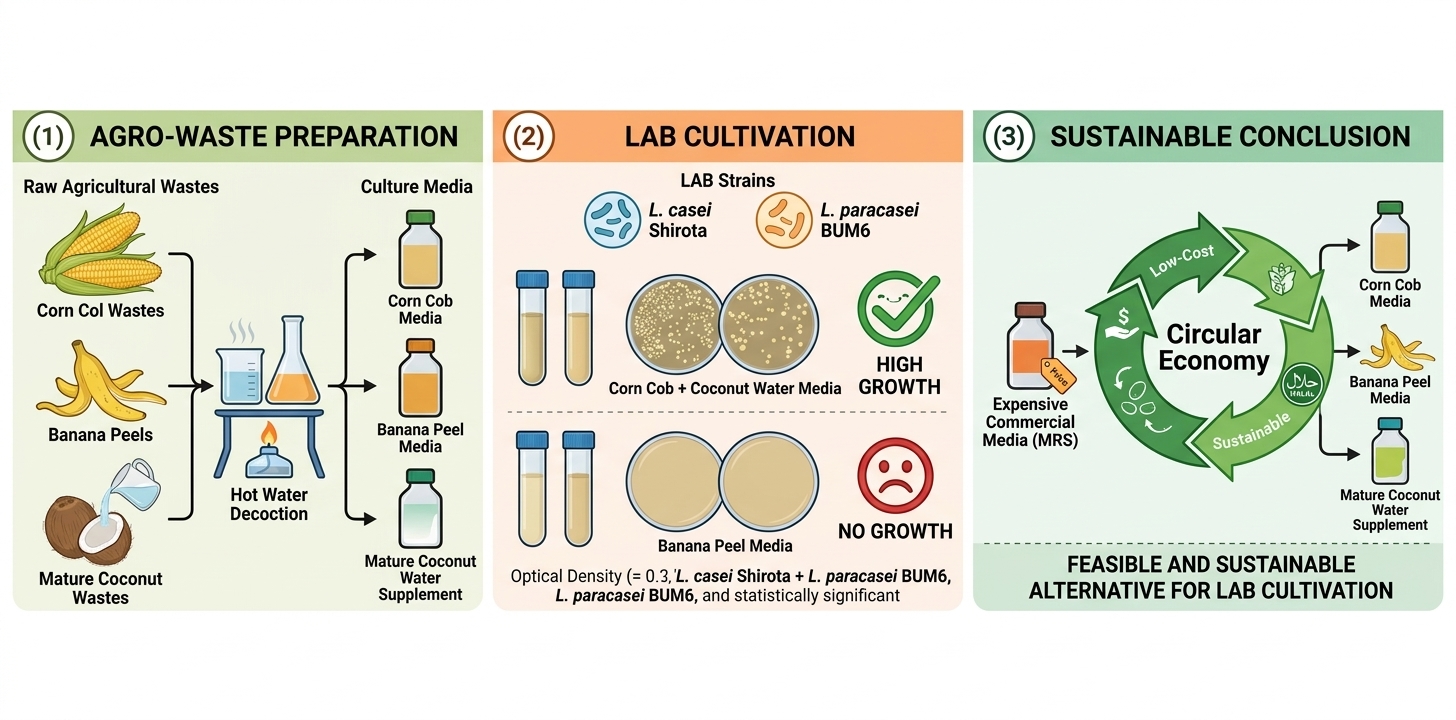
Lactic Acid Bacteria, or LAB, are widely used in the food industry, particularly in fermented products like yogurt, cheese, fermented meats and vegetables. This study examines the possibility of using agricultural waste (corn cob waste, banana peels, and mature coconut water), as plant-based alternatives in the proliferation of LAB. Wastes medium were used to grow two LAB strains, Lacticaseibacillus paracasei BUM6 and Lactobacillus casei Shirota, and the growth were compared to that observed in commercial MRS broth and agar. The findings indicated that enrichment of corn cob media with mature coconut water promoted the growth of LAB as compared to the control MRS media. Banana peel media on the other hand had some or no bacterial growth (p < 0.05) probably due to some antimicrobial elements and absence of available nutrients. The corn cob had potential in offering a feasible and cost-effective alternative. The research focuses on the utilization of agricultural waste into culture media of microbial strains that can be used in resourceful biotechnology incorporating halal requirements and the original concepts of a circular economy.
References
Anumudu, C. K., Miri, T., & Onyeaka, H. (2024). Multifunctional applications of lactic acid bacteria: enhancing safety, quality, and nutritional value in foods and fermented beverages. Foods, 13(23), https://doi.org/10.3390/foods13233714.
Ahmad, R., Ariffin, M., & Yusof, M. (2024). Current energy recycling technology for agricultural waste in Malaysia. Progress in Energy and Environment, 26, 1-15.
Chong, C. T., Mong, G. R., Ng, J. H., Chong, W. W. F., Ani, F. N., Lam, S. S., & Ong, H. C. (2023). Transitioning to a sustainable development framework for bioenergy in Malaysia: Policy suggestions to catalyse the utilisation of palm oil mill residues. Energy, Sustainability and Society, 13, 42.
Castorina, G., Cappa, C., Negrini, N. et al. (2023). Characterization and nutritional valorization of agricultural waste corncobs from Italian maize landraces through the growth of medicinal mushrooms. Sci Rep, 13, 21148. https://doi.org/10.1038/s41598-023-48252-9.
Zaini, H. M., Roslan, J., Saallah, S., Munsu, E., Sulaiman, N. S., & Pindi, W. (2022). Banana peels as a bioactive ingredient and its potential application in the food industry. Journal of Functional Foods, 92, 105054.
Astuti, A., Susilawati, N. M., & Peni, A. (2024). Utilizing maize cob media as a replacement for nutrient agar media in the growth of Escherichia coli and Staphylococcus aureus bacteria. International Journal of Educational Research, 1(2), 28–35.
Ilyanie, H. Y., Huda-Faujan, N., Ida Muryany, M. Y., & Zuraida, J. (2022). Isolation and characterisation of probiotic lactic acid bacteria from Malaysian fermented fish products budu and bosou. International Food Research Journal, 29(2), 338–348. Retrieved from http://www.ifrj.upm.edu.my.
Mat Nayan, N., Mohamad, S., & Abd Hadi, N. A. (2020). SP Agar: Alternative culture medium for the growth of bacteria. Jurnal Inovasi Malaysia (JURIM), 4(1), 45–60.
Prayekti, E., Suliati, S., & Wulandari, D. A. (2021). Comparation Between Mac conkey and Coconut Water Medium as a Growth Medium for Escherichia coli. Indonesian Journal of Medical Laboratory Science and Technology, 3(1), 19–25. https://doi.org/10.33086/ijmlst.v3i1.1906.
Zvidzai, C., Muzhinji, N., Chidzvondo, F., Mundembe, R., & Sithole-Niang, I. (2007). Potential commercialization of a microbial medium formulated from industrial food waste. African Journal of Microbiology Research, 1(6), 79–87. http://www.academicjournals.org/ajmr.
Yang, X., Li, X., Zhu, L., Liang, J., & Zhu, J. (2023). Production of Hemicellulose Sugars Combined with the Alkaline Extraction Lignin Increased the Hydro-Depolymerization of Cellulose from Corn Cob. Sustainability, 15(11), Article 9041. https://doi.org/10.3390/su15119041.
Odedina, S., Charnnok, B., Saritpongteeraka, C., & Chaiprapat, S. (2021). New perspectives for banana peel polysaccharides and their conversion to oligosaccharides. Food Research International, 149, 110706.
Nascimento, P. H., Costa, J. A., & Ferreira, L. M. (2020). Development of low-cost culture media for bacterial cellulose production: A comprehensive review. Applied Microbiology and Biotechnology, 104, 8431–8445.
Ahmed, S., Rahman, M. S., & Hassan, L. (2024). Optimization of bacterial cellulose production from corn cob hydrolysate using response surface methodology. Bioresource Technology, 389, 129–137.
Shaaban, M., Ahmed, N., & Thompson, R. (2024). Recent advances in bacterial cellulose production from waste biomass: A systematic review. Renewable and Sustainable Energy Reviews, 171, 113–125.
Silva, T. R., Oliveira, K., & Martinez, P. (2023). Challenges in utilizing fruit peels for bacterial cellulose production: Composition analysis and pretreatment strategies. Waste Management, 156, 78–87.
Lee, J. H., & Lee, K. (2015). Evaluation of a differential medium for the preliminary identification of members of the Lactobacillus plantarum and Lactobacillus casei groups. Annals of Microbiology, 65(3), 1313–1324.
Oliveira, A. B., Silva, M. R., & Santos, L. F. (2023). Phenolic compounds and antioxidant activity of banana peel extracts: Testing and optimization of enzyme-assisted conditions. Measurement: Food, 10, 100085.
Stanescu, M., Popescu, C., Ionescu, D., & Marin, O. (2022). Functional compounds from banana peel used to decrease oxidative stress effects. Processes, 10(2), 248. https://doi.org/10.3390/pr10020248.
Al-Jassani, M. J. (2023). Evaluation of the antimicrobial potential of phenolic compounds extracted from banana peels (Musa paradisiaca L.) against S. aureus and S. typhimurium in meat and fish. Journal of Survey in Fisheries Sciences, 10(3S), 2048–2054.
Downloads
Published
Issue
Section
License
Copyright (c) 2026 Nuriylia Najihah Mohd Faizal, ILYANIE yaacob

This work is licensed under a Creative Commons Attribution-NonCommercial 4.0 International License.