
Beyond ARIMA: A GARCH Framework for Forecasting Kijang Emas Gold Price Volatility in Pre- and Post-COVID Analysis
DOI:
https://doi.org/10.11113/mjfas.v22n3.4718Keywords:
Kijang Emas, volatility persistence, ARIMA, GARCH, COVID-19Abstract
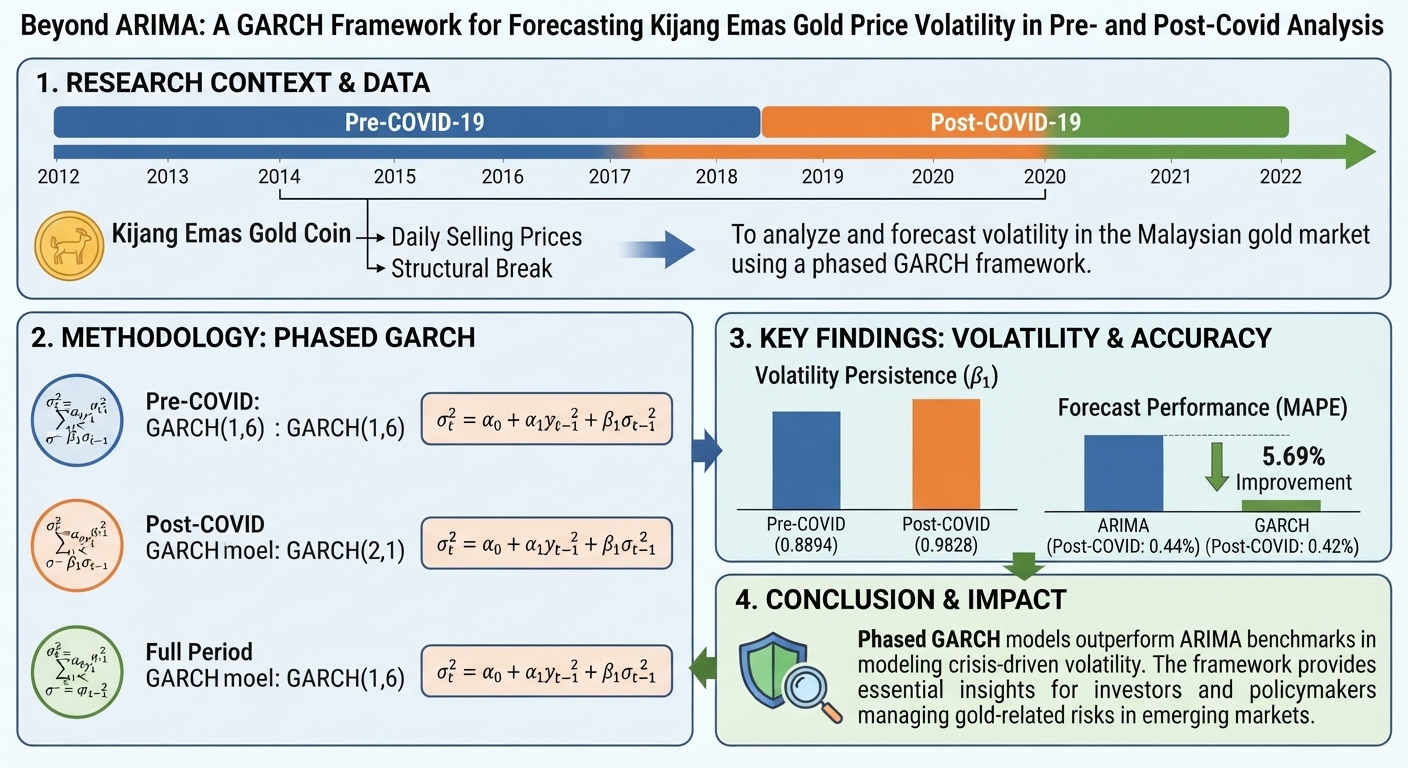
This study applies Generalised Autoregressive Conditional Heteroscedasticity (GARCH) models to examine volatility in Kijang Emas 1oz gold prices in Malaysia from 2012 to 2022 across three analytically distinct phases: pre-COVID-19, post-COVID-19 and the full observation period. Stationarity is confirmed via the Kwiatkowski-Phillips-Schmidt-Shin (KPSS) test following first-order differencing, while the Jarque-Bera test and excess kurtosis are identified across the three phases, formally reject normality and confirm leptokurtic, heavy-tailed return distributions, providing the statistical justification for GARCH over constant-variance alternatives. Autoregressive Conditional Heteroscedasticity (ARCH) effects are confirmed in all phases via the Ljung-Box and ARCH-LM tests on squared first differences. Following systematic model selection, the optimal models are identified as GARCH(1,6) for the pre-COVID-19 phase, GARCH(2,1) for the post-COVID-19 phase, and GARCH(1,6) for the full period. These models achieve persistence parameters Σ(α+β) of 0.998999, 0.993806, and 0.998146 respectively, indicative of near-integrated variance processes. Critically, ARCH-LM tests on GARCH standardised residuals confirm complete elimination of conditional heteroscedasticity for all phases and all lags up to 10, whereas Autoregressive Integrated Moving Average (ARIMA) residuals retain highly significant ARCH effects, formally demonstrating GARCH's superiority in capturing volatility dynamics. The GARCH models achieve post-COVID mean absolute percentage error (MAPE) of 0.42308%, representing a 5.69% improvement over the ARIMA benchmark. Student’s t-distributional GARCH further reduces Akaike information criterion (AIC) by approximately 0.4311 to 0.4545 units across all phases with shape parameter, ν ≈ 2.12 to 2.38, confirming the presence of extreme fat tails consistent with the high excess kurtosis observed. These findings have direct implications for gold risk management in emerging markets under crisis-driven regimes.
References
Areh, S. O., & Miswan, N. H. (2024). ARIMA models for Kijang Emas price forecasting: Pre- and post-COVID analysis. Malaysian Journal of Mathematical Sciences, 18(1), 127–140.
Baker, S. R., Bloom, N., Davis, S. J., & Terry, S. J. (2020). COVID-induced economic uncertainty. National Bureau of Economic Research Working Paper No. 26983.
Batten, J. A., Ciner, C., & Lucey, B. M. (2020). Which precious metals spill over on which, when and why? Some evidence on gold, silver, platinum and palladium. The North American Journal of Economics and Finance, 54, 101251.
Baur, D. G., & Lucey, B. M. (2010). Is gold a safe haven? International evidence. Journal of Banking & Finance, 34(8), 1886–1898.
Baur, D. G., & McDermott, T. K. (2010). Is gold a safe haven? International evidence. Journal of Banking & Finance, 34(8), 1886–1898.
Beckmann, J., Berger, T., & Czudaj, R. (2020). Gold price dynamics and the role of uncertainty. Quantitative Finance, 20(4), 573–585.
Bergmeir, C., & Benítez, J. M. (2012). On the use of cross-validation for time series predictor evaluation.
Information Sciences, 191, 192–213.
Bollinger, J. (2002). Bollinger on Bollinger Bands. McGraw-Hill.
Bollerslev, T. (1986). Generalized autoregressive conditional heteroskedasticity. Journal of Econometrics, 31(3), 307–327.
Bollerslev, T. (1987). A conditionally heteroskedastic time series model for speculative prices and rates of return. Review of Economics and Statistics, 69(3), 542–547.
Bollerslev, T., Chou, R. Y., & Kroner, K. F. (1992). ARCH modeling in finance: A review of the theory and empirical evidence. Journal of Econometrics, 52(1–2), 5–59.
Box, G. E. P., & Cox, D. R. (1964). An analysis of transformations. Journal of the Royal Statistical Society: Series B, 26(2), 211–243.
Box, G. E. P., Jenkins, G. M., Reinsel, G. C., & Ljung, G. M. (2015). Time Series Analysis: Forecasting and Control (5th ed.). Wiley.
Brooks, C. (2014). Introductory Econometrics for Finance (3rd ed.). Cambridge University Press.
Enders, W. (2014). Applied Econometric Time Series (4th ed.). Wiley.
Engle, R. F. (1982). Autoregressive conditional heteroscedasticity with estimates of the variance of United Kingdom inflation. Econometrica, 50(4), 987–1007.
Engle, R. F. (2001). GARCH 101: The use of ARCH/GARCH models in applied econometrics. Journal of Economic Perspectives, 15(4), 157–168.
Engle, R. F., & Bollerslev, T. (1986). Modelling the persistence of conditional variances. Econometric Reviews, 5(1), 1–50.
Engle, R. F., & Ng, V. K. (1993). Measuring and testing the impact of news on volatility. Journal of Finance, 48(5), 1749–1778.
Fama, E. F. (1970). Efficient capital markets: A review of theory and empirical evidence. Journal of Finance, 25(2), 383–417.
Ghalanos, A. (2022). rugarch: Univariate GARCH models. R package version 1.4-9.
Hansen, P. R., & Lunde, A. (2005). A forecast comparison of volatility models: Does anything beat a GARCH(1,1)? Journal of Applied Econometrics, 20(7), 873–889.
Hyndman, R. J., & Koehler, A. B. (2006). Another look at measures of forecast accuracy. International Journal of Forecasting, 22(4), 679–688.
Jarque, C. M., & Bera, A. K. (1980). Efficient tests for normality, homoscedasticity and serial independence of regression residuals. Economics Letters, 6(3), 255–259.
Ji, Q., Zhang, D., & Zhao, Y. (2020). Searching for safe-haven assets during the COVID-19 pandemic. International Review of Financial Analysis, 68, 101526.
Kwiatkowski, D., Phillips, P. C. B., Schmidt, P., & Shin, Y. (1992). Testing the null hypothesis of stationarity against the alternative of a unit root. Journal of Econometrics, 54(1–3), 159–178.
Ljung, G. M., & Box, G. E. P. (1978). On a measure of lack of fit in time series models. Biometrika, 65(2), 297–303.
Mandelbrot, B. (1963). The variation of certain speculative prices. Journal of Business, 36(4), 394–419.
McNeil, A. J., Frey, R., & Embrechts, P. (2005). Quantitative Risk Management: Concepts, Techniques and Tools. Princeton University Press.
Narayan, P. K. (2020). Did bubble activity intensify during COVID-19? Economic Analysis and Policy, 68, 21–29.
Nelson, D. B. (1990). Stationarity and persistence in the GARCH(1,1) model. Econometric Theory, 6(3), 318–334.
Poon, S. H., & Granger, C. W. J. (2003). Forecasting volatility in financial markets: A review. Journal of Economic Literature, 41(2), 478–539.
Reboredo, J. C. (2013). Is gold a hedge or safe haven against oil price movements? Resources Policy, 38(2), 130–137.
Sufian, F., & Kamarudin, F. (2016). Price discovery and volatility spillovers in Malaysian gold futures and spot markets. Emerging Markets Finance and Trade, 52(12), 2773–2788.
Tsay, R. S. (2010). Analysis of Financial Time Series (3rd ed.). Wiley.
Umar, Z., Gubareva, M., & Teplova, T. (2021). The impact of Covid-19 on commodity markets volatility. Resources Policy, 73, 102164.
World Gold Council. (2021). Gold Demand Trends Full Year 2020. World Gold Council.
Downloads
Published
Issue
Section
License
Copyright (c) 2026 Nor Hamizah Miswan, Sam Oliver Areh

This work is licensed under a Creative Commons Attribution-NonCommercial 4.0 International License.