
The Effects of Non-Ionizing Radiation (NIR) Towards Cytoplasmic Activity and DNA Integrity in Acanthamoeba sp. Paradigmatic
DOI:
https://doi.org/10.11113/mjfas.v22n3.3790Keywords:
Non-ionizing radiation, Frequency, Eukaryotic, Bioindicator, Cell viability, Autophagy, Necrosis, DNA integrity, Mode of cell deathAbstract
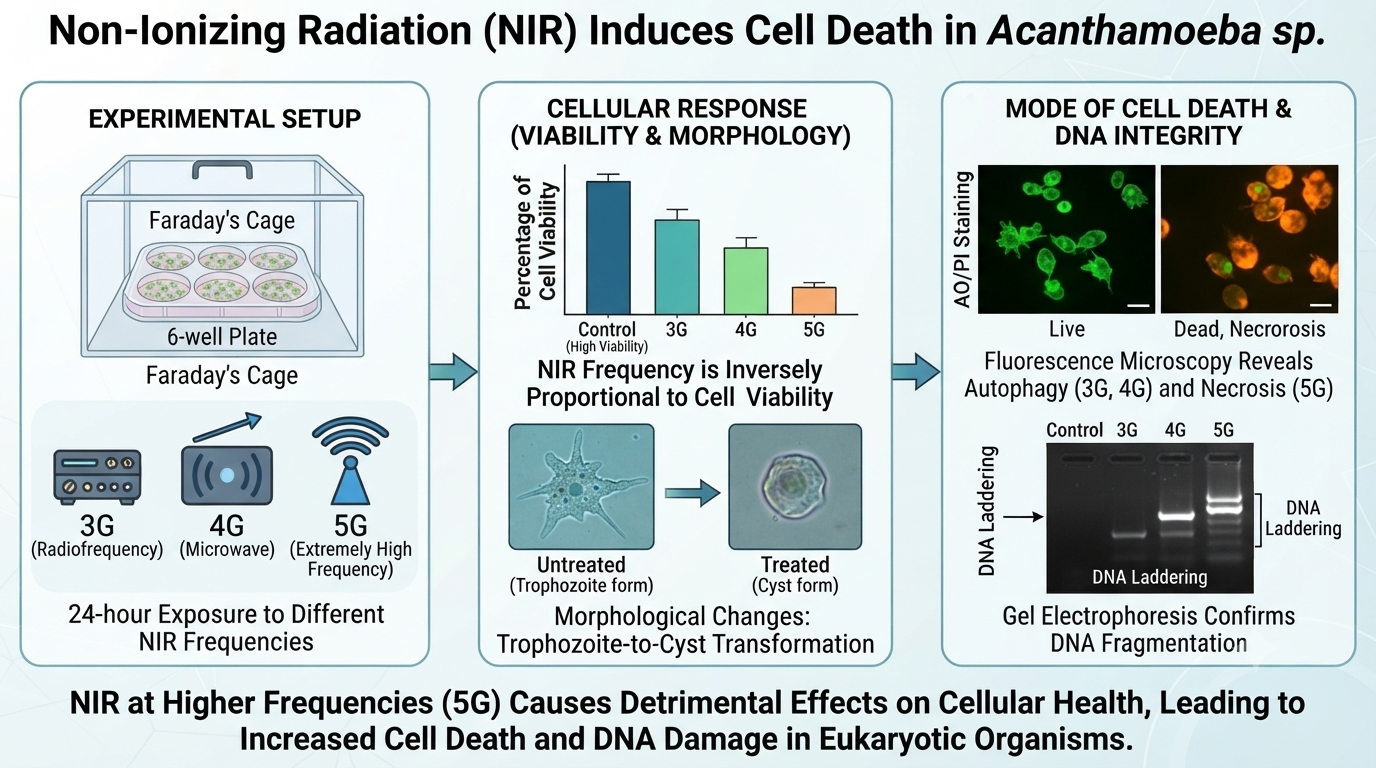
Electromagnetic fields (EMFs) with low frequency, usually used in communication (known as radiofrequency, 30kHz-300GHz) and generated by electricity (called extremely low-frequency, 3Hz-3kHz), known as the non-ionizing radiation (NIR) which lacks energy to induce ionization directly. In the current situation, the high exposure of NIR has been used for communication purposes. Wi-Fi is a wireless network that consists of at least one antenna, providing access to the internet and/or other wireless devices, such as laptops, computers, and mobile phones, which communicate wirelessly using Wi-Fi. The Wi-Fi produces different strengths of frequencies (3G, 4G and 5G). Acanthamoeba sp. is classified as an eukaryotic organism which is like human cells and acts as a good bioindicator for other eukaryotic organisms. Their morphological changes can be easily detected whether in healthy or unhealthy conditions. This study aims to investigate the effects of three different strengths of Wi-Fi frequency (3G, 4G and 5G) on the morphological changes in Acanthamoeba sp. The percentage of cell viability was observed by undergoing MTT assay technique. It was shown that the higher the frequency of NIR, 5G – the lower the cell viability counted. Light microscopy was used to observe morphological changes of the cell and cytoplasmic activity, under fluorescence microscopy and stain cells with the Acridine Orange and Propidium Iodide (AO/PI) dyes. Based on that, the frequencies of NIR are directly proportional to the cell death, autophagy and necrosis of Acanthamoeba sp. Precisely, the cell with treatment of 5G frequency of NIR showed the highest number of necrotic cells compared to 3G and 4G frequencies. Treatment using NIR frequencies has the potential to affect cellular health, and its presence in the environment is detrimental to living organisms. DNA integrity was observed by gel electrophoresis systems to determine the DNA fragmentation occurred after exposure to different strengths. DNA fragments showed that late autophagy and necrosis modes of cell death in cell.
References
Belpomme, D., Hardell, L., Belyaev, I., Burgio, E. and Carpenter, D.O., 2018. Thermal and non-thermal health effects of low intensity non-ionizing radiation: An international perspective. Environmental Pollution, 242, pp.643-658.
International Commission on Non-Ionizing Radiation Protection, 2020. Guidelines for limiting exposure to electromagnetic fields (100 kHz to 300 GHz). Health Physics, 118(5), pp.483-524.
Bisht, B., Bhatnagar, P., Gururani, P., Kumar, V., Tomar, M.S., Sinhmar, R., Rathi, N. and Kumar, S., 2021. Food irradiation: Effect of ionizing and non-ionizing radiations on preservation of fruits and vegetables–a review. Trends in Food Science & Technology, 114, pp.372-385.
Leach, V. and Bromwich, D., 2018. Why the precautionary approach is needed for non- ionising radiation devices. Radiat Prot Australas, 35, pp.13-21.
Pall, M.L., 2018. Wi-Fi is an important threat to human health. Environmental Research, 164, pp.405-416.
Putaporntip, C., Kuamsab, N., Nuprasert, W., Rojrung, R., Pattanawong, U., Tia, T., Yanmanee, S. and Jongwutiwes, S., 2021. Analysis of Acanthamoeba genotypes from public freshwater sources in Thailand reveals a new genotype, T23 Acanthamoeba bangkokensis sp. Nov. Scientific Reports, 11(1), p.17290.
Saberi, R., Nakhaei, M., Fakhar, M., Zarrinfar, H., Sharifpour, A. and Hezarjaribi, H.Z., 2022. Molecular identification and genotyping of Acanthamoeba spp., in bronchoalveolar lavage fluid from immunocompetent patients with chronic respiratory disorders (CRD). Parasitology Research, 121(10), pp.3013-3017.
Anwar, A., Khan, N.A. and Siddiqui, R., 2018. Combating Acanthamoeba spp. cysts: what are the options? Parasites & Vectors, 11(1), pp.1-6.
Kim, M.J., Chu, K.B., Lee, H.A., Quan, F.S., Kong, H.H., and Moon, E.K., 2022. Detection of Acanthamoeba spp. using carboxylesterase antibody and its usage for diagnosing Acanthamoeba-keratitis. Plos One, 17(1), p.e0262223.
Crary, M.J., Walters, R., Shannon, P. and Gabriel, M.M., 2021. Variables affecting the recovery of
Acanthamoebat rophozoites. Pathogens, 10(2), p.221.
Ghasemi, M., Turnbull, T., Sebastian, S. and Kempson, I., 2021. The MTT assay: utility, limitations, pitfalls, and interpretation in bulk and single-cell analysis. International journal of molecular sciences, 22(23), p.12827.
Al-Falahy, N. and Alani, O.Y., 2019. Millimetre wave frequency band as a candidate spectrum for 5G network architecture: A survey. Physical Communication, 32, pp.120-144.
Bínová, E., 2021. Encystation and life cycle of free-living amoebae of the genus Acanthamoeba spp.
Scheid, P.L., 2019. A Free-Living Amoeba with Public Health and Environmental Health Significance. The Open Parasitology Journal, 7(1).
Obeng, E., 2020. Apoptosis (programmed cell death) and its signals-A review. Brazilian Journal of Biology, 81, pp.1133-1143.
Sancataldo, G., Silvestri, L., Mascaro, A.L.A., Sacconi, L. and Pavone, F.S., 2019. Advanced fluorescence microscopy for in vivo imaging of neuronal activity. Optica, 6(6), pp.758-765.
Hussain, H., Ahmad, S., Abd. Razak, M.F., Wan Mohamud, W.N., Bakar, J. and Ghazali, H.M., 2019. Determination of cell viability using acridine orange/propidium iodide dual-spectrofluorometry assay. Cogent Food & Agriculture, 5(1), p.1582398.
Agarwal, A., Majzoub, A., Baskaran, S., Selvam, M.K.P., Cho, C.L., Henkel, R., Finelli, R., Leisegang, K., Sengupta, P., Barbarosie, C. and Parekh, N., 2020. Sperm DNA fragmentation: a new guideline for clinicians. The world journal of men's health, 38(4), p.412.
Bertheloot, D., Latz, E. and Franklin, B.S., 2021. Necroptosis, pyroptosis and apoptosis: an intricate game of cell death. Cellular & Molecular Immunology, 18(5), pp.1106-1121.
Bunsuwansakul, C., Mahboob, T., Hounkong, K., Laohaprapanon, S., Chitapornpan, S., Jawjit, S., Yasiri, A., Barusrux, S., Bunluepuech, K., Sawangjaroen, N. and Salibay, C.C., 2019. Acanthamoeba in Southeast Asia–overview and challenges. The Korean journal of Parasitology, 57(4), p.341.
Burby, P.E. and Simmons, L.A., 2020. Regulation of cell division in bacteria by monitoring genome integrity and DNA replication status. Journal of bacteriology, 202(2), pp.10-1128.
Jung, S., Jeong, H. and Yu, S.W., 2020. Autophagy as a decisive process for cell death. Experimental & Molecular Medicine, 52(6), pp.921-930.
Kesari, K.K., Agarwal, A. and Henkel, R., 2018. Radiations and male fertility. Reproductive Biology and Endocrinology, 16(1), pp.1-16.
Kostoff, R.N. and Lau, C.G., 2017. Modified health effects of non-ionizing electromagnetic radiation combined with other agents reported in the biomedical literature. Microwave Effects on DNA and Proteins, pp.97-157.
Kostoff, R.N., Heroux, P., Aschner, M. and Tsatsakis, A., 2020. Adverse health effects of 5G mobile networking technology under real-life conditions. Toxicology Letters, 323, pp.35-40.
Lans, H., Hoeijmakers, J.H., Vermeulen, W. and Marteijn, J.A., 2019. The DNA damage response to transcription stress. Nature reviews Molecular cell biology, 20(12), pp.766-784.
Noguchi, M., Hirata, N., Tanaka, T., Suizu, F., Nakajima, H. and Chiorini, J.A., 2020. Autophagy as a modulator of cell death machinery. Cell Death & Disease, 11(7), p.517.
Quinet, T., Samba-Louaka, A., Héchard, Y., Van Doninck, K. and Van der Henst, C., 2020. Delayed cytokinesis generates multinuclearity and potential advantages in the amoeba Acanthamoeba castellanii Neff strain. Scientific Reports, 10(1), p.12109.
Schumacher, B., Pothof, J., Vijg, J. and Hoeijmakers, J.H., 2021. The central role of DNA damage in the ageing process. Nature, 592(7856), pp.695-703.
Tuchalska-Czuroń, J., Lenart, J., Augustyniak, J. and Durlik, M., 2020. Clinical value of tissue DNA integrity index in pancreatic cancer. The Surgeon, 18(5), pp.269-279.
Wang, Y., Jiang, L., Zhao, Y., Ju, X., Wang, L., Jin, L., Fine, R.D. and Li, M., 2023. Biological characteristics and pathogenicity of Acanthamoeba. Frontiers in Microbiology, 14, p.1147077.
Yue, Y., Nabar, N.R., Shi, C.S., Kamenyeva, O., Xiao, X., Hwang, I.Y., Wang, M. and Kehrl, J.H., 2018. SARS-Coronavirus open reading frame-3a drives multimodal necrotic cell death. Cell Death & Disease, 9(9), p.904.
Downloads
Published
Issue
Section
License
Copyright (c) 2026 AIDATUL AIFA MOHD TAJUDIN, Dr. Suzana, Thivyan Manisekaran, Ummu Mikyal Abdul Halim, Dr. Hazmin, Dr. Fatimah, Nur Humairah Amni Mohd Wuzri

This work is licensed under a Creative Commons Attribution-NonCommercial 4.0 International License.