
Herpetofauna Diversity and Composition in Mak Jintan Peat Swamp Forest, North-Eastern Terengganu, Peninsular Malaysia: An Assessment With an Updated National Checklist: Amphibians and Reptiles of Peat Swamp Forest
DOI:
https://doi.org/10.11113/mjfas.v22n4.3745Abstract
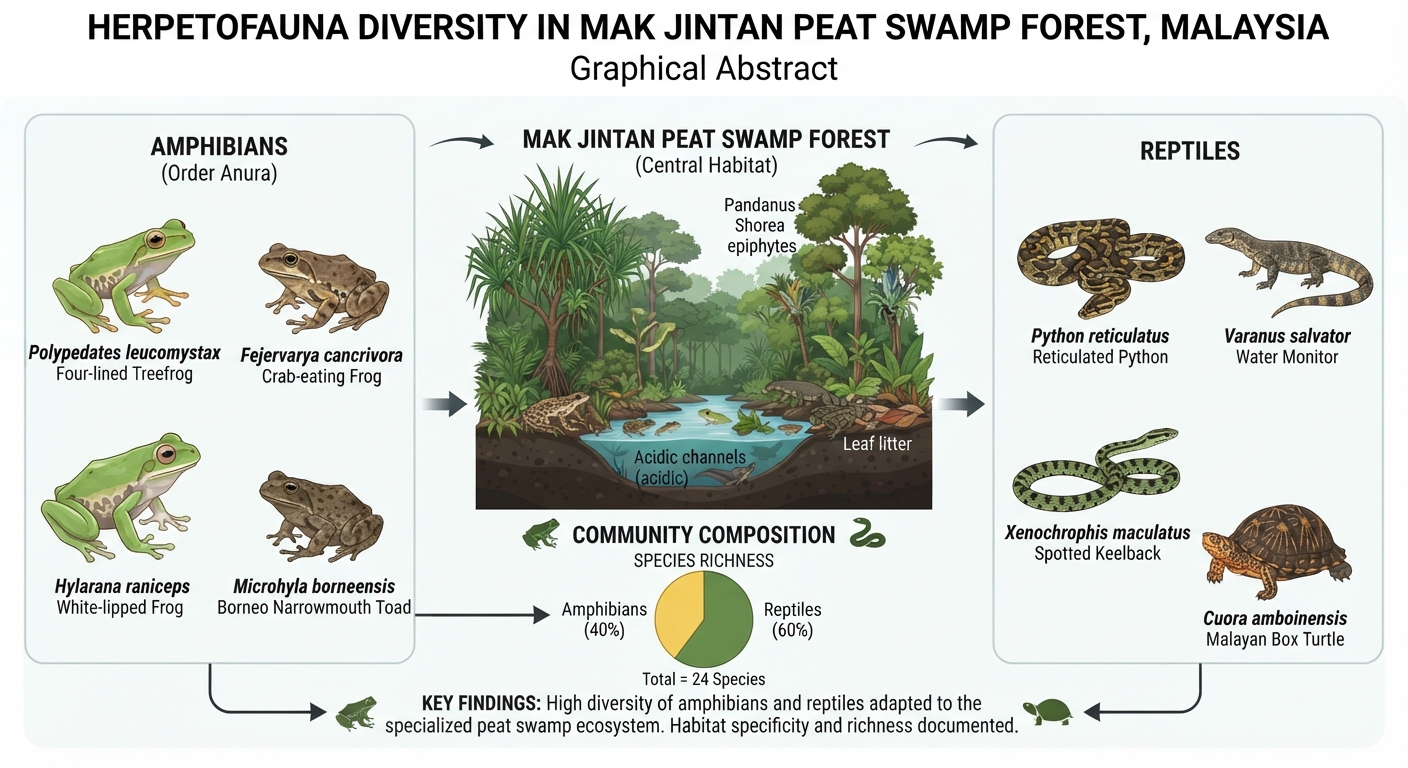
Peat swamp forests in Malaysia harbor diverse amphibian and reptile populations, yet these ecosystems remain understudied and undervalued in conservation efforts. This study presents the first assessment of amphibian and reptile diversity in Terengganu's peat swamp forests. A survey conducted in 2019 at Mak Jintan peat swamp forest employed Visual Encounter Survey (VES), Acoustic Encounter Survey (AES) and collapsible trap methods. We recorded 68 individuals comprising 15 amphibian species from five families and eight reptile species from eight families. Amphibian diversity (H'= 2.3552) exceeded that of reptiles (H'= 1.7260). An updated checklist for peninsular Malaysia's peat swamp forests now includes at least 129 species from 22 families. This research enhances our understanding of herpetofauna diversity in peninsular Malaysia's peat swamp forests and provides recommendations for their conservation.
References
Tong, P. S. (2020). More policies and laws, is it better for biodiversity conservation in Malaysia? Conservation Science and Practice, 2(8), e235.
Saw, L. G. (2010). Vegetation of Peninsular Malaysia. In: Kiew, R., Chung, R. C. K., Saw L. G., Soepadmo, E., & Boyce, P. C. (Eds.). Flora of Peninsular Malaysia, Vol 1, Series II: Seed Plants. Selangor: Forest Research Institute Malaysia. Pp. 21-300.
Musah, Y., Ofori, B. Y., & Attuquayefio, D. K. (2019). Herpetofauna community diversity and composition of a changing coastal wetland in Ghana. West African Journal of Applied Ecology, 27(1): 52-65.
Leo, S., Suherman, M., Permatasari, A., Suganda, D., Zulamri, & Winarni, N. L. (2020). Herpetofauna diversity in Zamrud National Park, Indonesia: Baseline checklist for a Sumatra peat swamp forest ecosystem. Amphibian & Reptile Conservation, 14(2): 250-263.
Nur Amalina, M. I., Norhayati, A., Shukor, M. N., Nazron, N. S., Muhammad Nazir, N. A., Magintan, D., Farinordin, F. A., Darbis, N. D. A., & Zainul Abidin, M. K. (2021). Herpetofauna diversity in Sg. Deka, Hulu Terengganu, Peninsular Malaysia. Gading Journal of Science and Technology, 4(1): 86-93.
Zug, G. R., Vitt, L. J., & Caldwell, J. P. (2001). Herpetology: An Introductory Biology of Amphibians and Reptiles. 2nd Edition. California: Academic Press.
Hocking, D. J., & Babbitt, K. J. (2014). Amphibian contributions to ecosystem services. Herpetological Conservation and Biology, 9(1): 1-17.
de Miranda, E. B. P. (2017). The plight of reptiles as ecological actors in the tropics. Frontiers in Ecology and Evolution, 5: 159.
Posa, M. R. C., Wijedasa, L. S., & Corlett, R. T. (2011). Biodiversity and conservation of tropical peat swamp forests. BioScience, 61(1): 49-57.
Jackson, C. R., Liew, K. C., & Yule, C. M. (2009). Structural and functional changes with depth in microbial communities in a tropical Malaysian peat swamp forest. Microbial Ecology, 57: 402-412.
Jusoff, K., Hassan, C. H., & Hamzah, K. A. (2007). Tropical peat swamp forest ecosystem and floristic diversity in Pahang, Malaysia. International Journal of Systems Applications, Engineering & Development, 3(1): 41-44.
Davies, J., Mathhew, U., Aikanathan, S., Chik, N. Y., & Chong, G. (2009). A quick scan of peatlands in Malaysia. In: Davies, J., Ibrahim, N., Lopez, A., Popp, R. &, Silvius, M. (Eds.). Roundtable for Sustainable Palm Oil Conference. Kuala Lumpur: Wetlands International.
Chan, K. O., Grismer, L. L., Matsui, M., Nishikawa, K., Wood Jr, P. L., Grismer, J. L., Belabut, D., & Ahmad, N. (2010). Herpetofauna of Gunung Panti Forest Reserve, Johor, Peninsular Malaysia. Tropical Life Sciences Research, 21(1): 71-82.
Munisamy, B., Kamaruddin, K. N., Mohd Kulaimi, N. A., Mohamed, K. A, Ithnin, H., Rovie-Ryan, J. J., Topani, R., & Manickam, S. (2020). A revised and updated checklist of herpetofauna of Tasek Bera Ramsar Site, Pahang, Malaysia. Journal of Widlife and Parks, 35: 93-103.
Das, I., & Jensen, K. A. (2006). The herpetofauna of Loagan Bunut. 1st Edition. In: Tuen, A. A., Sayok, A. K., Toh, A. N., & Noweg, G. T. (Eds). Scientific Journey Through Borneo: Loagan Bunut. A Scientific Expedition on the Physical, Chemical, Biological, and Sociological Aspects. Kuala Lumpur: Ministry of Natural Resources and Environment. Pp. 131-154.
Baharudin, M. S., Shahfiz, M. A., Munian, K., Fauzi, N. F. M., Ahmad Ruzman, N. H., Azhar, M. A., & Zamberi, A. Z. (2021). Checklist on small vertebrates at Kuala Langat North Forest Reserve, Selangor, Malaysia. IOP Conference Series: Earth and Environmental Science, 842(1): 012028.
Graeter, G. J. (2005). Habitat selection and movement patterns of amphibians in altered forest habitats. M. Sc. thesis, University of North Carolina-Chapel Hill, North Carolina.
Dhandapani, S., Ritz, K., Evers, S. L., Yule, C. M., & Sjogersten, S. (2018). Are secondary forests second-rate? Comparing peatland greenhouse gas emissions, chemical and microbial community properties between primary and secondary forests in Peninsular Malaysia. Science of the Total Environment, 655(5): 220-231.
Norhayati, A., Ehwan, N., Nurul Nadiah, R., Nur Izzah Syahirah, M., Nur Johana, J., Baizul Hafsyam, B. S., Amirah Azizah, Z., & Amirrudin, A. (2019). Species richness and diversity of amphibians and reptilians in Pulau Pangkor, Perak, Peninsular Malaysia. The Malaysian Forester, 82(1): 283-296.
Ueda, H., Hasegawa, Y., & Marunouchi, J. (1998). Geographical differentiation in a Japanese stream-feeding frog, Buergeria buergeri, elucidated by morphometric analyses and crossing experiments. Zoological Science, 15(4): 615-622.
Berry, P. Y. (1975). The Amphibian Fauna of Peninsular Malaysia. Kuala Lumpur: Tropical Press.
Norhayati A. (2017). Frogs and Toads of Malaysia: Malaysia Biodiversity Information System (MyBIS). 1st Edition. Selangor: Penerbit Universiti Kebangsaan Malaysia.
Das, I., & van Djik, P. P. (2013). Species richness and endemicity of the herpetofauna of South and Southeast Asia. Raffles Bulletin of Zoology, 29: 269-277.
Grismer, L. L. (2011). Lizards of Peninsular Malaysia, Singapore and Their Adjacent Archipelagos. 1st Edition. Frankfurt: Edition Chimaira.
Uetz, P., Freed, P., Aguilar, R., & Hošek, J. (Eds.) (2021). The Reptile Database. Retrieved from http://www.reptile-database.org.
Heck, K. L., Belle, G., & Simberloff, D. (1975). Explicit calculation of the rarefaction diversity measurement and the determination of sufficient sample size. Ecology, 56: 1459-1461.
Weiss, S., Xu, Z. Z., Peddada, S., Amir, A., Bittinger, K., Gonzalez, A., et al. (2017). Normalization and microbial differential abundance strategies depend upon data characteristics. Microbiome, 5: 27.
Ugland, K. I., Gray, J. S., & Ellingsen, K. E. (2003). The species-accumulation curve and estimation of species richness. The Journal of Animal Ecology, 72(5): 888-897.
Hammer, Ø., Harper, David, A. T., & Paul, D. R. (2001). Past: Paleontological Statistics Software Package for Education and Data Analysis. Palaeontologia Electronica, 4 (1), Art. 4: 9pp., 178kb.
Gotelli, N. J., & Entsminger, G. L. (2001). EcoSim: Null models software for ecology. Version 7.0. Acquired Intelligence Inc. & Kesey-Bear. Retrieved from: http://homepages.together. net/~gentsmin/ecosim.htm.
Bossuyt, F., Brown, R. M., Hillis, D. M., Cannatella, D. C., & Milinkovitch, M. C. (2006). Phylogeny and biogeography of a cosmopolitan frog radiation: Late cretaceous diversification resulted in continent-scale endemism in the family Ranidae. Systematic Biology, 55(4): 579-594.
Inger, R. F., Stuart, B. L., & Iskandar, D T. (2009). Systematics of a widespread Southeast Asian frog, Rana chalconota (Amphibia: Anura: Ranidae). Zoological Journal of the Linnean Society, 155(1): 123-147.
Nadia, S., Marina, M. T. I., Nadirah, R., Siti Fara Najua, M. N., Muhammad Faris, A. A., Mohamad Roslan, M. K., & Alias, M. A. (2020). The diversity of anuran species in urban forest in Selangor. IOP Conference Series: Earth and Environmental Science, 494: 012009.
Prates, I., & Navas, C. A. (2009). Cutaneous resistance to evaporative water loss in Brazilian Rhinella (Anura: Bufonidae) from contrasting environments. Copeia, 3: 618-622.
Inger, R. F., & Stuebing, R. B. (2005). A Field Guide to the Frogs of Borneo. 2nd Edition. Kota Kinabalu: Natural History Publications (Borneo).
Deka, E. Q., Zainudin, R., & Ahmad Puad, A. S. (2019). Habitat preferences of the Bornean Horned frog, Megophrys nasuta (Schlegel, 1858) (Anura: Megophryidae) in Sarawak. Journal of Sustainable Science and Management, 14(4): 25-37.
Hasan, M. K., & Feeroz, M. M. (2014). Species diversity and habitat preferences of amphibian fauna in six protected areas of Bangladesh. Bangladesh Journal of Zoology, 45(1): 105-116.
Ngo, C. D., Ngo, B. V., Hoang, T. T., Nguyen, T. T. T., & Dang, H. P. (2015). Feeding ecology of the common sun skink, Eutropis multifasciata (Reptilia: Squamata: Scincidae), in the plains of central Vietnam. Journal of Natural History, 49(39): 1-20.
Stuart, B., Wogan, G., Grismer, L., Auliya, M., Inger, R., Lilley, R., Chan-Ard, T., Thy, N., Nguyen, T. Q., Srinivasulu, C., & Jelić, D. (2012). Ophiophagus hannah [online]. The IUCN Red List of Threatened Species. Retrieved from https://www.iucnredlist.org/species/177540/1491874.
Colwell, R. K., & Coddington, J. A. (1994). Estimating terrestrial biodiversity through extrapolation. Philosophical Transactions of the Royal Society of London. Series B: Biological Sciences, 345(1311): 101-118.
Ugland, K. I., Gray, J. S., & Ellingsen, K. E. (2003). The species-accumulation curve and estimation of species richness. The Journal of Animal Ecology, 72(5): 888-897.
Ricotta, C., Bacaro, G., Marignani, M., Godefroid, D., & Mazzoleni, S. (2012). Computing diversity from dated phylogenies and taxonomic hierarchies: Does it make a difference to the conclusions? Oecologia, 170(2): 501-506.
Lim, K. K. P., & Lim, F. L. K. (1992). A Guide to Amphibians and Reptiles of Singapore. 1st Edition. Jurong East: Singapore Science Centre.
Sukumaran, J., Yaakob, N., & Yong, D. (2006). The herpetofauna of the south-east Pahang peat-swamp forest. Hamadryad, 30(1-2): 75-91.
Munisamy, B., Kamaruddin, K. N., Mohd Kulaimi, N. A., Mohamed, K. A., Ithnin, H., Rovie-Ryan, J. J., Topani, R., & Manickam, S. (2020). A revised and updated checklist of herpetofauna of Tasek Bera Ramsar Site, Pahang, Malaysia. Journal of Widlife and Parks, 35: 93-103.
Baharudin, M. S., Shahfiz, M. A., Munian, K., Fauzi, N. F. M., Ahmad Ruzman, N. H., Azhar, M. A., & Zamberi, A. Z. (2021). Checklist on small vertebrates at Kuala Langat North Forest Reserve, Selangor, Malaysia. IOP Conference Series: Earth and Environmental Science, 842(1): 012028.
Chan, K. O, Grismer, L. L., Matsui, M., Nishikawa, K., Wood Jr, P. L., Grismer, J. L., Belabut, D., & Ahmad, N. (2010). Herpetofauna of Gunung Panti Forest Reserve, Johor, Peninsular Malaysia. Tropical Life Sciences Research, 21(1): 71-82.
Zaidey, A. K., Arifin, A., Zahari, I., Hazandy, A. H., Zak,i M. H., Affendy, H., Wasl, M. E., Khairul Hafiz, Y., Shamshuddin, J., & Nik Muhamad, M. (2010). Characterizing soil properties of lowland and hill dipterocarp forests at Peninsular Malaysia. International Journal of Soil Science, 5: 112-130.
Downloads
Published
Issue
Section
License
Copyright (c) 2026 Dr. Nurulhuda Zakaria

This work is licensed under a Creative Commons Attribution-NonCommercial 4.0 International License.